
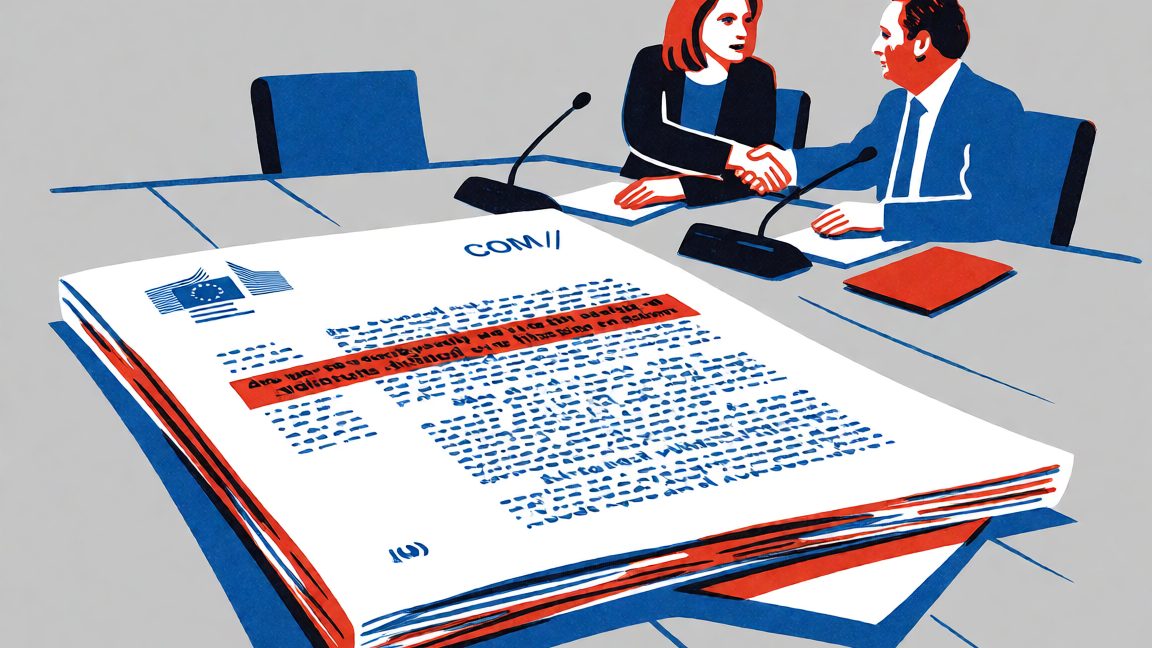
The European Commission unveiled a draft procurement regulation that would require public‑sector contracts to allocate at least 30 % of the evaluation to quality criteria, including a “Made in Europe” element, and would give member states the discretion to exclude Chinese bidders.
30 % quality weighting becomes mandatory
According to Handelsblatt, EU Industry Commissioner Stéphane Séjourné confirmed that the draft introduces a “price‑quality ratio” in which quality criteria must make up 30 % of the overall assessment. The move departs from the EU’s traditional reliance on price alone when awarding public contracts.
“Made in Europe” as a qualifying quality criterion
The same report states that the draft allows authorities to use “Made in Europe” as a quality criterion. The wording gives European suppliers a preferential advantage because contracts could be awarded on the basis of added value generated within Europe, not just on cost.
Other quality dimensions, such as sustainability, remain permissible, but the “Made in Europe” label is singled out as a new industrial‑policy tool.
Member states can now bar Chinese bidders
Handelsblatt quotes the Commission’s text: “Member states and local authorities will have more freedom to decide whether to exclude Chinese bidders from public‑contract awards.” This explicit permission to exclude Chinese firms marks a clear shift toward protecting EU industry from what Brussels describes as a “swarm of subsidised cheap imports from China.”
Political backdrop – a turn away from free‑trade orthodoxy
The draft is described in the packet as an “industrial‑policy turn away from the EU’s traditional free‑trade stance.” German Chancellor Friedrich Merz, who previously accused the EU of tolerating protectionism, has now aligned his position with the draft, signalling political support from a key EU economy.
What this means for UK exporters
While the draft is aimed at EU firms, its impact reaches beyond the bloc. UK companies that rely on EU public‑procurement contracts will no longer be able to meet the “Made in Europe” quality criterion, because the UK is not an EU member state. In practice, this could mean that UK bidders are evaluated solely on price, or are excluded altogether if a contracting authority chooses to apply the new criterion.
Analysts note that the change adds a layer of uncertainty for UK firms that previously competed on a level playing field in EU tenders. The ability of member states to bar Chinese bidders does not automatically extend to UK firms, but the same legal basis could be used to justify broader exclusions, especially where the “value‑creation in Europe” test is applied.
Next steps and unanswered questions
The draft was presented on a Wednesday, but the packet does not include a detailed timeline for adoption. The European Parliament and Council will need to negotiate the final text, and the implementation date has not been set.
Key points that remain unclear include:
- How contracting authorities will define and verify “Made in Europe” – whether a simple provenance test will suffice or a more detailed value‑chain assessment will be required.
- Whether the 30 % quality weighting will be fixed or allow flexibility for sectors that traditionally rely on price competition.
- How the rule will be applied to cross‑border projects that involve UK‑based subsidiaries of EU firms.
Stakeholders, including UK trade bodies, are expected to seek clarification from the Commission before the rule is finalised. For UK exporters, the immediate priority is to monitor the legislative process and to assess whether alternative procurement strategies – such as joint ventures with EU partners – can mitigate the risk of being sidelined.
In summary, the EU’s draft procurement regulation introduces a mandatory 30 % quality weighting, a “Made in Europe” quality criterion and the option to exclude Chinese bidders. The shift signals a broader industrial‑policy agenda and could reshape the competitive landscape for UK firms seeking EU public‑contract work.