
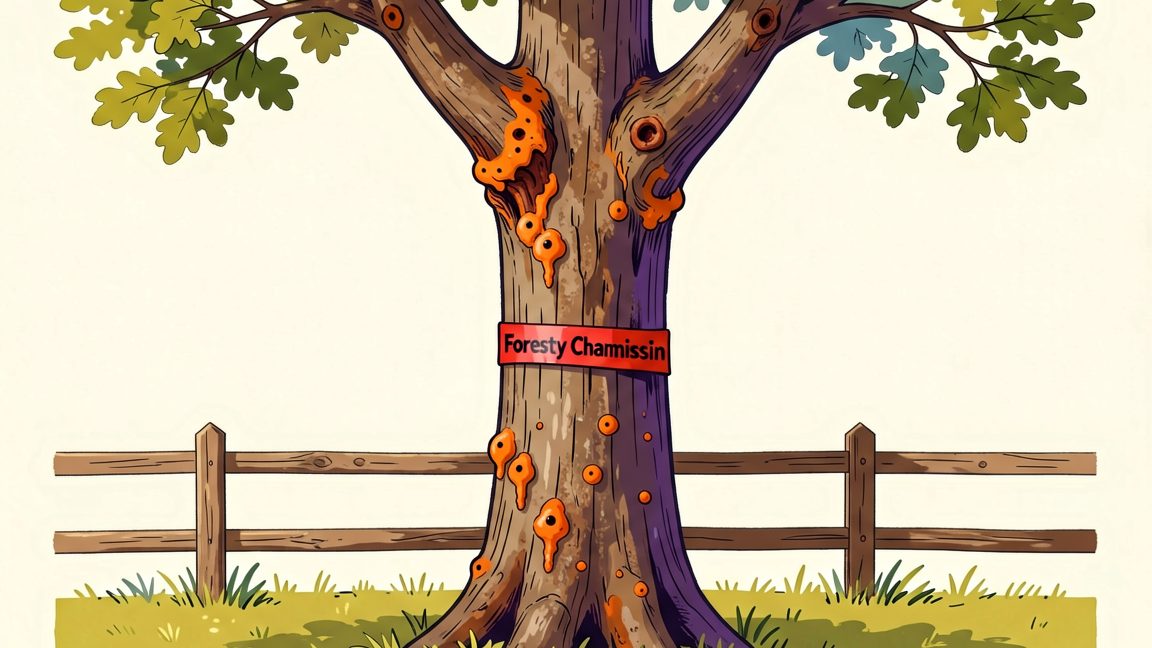
On 19 August 2026 the Forestry Commission announced that the Sweet Chestnut Blight demarcated area will be extended to include West Devon District and the South‑East Cornwall constituency, with the new restrictions coming into force on 26 August 2026.
Extension announced on 19 August
The official GOV.UK press release dated 19 August 2026 states: “The Forestry Commission is today (Wednesday 19 August) announcing an extension to the demarcated area for Sweet Chestnut Blight in Devon, and into a small part of Cornwall, following further findings close to the current restricted zone boundary.”1 The announcement was made by the Forestry Commission, the government body responsible for protecting the nation’s forests and woodlands.
Effective from 26 August 2026
The same release confirms that “The new area will come into force on Wednesday 26 August.”1 From that date the quarantine zone will cover two distinct geographic units: West Devon District – an administrative district in the county of Devon – and the South‑East Cornwall constituency, a parliamentary constituency that sits on the eastern edge of Cornwall. Prior to the extension, the demarcated area was confined to parts of Devon only.
Why the extension was needed
Surveillance work carried out by the Forestry Commission identified additional infected sites that showed “sexual sporulation, meaning an increased number of airborne spores are being produced.”1 Sexual sporulation is a stage in the life‑cycle of the fungus that spreads Sweet Chestnut Blight, and it raises the risk that the disease could move beyond the existing boundary. The press release links the extension directly to these new findings, stating that the additional outbreak sites were “close to the current restricted zone boundary.”1
Implications for landowners, growers and the timber trade
When an area is placed inside a demarcated quarantine zone, the Forestry Commission imposes a set of plant‑health restrictions designed to stop the spread of the pathogen. Although the press release does not list the exact measures, previous guidance on Sweet Chestnut Blight has required landowners to:
- Obtain a plant‑health certificate before moving sweet chestnut material (such as timber, seedlings or cuttings) into or out of the zone.
- Carry out regular inspections of trees within the zone and report any signs of disease.
- Apply approved treatment methods, where available, to infected trees.
For the newly‑included parts of West Devon and South‑East Cornwall, these rules will now apply from 26 August 2026. The immediate effect is that any commercial activity involving sweet chestnut – for example, the harvesting of timber for furniture or the sale of nursery stock – will need to comply with the quarantine requirements. Failure to do so can result in enforcement action, including fines or the seizure of material.
Landowners who were previously outside the quarantine zone will now have to adjust their management plans. The added administrative burden may increase costs, particularly for smallholders who lack the resources to navigate the certification process. Larger forestry enterprises are likely to have existing compliance frameworks, but they will still need to extend those to the new area and ensure that any subcontractors are aware of the change.
From a trade perspective, the extension creates a new barrier for the movement of sweet chestnut products from the affected districts to the rest of the UK and to export markets. Importers will need to verify that any incoming material complies with the quarantine rules, potentially adding delays at ports or processing facilities. While the press release does not quantify the economic impact, the change is significant for any business that relies on the swift transport of sweet chestnut timber or seedlings.
What remains unknown
The press release does not disclose the exact number of newly identified infected sites, nor does it provide a detailed map of the expanded zone. It also does not specify whether any compensation or support schemes will be offered to affected landowners. The Forestry Commission has not commented on the duration of the quarantine – whether the extension is intended to be permanent or will be reviewed after a set period.
Stakeholders are awaiting further guidance on the practical steps required to achieve compliance before the 26 August start date. The Forestry Commission is expected to publish detailed instructions in the coming days, but until those are released, landowners and businesses must assume that the full suite of existing Sweet Chestnut Blight restrictions will apply to the new area.
What comes next
With the extension set to take effect on 26 August 2026, the next few weeks will be crucial for preparation. The Forestry Commission is likely to issue a follow‑up notice outlining the specific plant‑health measures, certification procedures and reporting obligations for the West Devon and South‑East Cornwall zones. Landowners and traders should monitor the Forestry Commission’s website and the Defra guidance on plant health for updates.
In the longer term, the extension underscores the importance of ongoing surveillance for Sweet Chestnut Blight. The identification of sexual sporulation at new sites suggests that the pathogen remains active and capable of spreading beyond previously known boundaries. Continued monitoring, combined with rapid response measures, will be essential to protect the UK’s sweet chestnut resources and to minimise disruption to the forestry and timber sectors.
For a full history of previous updates on Sweet Chestnut Blight, see the Forestry Commission’s collection of past announcements.2 Additional guidance on plant‑health quarantine measures can be found on the Department for Environment, Food & Rural Affairs (Defra) website.3