Thank you for subscribing!
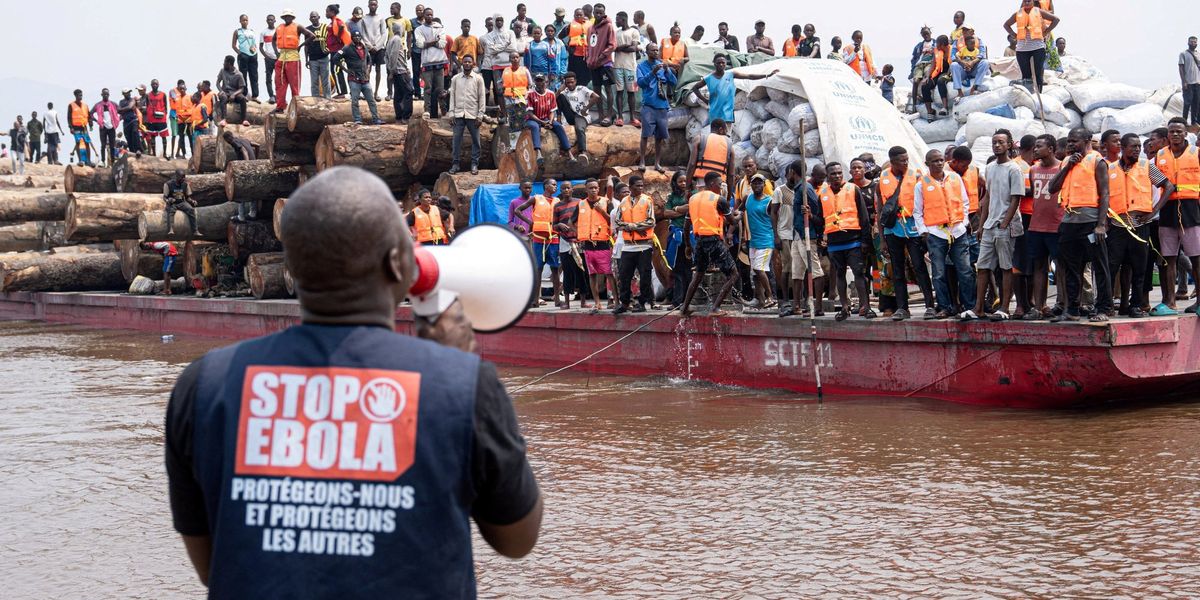
The outbreak is driven by the rare Bundibugyo species of Ebola rather than the more common Zaire strain
The Ebola epidemic in the Democratic Republic of Congo (DRC) is showing signs of spreading across the country, according to modelling.
By the end of August, the daily count of fresh infections was declining, but cases were increasingly being detected beyond Ituri, where the outbreak first erupted.
Official data now puts the death toll above 3,000, with more than 6,100 confirmed infections, making it the fastest-spreading Ebola epidemic ever documented.
However, Airfinity's modelling indicates the actual number of cases may be upwards of four times greater than official figures reflect.
The outbreak is expected to surpass the 2014 West Africa epidemic later this month, becoming the largest on record.
According to health analytics company Airfinity, seven-day averages for both reported cases and deaths dropped by 16 per cent and 18 per cent respectively in late August.
Yet the firm cautioned that it was "too early to confirm the decline will hold, and it may mask subnational variation."
While case growth has begun to slow in Ituri, it has merely levelled off in North Kivu province and is picking up pace in Haut-Uélé.
The outbreak's geographic reach continues to expand, with the firm warning it threatens to move along the Congo river even as weekly case numbers appear to dip.
Airfinity estimates there is a one-in-two probability the epidemic will reach 50,000 infections, which would be twice the scale of the 2014 West Africa crisis.
The US Centres for Disease Control warned that containment efforts "remained below established response targets," with the rapid expansion across multiple health zones pointing to "uncontrolled expansion of the outbreak."
Epidemiologists are especially concerned about fatalities occurring among individuals who were never hospitalised or identified as contacts of known cases.
WHO Director General Tedros Adhanom Ghebreyesus said "Until every chain is found and broken, the epidemic will continue and will continue to pose a threat to DRC, its neighbours and the region as a whole."
Meanwhile, a fresh case has emerged in rebel-controlled territory in eastern Congo.
AFC/M23 rebels reported that a 21-year-old man arriving from the government-held city of Butembo tested positive in the Kayna health zone of North Kivu, near Lubero.
The case was confirmed more than two months after the group had declared its areas free of the virus.
The outbreak is driven by the rare Bundibugyo species of Ebola rather than the more commonly seen Zaire strain, which means no approved vaccines exist to combat it.
Clinical efficacy trials for three candidate vaccines are expected to begin in October or November, Dr Tedros said.
Safety testing is already under way in Britain and Canada on two new Bundibugyo-specific vaccines, one developed by Moderna using mRNA technology, the other by the University of Oxford.
The WHO has additionally recommended a full human trial of Ervebo, which is licensed against the Zaire strain, to determine whether it provides any cross-protection.
Over 300 patients have been enrolled in treatment trials, while the antiviral obeldesivir is being tested among high-risk contacts.
The UK Government this week pledged an additional £51.8million, bringing total British funding to £78.7million.