


Octopus Energy has debuted a groundbreaking new technology that could revolutionise electric vehicle charging as it prepares to launch the service across Europe.
Octopus and Chinese manufacturing giant CATL have joined forces to build a European network of battery-swapping hubs across Europe for electric lorries.
The joint venture allows operators and businesses to replace depleted batteries in electric heavy goods vehicles within minutes, as confirmed at the Energy Tech Summit this morning.
It will eliminate long charging times and remove one of the key barriers to decarbonising heavy transport, which remains one of the most polluting sectors.
Octopus outlined a timeline that will see the first UK mega hubs open in 2027, with more than 30 planned by 2035.
It claims that each hub will be capable of servicing "thousands of lorries a day" as the number of electric lorries continues to grow, as businesses embrace clean technology.
The partnership between Octopus and CATL believes that the network could support over 300,000 electric trucks and unlock more than £30billion once in full operation.
This will reduce Europe's dependence on imported oil and replace it with clean energy, with the joint venture set to be called "Swaptopus".
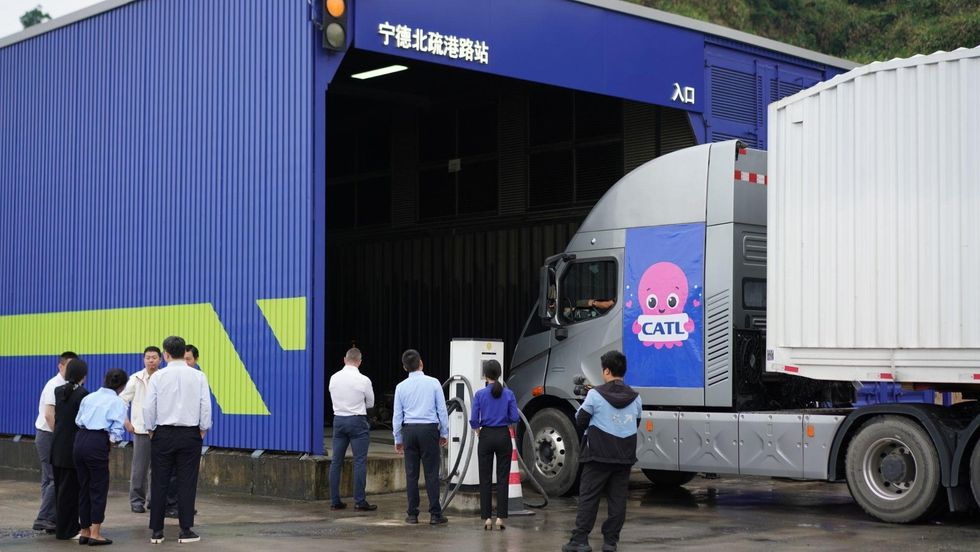
Octopus Energy is aiming to install the UK's first electric vehicle battery swapping hub next year
|OCTOPUS ENERGY
Commenting on the emerging technology, Octopus Energy CEO Greg Jackson said: "Electric trucks already beat diesel on running costs, the challenge is keeping them moving.
"Battery swapping changes that. Instead of waiting for hours, trucks can be back on the road in minutes.
"By combining Octopus's software and energy expertise with CATL's world-class battery technology, we're making clean freight practical at scale across Europe."
In total, trucking accounts for seven per cent of global CO2 emissions, with some considering it to be one of the most difficult sectors to decarbonise.
LATEST DEVELOPMENTS

The Octopus Energy and CATL joint venture was confirmed at the Energy Tech Summit this morning
|OCTOPUS ENERGY
Dr Robin Zeng, chairman and CEO of CATL, explained that battery swapping will make up a "significant part of the future" for heavy goods and commercial transport.
CATL announced in 2024 that it envisions a future where 30,000 of its Choco-Swap stations are in use in the future, with a mid-term goal of having 10,000 stations.
The Choco-Swap ecosystem was described as "marking a historic step toward the standardisation of electric vehicle battery swapping".
Dr Zeng added: "We have field-proven this technology in China, and we are delighted to bring it to the UK and Europe as part of our joint venture with Octopus.
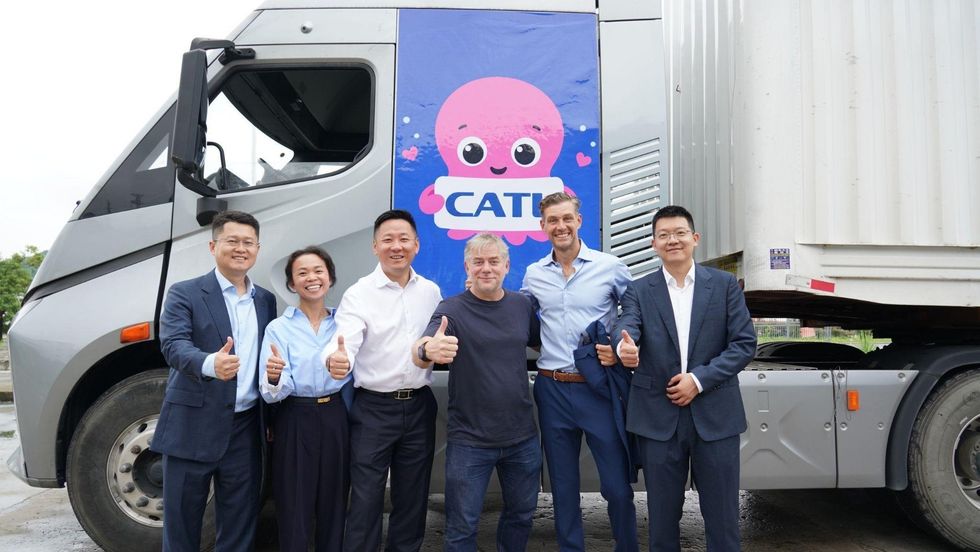
The 'Swaptopus' joint venture aims to revolutionise transport across Europe
|OCTOPUS ENERGY
"Together, our expertise in battery swapping, B2G (Battery-to-Grid) and energy storage, paired with Octopus's AI-powered energy trading and management technologies, will speed up the electrification of road transport across the region."
Octopus will also explore options with CATL to scale Vehicle-to-Grid (V2G) technology, which could turn millions of electric cars into "virtual power plants".
William Rowe, CEO and founder of Swaptopus, said battery swapping would be integral for the future of transport, which will be electric and autonomous.
"Not only does it significantly reduce downtime, but since the batteries at the swapping stations can be charged and discharged when the grid needs it, they act as a virtual power plant and in turn lower costs for consumers," he added.