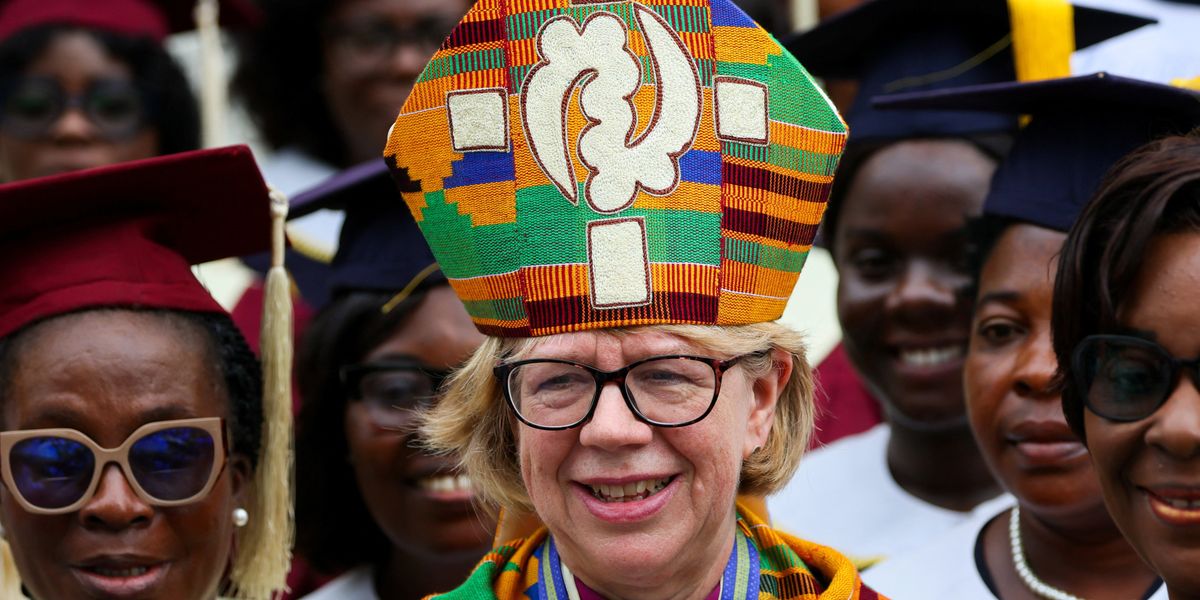
Dame Sarah Mullaly has pledged to support communities 'that feel the legacy of the slave trade' centuries later
The Archbishop of Canterbury has doubled down on £100million slavery payouts and vowed to "repent" for the Church's past.
Dame Sarah Mullaly, the first woman to lead the Church of England, is now on a visit to Cape Coast Castle in Ghana.
The site is one of forty "slave castles" - where slaves were kept in dungeons before being led to ships.
Touring the castle made her reflect on the crimes committed by the Church of England, she said.
She said: "We played a part in the transatlantic slave trade. That is clear.
"Part of the Christian belief in repentance is about action, so we are putting in place action to support those communities that feel the legacy of the slave trade."
The visit marks Dame Sarah's first to Africa since being installed as the head of the Church of England at a ceremony in Canterbury Cathedral in March.
Dame Sarah was shown the dungeons and the so-called of "door of no return" through which slaves were marched to ships.
Above the dungeons sit a chapel - evidence, Dame Sarah said, that the Church of England was "involved in the slave trade".
"You can't help but be deeply moved by the horrific conditions that people were kept in and the way that they were treated," she said.
"It completely throws you off balance and brings home the evil that was transatlantic slavery."
The Church of England established a £100million slavery reparations fund, which the Archbishop of Canterbury has previously defended.
CHURCH OF ENGLAND - READ MORE:
MPs and peers have criticised the church's Project Spire, an act of "repentance" for links to the transatlantic slave trade.
The fund emerged following revelations a substantial portion of the Church's £11.1billion assets were traced to a fund called the Queen Anne's Bounty, which had donor linked to slavery.
Also in question were investment in South Sea Annuities, distributed by the South Sea Company, which trafficked around 34,000 enslaved Africans to the Spanish Americas.
But the fund has come under fire from MPs, peers and academics - some of whom have described it as "divisive".
Tory MP Katie Lam said the fund "embeds a narrative of victimhood that many black people rightly hate".
And academic Richard Dale, a professor of international banking, said the South Sea Annuities were similar to government bonds, and did not directly fund the South Sea Company.
"The enormity of this mistake cannot be overstated," he said.
"To come up with the idea that the major, almost the entire portfolio consists of slavery-related investments, when in fact they were not, is quite a big mistake."