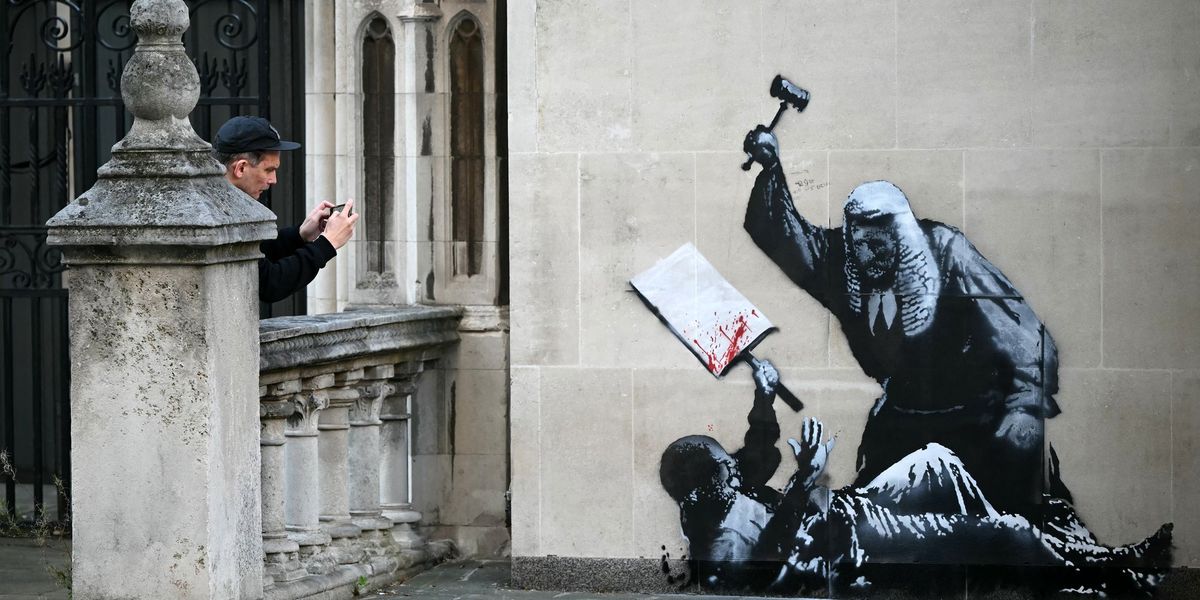
Shadow Justice Secretary Nick Timothy has called for the artist to foot the bill himself
Taxpayers have been landed with a bill approaching £150,000 to deal with three Banksy artworks across London, according to figures obtained through Freedom of Information requests.
The costs, covering cleaning operations and security measures, are expected to climb further still.
The most significant expense stems from a mural that appeared on the Royal Courts of Justice in September 2025, depicting a bewigged judge striking a protester with his gavel. Efforts to remove the image and keep the site secure have already exceeded £85,000.
The disclosure is likely to fuel the long-running argument over whether the anonymous Bristol-born artist's interventions constitute valuable public art or straightforward vandalism against publicly owned buildings.
The Ministry of Justice confirmed that £50,000 had been spent attempting to scrub paint from the Carey Street wall of the Grade II-listed building.
An additional £35,300 went on overtime payments and security arrangements after court staff cordoned off the area and stood guard.
A spokesman for HM Courts and Tribunals Service said: "The Royal Courts of Justice is a listed building and HMCTS are obliged to maintain its original character."
Initial cleaning efforts proved inadequate, prompting contractors to deploy laser technology on the stonework. Westminster City Council must still inspect the wall, and should the results fall short, alternative removal techniques will be required.
In the worst-case scenario, the damaged stone sections may need to be physically extracted and replaced entirely, pushing costs higher still.
Shadow Justice Secretary Nick Timothy told the BBC: "It's outrageous that tens of thousands of pounds of taxpayers' money – maybe more – will have to be spent cleaning up after Banksy, who seems to believe he has a right to deface public buildings with impunity.
"Our courts are a national symbol of justice and the rule of law.
"Banksy's vandalism should be stopped and he should foot the bill for the costs he imposes on others."
He described the courts as "a national symbol of justice and the rule of law" and insisted: "Banksy's vandalism should be stopped and he should foot the bill for the costs he imposes on others."
Art critic Estelle Lovatt offered a sharply different perspective, highlighting the cultural draw of the artist's output: "Some people visit Buckingham Palace and others visit Banksy's art."
She argued his pieces foster unity where politics creates division, adding: "He makes art accessible because there's no gallery fee."
Beyond the court mural, Westminster City Council has racked up close to £60,000 dealing with a Banksy statue that materialised in Waterloo Place near Trafalgar Square in April. The figure depicts a man clutching a flag that obscures his face, apparently on the verge of toppling from a plinth. The council, which had no advance warning of the installation, spent the money on safety barriers, administrative work and round-the-clock security.
The authority confirmed it now owns the sculpture by virtue of being the landowner and has contacted the artist's agent to discuss its future.
A third piece — piranha fish painted on a City of London Police sentry box in August 2024 — cost £2,200 to remove. The box was never reinstalled and is set to go on display at the London Museum when it reopens in November.
An application for Listed Building Consent has been submitted to install protective railings across the wall targeted by Banksy, though the cost of that work remains unknown pending approval.
The Metropolitan Police confirmed that officers received a report of criminal damage to the Royal Courts of Justice on 8 September. No arrests have been made and the investigation continues.
Banksy, who rose to prominence through Bristol's graffiti scene in the 1990s, has a history of painting on heritage properties — his early Bristol works included a figure hanging from a window on a Georgian house.