A staggering 6,000 stowaways were found across France's Channel ports last year
The lorry transporting the Bayeux Tapestry to Britain was given a "thorough" police search for potential stowaway Channel migrants.
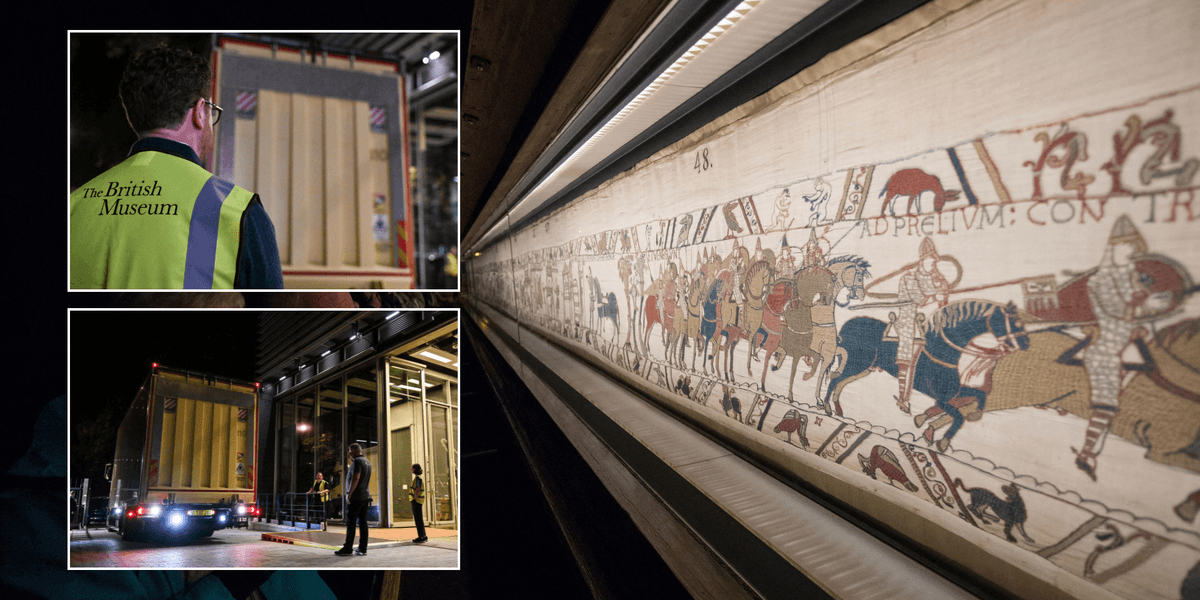
Armed officers escorted the historic 230-foot long artwork as it was taken from France's Bayeux Tapestry museum to the British Museum.
The embroidery, which depicts William the Conqueror's 1066 invasion of England, was stopped at the Eurotunnel entrance near Coquelles.
There, a "thorough" check was made - but border officials did not enter the climate-controlled lorry.
Instead, sniffer dogs were used to avoid disrupting the lorry's internal environment, sources familiar with the transportation plans told The Telegraph.
This pause was considered a risk by French officials, and the area near the Eurotunnel entrance was checked for migrants before the arrival of the tapestry.
Emmanuel Macron has taken a personal interest in the embroidery's loan, describing it as a "tangible expression of long-standing friendship" between France and the UK.
French authorities provided hundreds of officers, riot police and a helicopter escort to guard the historic work during its trip from Bayeux to Coquelles.
Almost 6,000 stowaways were found across all French Channel ports, including Coquelles, in the year between 2024 and 2025, and vehicle inspections are standard at the UK-France border.
After border checks, the tapestry entered British territory and was protected by Kent Police officers for its trip across the Channel.
As it arrived in Folkestone, the Metropolitan Police escorted the lorry up the M20 to the British Museum.
The tapestry, insured by the British Government for some £800million, will be on display from autumn 2026 to mid summer next year - with tickets to see the artwork from September to December selling out within 24 hours.
MORE ON THE BAYEUX TAPESTRY:
After carefully unfolding and inspecting the artwork, conservation experts and French Culture Minister Catherine Pegard declared the transport efforts a success.
Earlier this month, Ms Pegard told the BBC: "We can see that all the precautions have been taken… I believe that it will reassure all the sceptics."
She was joined in her inspection by chair of the British Museum and former Chancellor George Osborne.
Mr Osborne said: "They have done an amazing job in transporting this very very delicate item across the Channel and unfurling it here for us."
The historic artwork, folded 28 times to fit inside the lorry, was slowly and carefully unfurled by a team of up to six people in a process which took over 18 hours.
Millie Horton-Insch, an embroidery expert, admitted it was "painstakingly slow" to unveil the tapestry, which depicts 627 characters and 737 animals.
The British Museum expects over a million visitors to the exhibit and is planning for about 300 visitors per hour.
Ms Pegard said careful work to transport the artwork had assuaged any fears raised by French conservationists, who previously filed a legal challenge against the exhibition.
"The expertise, the work of scientists, the technical feat surrounding the transport, the building of the crate, the building of the display case, all these steps we have come through for the whole year have lifted all the doubts about the legitimacy of the tapestry being presented to the British public," she said.