Thank you for subscribing!
The panel depicting the scene appears immediately after a scene showing William the Conqueror and Harold Godwinson in an animated exchange
Millions of people visiting the British Museum to see the Bayeux Tapestry in the coming months could also uncover what the exhibition’s curator believes is a secret sex scandal.
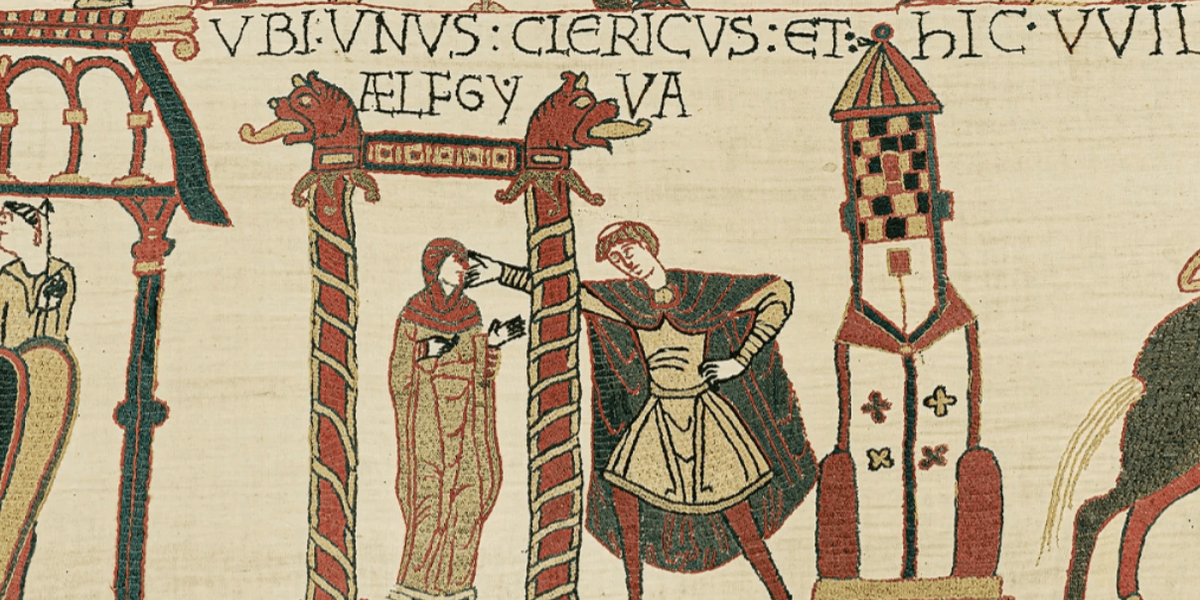
At the centre of the mystery is a panel showing a woman identified only as Aelfgyva, being touched on the face by an unidentified cleric, while a naked male figure strikes a suggestive pose in the border beneath.
Prof Michael Lewis's theory is that this enigmatic woman is in fact Emma of Normandy, queen consort to both Aethelred the Unready and Canute, mother of Edward the Confessor, and William the Conqueror's great-aunt.
It was precisely this family connection, Emma's role as Edward the Confessor's mother, that William invoked to justify his claim to England's throne and the invasion that followed.
Yet rumours persisted that Emma had conducted an adulterous affair with Alfwin, Bishop of Winchester.
Prof Lewis told the History Extra podcast: "She is the legitimacy for William's rule. That [naked] figure at the bottom, and the sexual scandal... then it kind of switches it completely against her. It undermines her legitimacy and therefore the legitimacy of the Norman Conquest."
The panel depicting Aelfgyva appears in the tapestry immediately after a scene showing William and Harold Godwinson in an animated exchange in France in 1064, two years before the Battle of Hastings.
Harold seems to gesture towards the woman, and scholars generally interpret the pair as debating the succession and who held the rightful claim to the crown.
Harold had initially pledged to back William's bid for the throne, though some historians believe this oath was extracted under duress.
He ultimately seized the crown himself following Edward the Confessor's death in 1066, triggering the Norman invasion.
Dr David Musgrove, content director of History Extra, noted that a second naked figure appears in the border beneath the Harold-William conversation, apparently engaged in carpentry.
He suggested this could represent a man fashioning the ploughshares used in Emma's ordeal: "If there was a scandal, if she was having this relationship with this bishop, then you can see the cleric as the bishop, and then the naked man beneath, with the prominent member... it would suggest this element of sex scandal."
Legend holds that Emma proved her innocence by walking barefoot across nine red-hot ploughshares in Winchester Cathedral's nave, invoking the protection of St Swithun and emerging unscathed.
Dr Emily Winkler of Oxford University observed that the figure nonetheless stands with dignity beneath a Scandinavian-style arch: "Is it because the scandal was talked about, but it didn't really get anywhere?"
Emmanuel Macron and Andy Burnham will officially unveil the Bayeux Tapestry exhibition at the British Museum tomorrow, an event already dubbed the "exhibition of the century".
The show, which runs until July 11 2027, has proved so popular that every available ticket is sold out through to April.
When bookings went live in July, some 80,000 people rushed to secure a place, with queues on the museum's website stretching to nine hours before visitors were told: "The queue is paused."
The 1070s embroidery has departed Normandy on only two previous occasions, once in 1803, when Napoleon exhibited it in Paris to drum up support for his own cross-Channel invasion, and again during the Nazi occupation.
Its journey to Britain in July required French authorities to deploy a helicopter and riot police to escort the exceptionally fragile artefact, which travelled in a secure box suspended inside a bright yellow lorry before crossing the Channel aboard a specially chartered Eurotunnel train.