Thank you for subscribing!
Solar farms function exactly the same whether they are placed on excellent soil, poor soil, or concrete
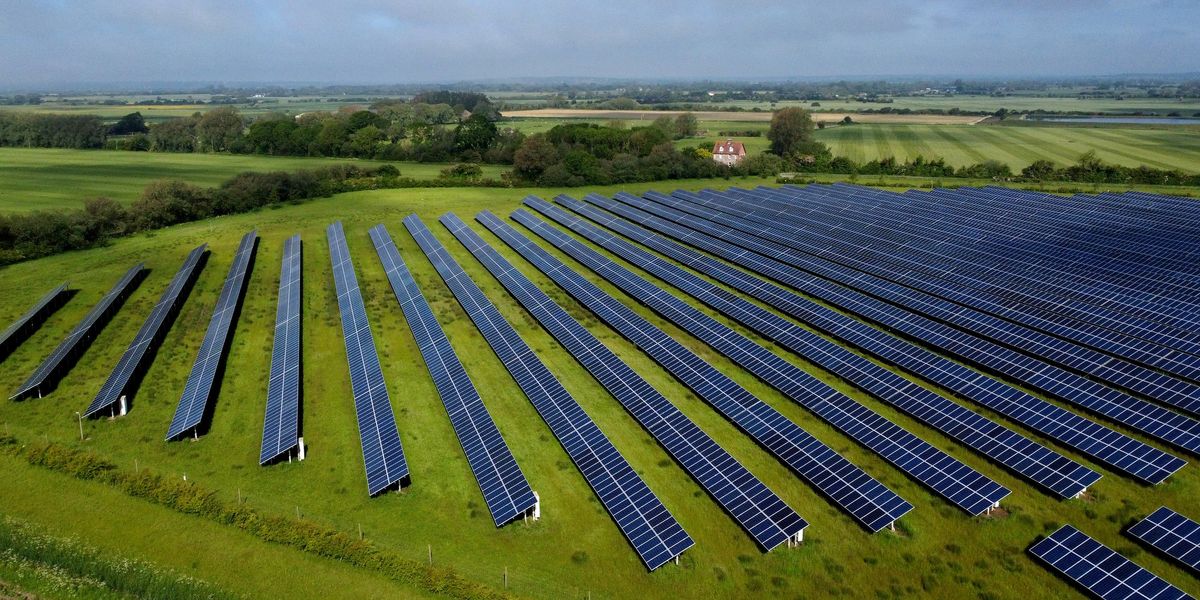
Hundreds of Britain's best farmlands have been destroyed in the pursuit of Net Zero targets.
As the UK struggles with its food security, heavily reliant on global imports, enough top-quality land to feed 200,000 people has been transformed into solar farms.
Agricultural land is graded from 1 to 5 based on climate, site landscape, and soil quality, with grade 1 being the best for food growth and production.
An estimated 4.5 million to 5 million hectares are classed as Best and Most Versatile agricultural land (BMV), ranked from 1-3a.
But around 827 hectares of this top-quality land has been destroyed, with solar farms built on the fertile ground, according to the countryside charity CPRE, which audited the UK's largest operational "mega-solar" installations.
Over 5 per cent of that was Grade 1, with a quarter Grade 2.
The remaining nearly 70 per cent of the converted BMV land falls into Grade 3a.
Solar farms function exactly the same whether they are placed on excellent soil, poor soil, or concrete.
However, the top-quality land destroyed to make these facilities could have produced around 20,700 tonnes of vegetables per year.
At an average UK consumption of 100kg of vegetables per person per year, that's enough to supply roughly 207,000 people's vegetable intake annually.
Solar electricity can also be replaced by other generation sources, including wind, nuclear and gas, without requiring this specific parcel of land.
Panels can also be sited on lower-grade land, rooftops, or brownfield sites instead.
The Campaign to Protect Rural England's own analysis argues the 2030 solar target is achievable in that way, meaning the use of high-quality farmland is completely unnecessary.
Vegetables need this specific land as Grade 1-2 fen silt soils, with this drainage profile, aren't interchangeable with land elsewhere in the country.
An investigation based on US federal, state, and local data, court records, and interviews with over 100 scientists, economists, and farmers found that even small amounts of the best cropland being taken for solar can damage valuable topsoil in ways that affect future crop potential.
Reduced yields leave the UK's food supply more dependent on imports from abroad.
Importing food from abroad, particularly foreign-grown grain, could also drive up animal feed costs.
The UN Food and Agriculture Organisation said certain food costs are at their highest in more than three years.
Sugar, cereals and vegetable oils are all more expensive in July than in the month before, it said.
A spokesman for the Department for Energy Security and Net Zero told GB News: “The biggest threat to agriculture and nature is the climate crisis.
“Solar is one of the cheapest and quickest forms of energy to build, helping get bills down for good.
“Even in the most ambitious scenarios, we only expect up to 0.4% of total UK land to be used for solar by 2030.”
GB News has also contacted the Department for Environment, Food and Rural Affairs for comment.