Thank you for subscribing!
Trilateral discussions between London, Paris and Berlin have gathered pace as anxiety mounts over Washington's commitment to European security
Germany is exploring the possibility of investing in Britain's nuclear deterrent, it has been revealed, in a bid to move away from reliance on the US.
Berlin is weighing up financial backing for Trident as part of a broader drive to strengthen Europe's atomic shield.
Rather than developing its own nuclear weapons, something Germany's wartime legacy makes politically untenable, Friedrich Merz's government want deeper integration with the existing British and French arsenals.
One well-placed source told the Telegraph: "We have a very strong interest that the existing nuclear powers in Europe extend their capabilities."
Trilateral discussions between London, Paris and Berlin have gathered pace in recent months as anxiety mounts over Washington's commitment to European security.
"Policymakers are waking up each morning and asking themselves what the hell the Americans are going to do tomorrow," a German diplomatic source told the publication.
German officials envisage several forms of practical support for the UK's nuclear programme.
Berlin believes they could help construct the next generation of submarines, contribute to missile development, or assist with uranium enrichment for future warheads.
A German manufacturer has prior experience building submarines for Israel's covert nuclear deterrent.
Conventional military assets could also form part of any deal.
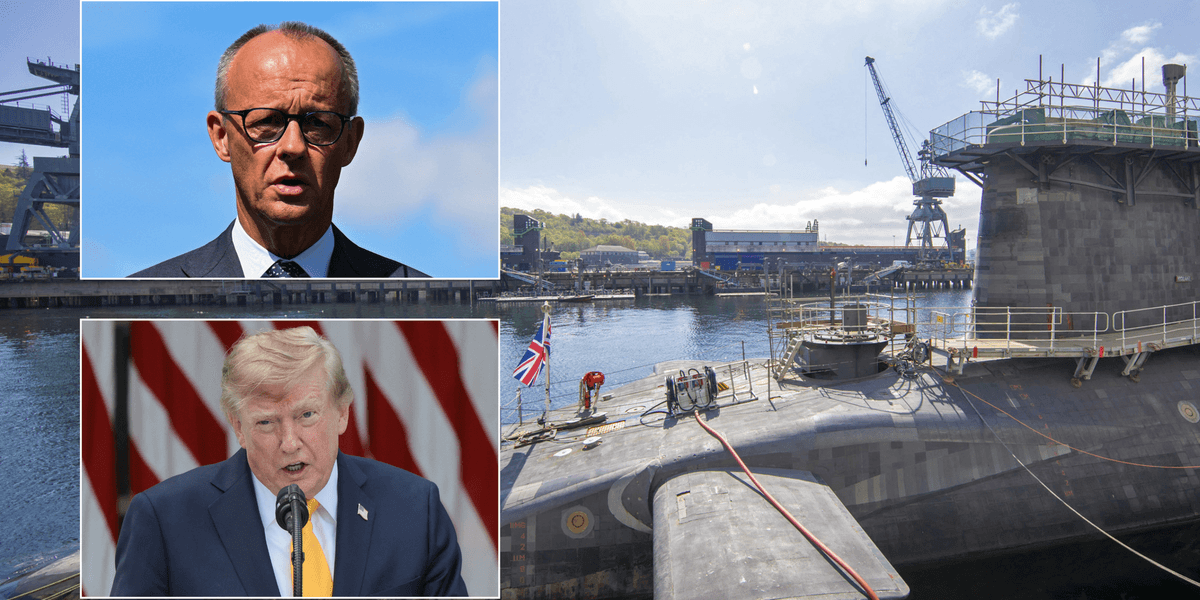
One proposal involves stationing German-operated Patriot air-defence systems at strategic sites, including the Faslane naval base in Scotland where Britain's Trident submarine fleet is housed.
A British defence source, however, cast doubt on whether German industry possessed the expertise needed for nuclear submarine construction.
The source conceded that protecting Faslane was a more realistic proposition, saying: "The ability to contribute to the defence of Faslane is more credible, likely and appropriate."
The UK's nuclear modernisation programme carries a price tag of £63billion, yet successive governments have delayed critical spending decisions due to budgetary pressures and the competing demand to rearm conventional forces.
Four Dreadnought-class ballistic-missile submarines are currently under construction to replace the existing fleet and maintain Britain's continuous at-sea deterrent.
Although Britain retains full authority to launch its weapons, it cannot build, service, or upgrade them without US involvement.
Trident missiles are manufactured and maintained at the Kings Bay facility in Georgia, while the new Astraea warhead is being developed in tandem with America's W93 programme, a reliance that troubles Berlin as it pushes for European strategic autonomy.
Germany is simultaneously engaged in nuclear discussions with France.
The two nations have already conducted joint exercises simulating the use of atomic weapons to defend Europe, and German forces are expected to participate in France's signature "Poker" nuclear drills this autumn for the first time.
However, Emmanuel Macron, who has offered to "open the strategic debate" with allies seeking shelter under France's entirely independent nuclear umbrella, departs office next year.
His likely successors, Marine Le Pen and Jean-Luc Mélenchon, are both Eurosceptic and could revert to a homeland-only nuclear doctrine.
Russia's invasion of Ukraine and US President Donald Trump's eagerness to pull forces from Europe have sparked nuclear weapons discussions in Poland and the Nordic states.
By bolstering British and French deterrents, Berlin hopes to dissuade other nations from pursuing their own atomic programmes.
A Ministry of Defence spokesman said: "Our nuclear deterrent is the cornerstone of our national security, protecting the UK and our Nato allies every moment of every day.
"We remain the only European ally to commit its nuclear deterrent to the defence of Nato. This means that all Nato allies already benefit from the protection of our nuclear deterrent."
GB News has approached the German Ministry of Defence for comment.