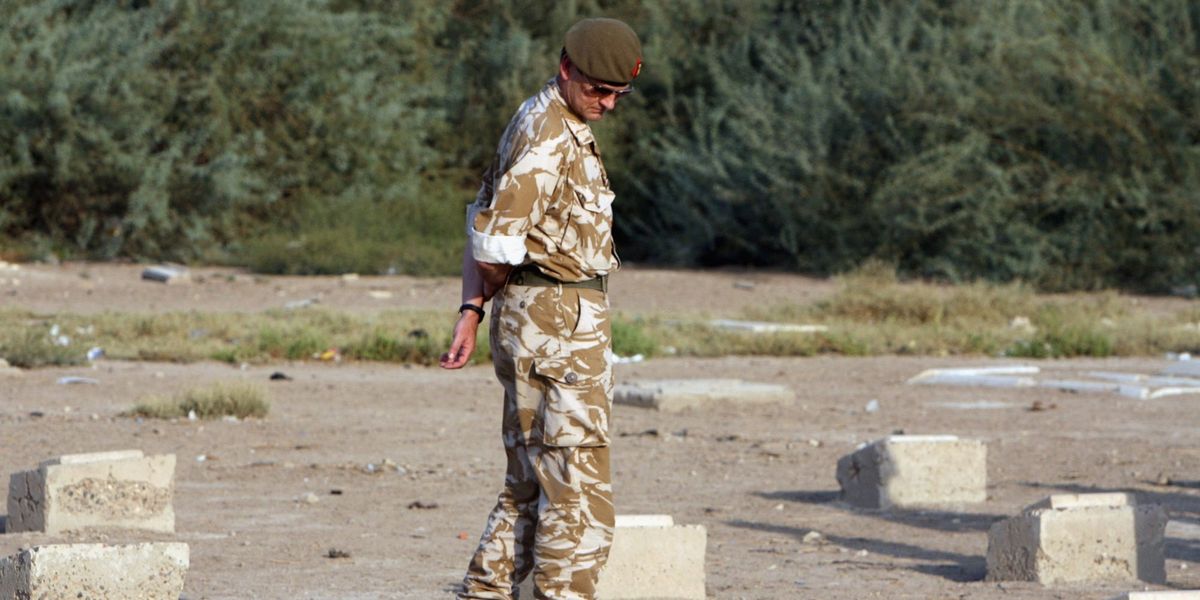
British Army has crushed hundreds of war hero graves into gravel in what has been labelled a “shocking disregard” for the fallen.
Almost 800 First and Second World War gravestones of Commonwealth soldiers were destroyed at Basra War Cemetery in the Iraqi desert.
The headstones, along with 80 thick slate panels inscribed with regimental crests and the names of the fallen, were removed from the cemetery in 2003 over concerns about local vandalism.
Yet rather than being safeguarded, nearly all were flattened into rubble within 18 months and used as fill material for a drainage ditch at a separate military installation.
The bodies of the servicemen and women who died in both World Wars remained in the ground, but their graves are left entirely unmarked.
British troops stationed in southern Iraq took the decision to strip the cemetery of its markers shortly before the US-led invasion in 2003, after local militia were found to have been using the headstones for target practice.
An unnamed officer was filmed during the removal operation, pledging the stones would be held safely at camp for the Commonwealth War Graves Commission, "which will come back in the future and restore this cemetery to its former glory".
No similar measures were taken at any other military graveyard in Iraq, and the Basra Memorial, situated just 30 kilometres away, was left completely undisturbed.
The crushing of the stones was carried out under the supervision of 64 Works Group, Royal Engineers, and reportedly received approval from a padre. A military situation report from April 2005 stated: "The gravestones have now been crushed and are ready to be placed in the soakaway."
The full extent of the destruction only came to light through Freedom of Information requests submitted by Ben Soppitt, a 55-year-old grandson of one of the soldiers buried at Basra.
Mr Soppitt, who resides near San Francisco, had to enlist the intervention of the Information Commissioner to compel the Ministry of Defence to release the documents.
The disclosed records included the damning situation report from 64 Works Group confirming the gravestones had been ground down and repurposed as drainage material at the Shaibah Logistics Base, located nine miles south-west of Basra.
Mr Soppitt maintains both the Government department and the Commonwealth War Graves Commission actively sought to conceal what had happened from the public.
Former chief of the defence staff Field Marshal Lord Richards of Herstmonceux, who held the role of Assistant Chief of the General Staff when the stones were destroyed, expressed regret but defended those involved.
He told The Mail on Sunday: "I am deeply saddened by what happened to this cemetery. With the benefit of hindsight there is of course no excuse. However, I have no doubt that in the dangerous and febrile environment of Basra at the time, the officers who took this decision thought they were doing the right thing."
Lord Dannatt, the former chief of the general staff, said: "The Chairman of the Commonwealth War Graves Commission is the Secretary of State for Defence. A decision should be taken to either re-instate all the graves, probably now impossible, or otherwise put in place a memorial with all the names of those buried in the cemetery with a suitable explanation of recent events."
Mr Soppitt's grandfather, Gunner Joseph Soppitt, died of dysentery in 1941 and was laid to rest at Basra War Cemetery, where more than 360 British servicemen and women are interred alongside fallen comrades from India, Poland and other Commonwealth nations.
Last year, Mr Soppitt made the journey to Basra carrying a newly commissioned granite headstone to place at his grandfather's grave.
A commemorative service was held at the cemetery, with the Archbishop of Basra and local Iraqi residents in attendance.
Mr Soppitt has filed a High Court application for judicial review, seeking to hold the MoD to account for the destruction of the gravestones.
He said: "The MoD is fighting this claim, unwilling to bear the cost of ensuring the over 3,000 men and women buried there are properly commemorated with the honour they deserve and that the public expects."
Mr Soppitt added: "It is a bitter irony that a member of the public, a relative of one of the casualties buried at Basra, is having to pursue the MoD through the courts simply to secure the basic dignity of commemoration that those who died in service are owed."
The MoD has declined to address the allegations, stating only that it is unable to comment for legal reasons.