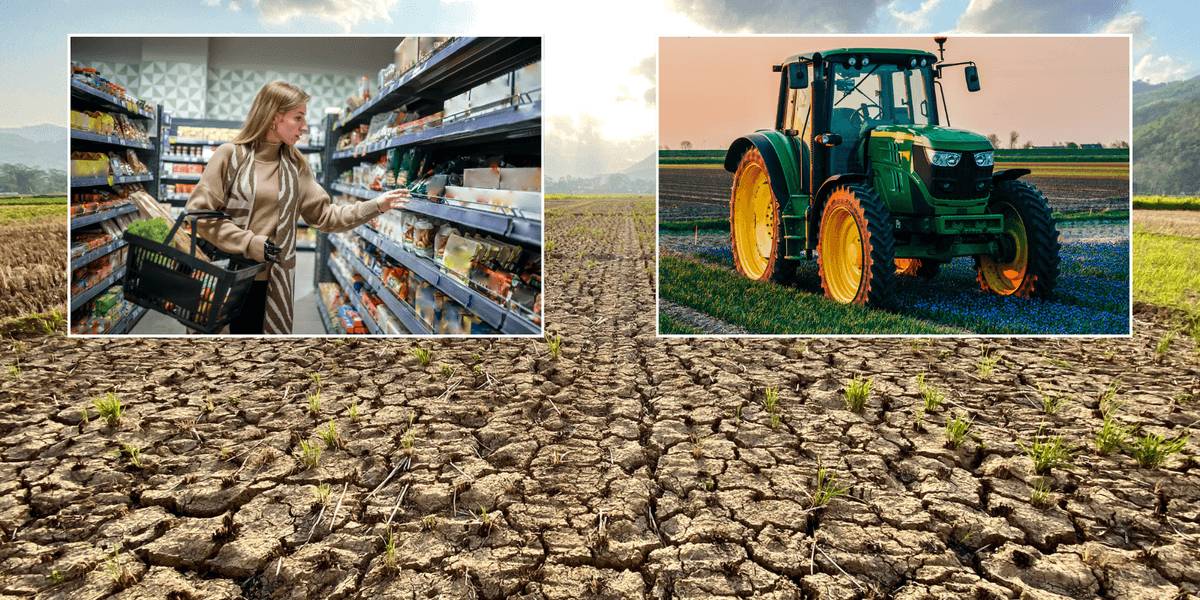
Southern and eastern England have recorded no measurable rainfall so far this month
Farmers across England have warned the next 10 days could bring food shortages to supermarket shelves, as large parts of the country edge closer to drought conditions following an exceptionally dry summer.
Southern and eastern England have recorded no measurable rainfall so far this month, marking the longest July dry spell in three decades.
Across England, only three per cent of the month's long-term average rainfall has fallen, following three successive heatwaves that have left rivers, streams and farmland under increasing pressure.
The prolonged dry weather has prompted authorities to declare a prolonged dry weather status across East Anglia, the West Midlands, Devon, Cornwall, the Isles of Scilly, Lincolnshire, Northamptonshire, Hertfordshire, London, Wessex, the Thames region, the Solent and the South Downs.
The National Drought Group has warned the lack of rainfall is having significant consequences for the environment, water supplies and food production.
Farmers say crops are already showing signs of stress, with cereals drying out in the fields and spring barley yields expected to fall after insufficient rainfall earlier in the growing season.
In some parts of East Anglia, growers have been forced to stop abstracting water from rivers because water levels have dropped too low.
Harvesting has begun earlier than usual, but the hot, dry conditions have created additional risks.
The combination of parched crops and high temperatures has increased the likelihood of fires breaking out in combine harvesters, raising concerns about further losses during one of the busiest periods of the farming calendar.
The National Farmers' Union (NFU) said the coming days would be crucial for many growers.
An NFU spokesman said while some farms had already begun harvesting, many had not, meaning rainfall over the next week could still influence final crop yields.
The organisation has called on the Environment Agency to adopt a flexible approach to water consumption rules to help farmers manage the challenging conditions.
NFU Deputy President Paul Tompkins said farmers in the east and south of England had experienced exceptionally low rainfall, creating serious challenges for agricultural businesses, adding: "We’re asking the Environment Agency to be flexible when it comes to abstraction.”
He warned many farmers now faced another costly harvest after enduring both drought and flooding during the extreme weather events of 2024 and 2025.
Although the Met Office is forecasting some rainfall this weekend, forecasters expect the heaviest showers to fall across northern parts of the UK.
Any rain reaching southern England is likely to be limited and futile to reverse the effects of the prolonged dry spell.
Thames Water is among several water companies introducing hosepipe bans as demand for water continues to rise.
Wildlife has also suffered, with 53 wildfires recorded this year at Sites of Special Scientific Interest, while low river levels have disrupted breeding habitats for amphibians and restricted the migration of Atlantic salmon.
Oliver Harmar, of Natural England, said: “As well as serious impacts for people, our wonderful wildlife is suffering as the effects of climate change take hold, with the increased likelihood of drought and wildfires.”
Meanwhile, the Met Office said conditions may become more changeable in early August but cautioned that widespread, meaningful rainfall across southern England remains unlikely, leaving many areas facing continued dry conditions in the weeks ahead.