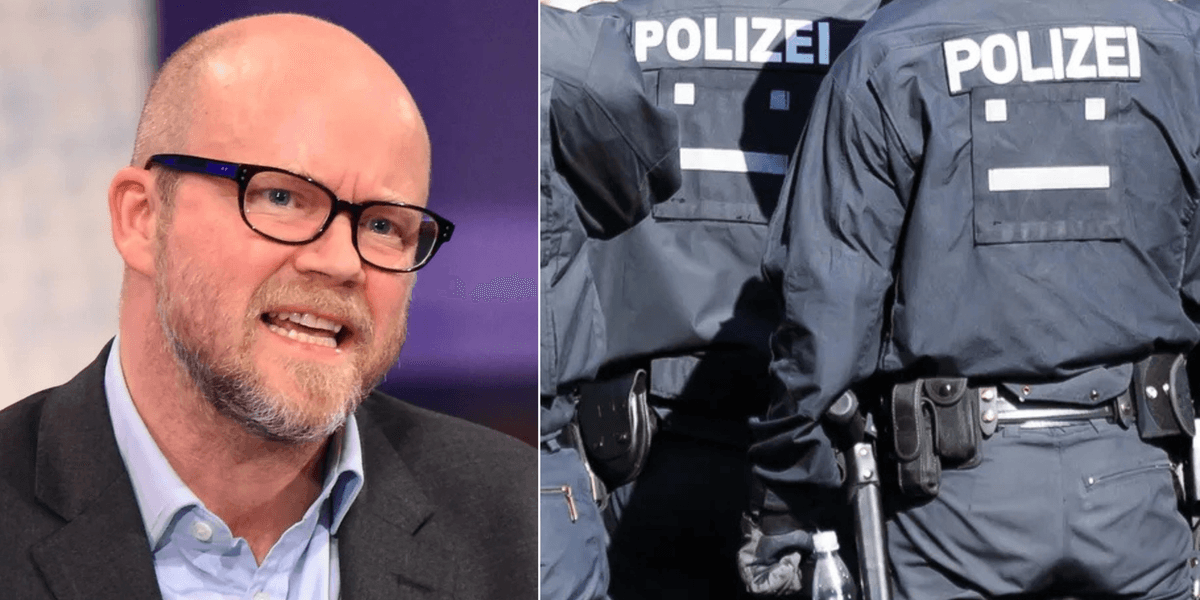
The FSU was launched in February 2020 at the height of the cancel culture phenomenon in Britain
The Free Speech Union is preparing to launch a German branch by mid-2027 in response to a surge of police investigations targeting citizens who ridicule politicians on the internet.
Lord Young of Acton, who established the Union, confirmed that FSU International has been in discussions with German free speech campaigners about setting up operations in the country.
"FSU International... has been talking to various groups in Germany and trying to persuade them to set up an FSU Germany.
"We hope to establish such a group within the next year," he told The Telegraph.
The move comes as investigations under Germany's controversial Section 188, the so-called political insult law, reached an unprecedented 4,792 last year, a record figure that has intensified concerns about the criminalisation of political satire.
Germany's Section 188 effectively criminalises crude mockery of elected officials, with those found guilty facing up to three years behind bars.
Authorities have defended the legislation as a necessary response to escalating threats and abuse directed at politicians, though detractors argue it is increasingly weaponised against ordinary citizens engaging in political ridicule.
One particularly striking incident occurred in 2024, when Bavarian police carried out a raid on a man's home after he described Robert Habeck, who was serving as vice-chancellor at the time, as a "schwachkopf", roughly translating to "dummy."
Those caught up in the law first undergo a police investigation, which can then escalate to criminal prosecution and imprisonment.
A related statute, Section 86a, which prohibits the display of Nazi symbols, has also drawn criticism after being deployed against historian Rainer Zitelmann.
Dr Zitelmann, who has authored approximately 30 books and is a recognised authority on Hitler's rise to power, faced the threat of criminal prosecution for sharing a meme that drew parallels between Hitler's invasion of Czechoslovakia and Vladimir Putin's assault on Ukraine.
The image included a photograph of Hitler wearing a swastika, which Dr Zitelmann believes a critic reported to authorities via a dedicated online portal for flagging offensive content.
German police ultimately abandoned the investigation following a significant public backlash.
The FSU was launched in February 2020 at the height of the cancel culture phenomenon in Britain.
Among its most prominent cases was its defence of Allison Pearson, the Telegraph columnist who faced a police investigation over social media posts she subsequently removed.
Lord Young of Acton and other free speech activists within the organisation have appeared on GB News to battle censorship.
The organisation now views Germany's deteriorating free speech climate, where one parliamentarian has warned of a resurgence of authoritarian tendencies reminiscent of the Nazi era, as demanding urgent intervention.
Max Thompson, the FSU's campaigns officer, condemned the pattern of investigations.
He said: "This is not normal in a purported Western liberal democracy.
"Even a historian who has devoted his career to studying the dangers of totalitarianism is not immune from being investigated under laws that increasingly resemble the very thing they were built to prevent."