'Unattended cars are basically bombs when they go off,' firefighters warned police amid panic on the A31
A huge wildfire broke out in Hampshire on Sunday after a van burst into flames on a major A-road.
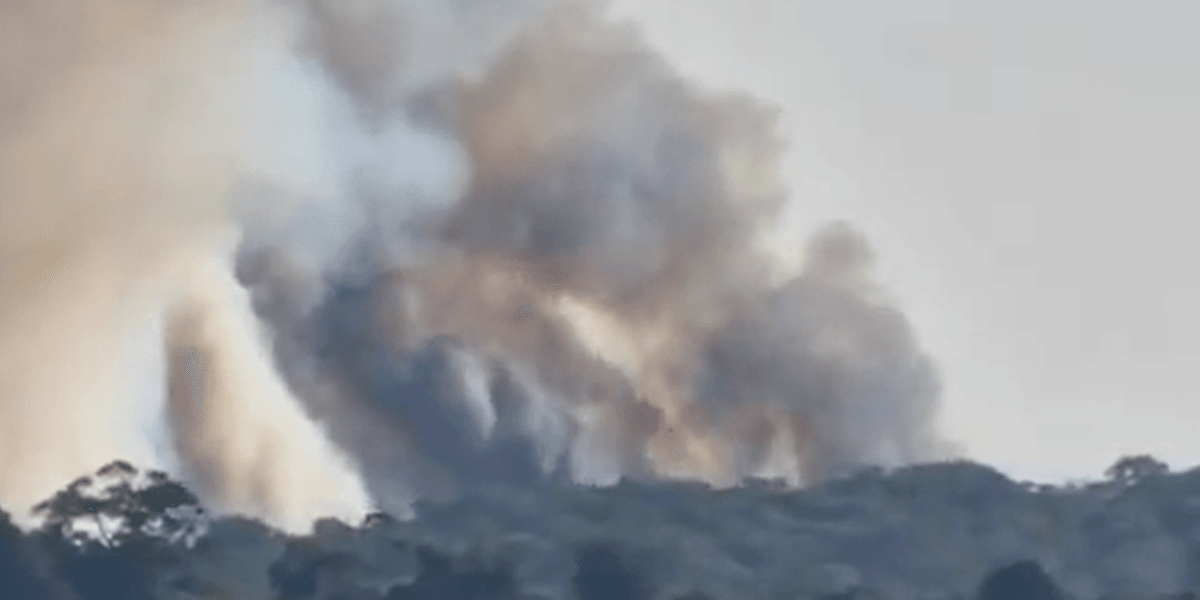
Flames from a vehicle fire on the A31 quickly spread to nearby heathland, sending smoke billowing into the sky which could be seen for miles around.
Traffic came to a standstill and drivers were ordered to the side of the road the van fire set off a "tinderbox" in the nearby heathland - near the New Forest.
Panic then spread on the A-road, with a policewoman ordering drivers to get out of their cars and move to the central reservation "if you want to stay alive".
A firefighter, according to the Mail, was overheard telling a police officer: "We want all the cars and people off the carriageway... Unattended cars are basically bombs when they go off."
The Hampshire and Isle of Wight Fire and Rescue Service said it received more than 160 emergency calls reporting the fire at about 5.24pm on Sunday.
It scrambled 26 fire engines, four water carriers, six off-road vehicles and several command vehicles to the scene near Ringwood to try and contain the inferno, with the vehicles set to stay in position overnight to ensure the fire does not spread further.
A witness said the smoke was clearly visible from Thorness Bay on the Isle of Wight, and was spiralling into the sky "way over to Portsmouth".
While one driver recalled: "It happened so fast. Some drivers just went straight through the flames. Others did emergency stops, turned around and tried to get back along the carriageway. It was sheer panic."
The fire service said: "The fire spread from the vehicle to the central reservation before progressing into nearby heathland.
"Crews from across Hampshire, supported by colleagues from Dorset and Wiltshire Fire and Rescue Service, are currently attending the incident."
Around 24 miles away in Holbury, Hampshire crews were despatched to another "significant" blaze, where bungalows and vehicles on Rollestone Road caught fire after flames spread from a hedgerow.
Earlier in the East Midlands, Nottinghamshire Fire and Rescue Service declared a major incident as its crews had to battle two wildfires near Mansfield.
One fire initially broke out at Strawberry Hill Heath at about 2pm on Saturday, with 12 crews tackling the blaze at its height.
FIRE CHAOS - READ MORE:
Eight fire engines were still at the site on Sunday - while six others and a water carrier were deployed to a second blaze which broke out at Sherwood Pines.
The fire service said in a statement: "As of 1.30pm, Nottinghamshire Fire and Rescue Service has declared a major incident.
"This relates to the cumulative impact of multiple incidents placing significant pressure on operational resources, rather than a single incident in isolation.
"The service is currently operating with very limited resources and reduced pump availability. As a result, response times to any further incidents are likely to be delayed."
Some 36,000 square metres of woodland and undergrowth were affected by the blaze at Strawberry Hill Heath.
Sunday's blazes follow several wildfires across Britain over recent weeks, including large blazes at Dunwich Heath in Suffolk, Headon Warren on the Isle of Wight, Llanwonno in the Rhondda Valleys, South Wales, and the Cairngorms National Park in Scotland.
Arthur's Seat, the volcanic rock which towers over Edinburgh, has seen repeated wildfires break out on its heathland.
Hot weather continued to build on Sunday, with southern England enjoying the highest temperatures around the country.
According to the Fire Severity Index, wildfires were likely to be exceptionally severe on Sunday in almost all of the East and South East.
The Met Office says heatwave conditions will likely return next week, with a balmy high of 36C expected in parts of East Anglia and southeast England by Thursday.
The UK has now bathed in four heatwaves from May to July: two record-breaking heatwaves in May and June, then two more in July, the driest July in England and Wales since records began in 1836.