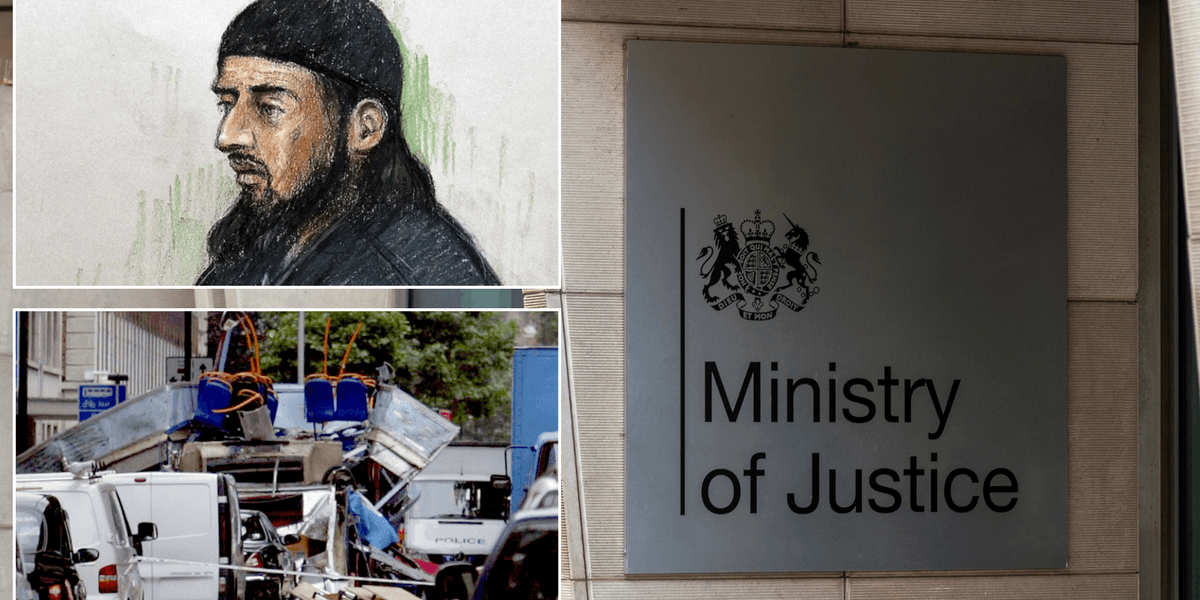
Police determined Haroon Aswat was a 'risk to national security' last year as he appealed for his release from detention
An Islamist terrorist linked to the London 7/7 bombings has received nearly £15,000 in taxpayer-funded aid for help relating to his "mental health", GB News can reveal.
Haroon Aswat, 51, born in Batley, West Yorkshire, has received mental health legal aid from the state totalling £14,074 over the course of 21 years.
Returning to Britain in 2022 after serving prison time in the United States for plotting to form an extremist training camp, Aswat was detained under the Mental Health Act.
Since then, he had been in Bethlem Royal Hospital in Bromley.
However, the convicted terrorist was released from the southeast London mental health hospital last month after a High Court judge ruled he would be free after completion of his treatment.
Despite Aswat's current whereabouts being unclear, with the Ministry of Justice (MoJ) not confirming his location, it has been speculated he has been moved to another institution for mental health support.
Legal aid the MoJ has matched to Aswat has been revealed to GB News via a Freedom of Information (FOI) request.
It shows his total cost for mental health legal aid was £14,092.96, spanning across five separate grants between 2008 and 2025.
Mental health legal aid is a category of civil legal aid in England and Wales, covering advice and representation for people sectioned under the Mental Health Act, including challenges to their detention.
After being captured in Zambia in 2005, Aswat was brought to the UK and fought extradition requests to the US for nine years over plotting to form an extremist training camp in the state of Oregon in 1999.
He was transferred to Broadmoor Hospital in 2008, after being diagnosed with schizoaffective disorder, which causes a person to have unpredictable and aggressive behaviour.
In 2015, Aswat was sentenced to 20 years in prison in the US for conspiring with convicted terrorist and ex-London imam Abu Hamza to set up an Islamist training camp in 1999.
He was returned to the UK four years ago after serving part of his sentence in the country, as periods of detention while awaiting extradition were discounted from his incarceration.
In 2022, a psychiatrist found no evidence Aswat had the condition at the time of the offences, which took place around November 1999.
The psychiatrist said Aswat openly endorsed "extremist ideology", telling him in an interview: "I am a terrorist."
In a report prepared ahead of Aswat's extradition, the psychiatrist wrote that even in a relatively stable mental state, Aswat had continued to express violent extremist Islamic views.
The report also noted Aswat was "highly ambivalent" about taking medication and had relapsed twice after stopping treatment, with each relapse coinciding with violent outbursts.
It concluded Aswat remains at risk of "Islamic violent extremism".
At the High Court hearing last year, the convicted terrorist was assessed by police in the UK, who concluded he "remains a risk to national security".
Aswat has been linked to the 7/7 bombings in London, 2005; however, he has never gone to trial for his alleged involvement.
Police traced 20 calls from the 7/7 bombers to a phone linked to him just before the attacks, which killed 52 people and injured 770.
Aswat left the UK via London Heathrow Airport for India just hours before the bombings took place.
While in US custody, Aswat is understood to have confessed to involvement in both the 9/11 attacks in New York and the 7/7 London bombings.
He is also understood to have trained at an al-Qaeda camp in Afghanistan in 2001 and to have stayed at a safe house in Pakistan, where he met two of the 7/7 bombers.
The FOI shows the convicted terrorist has received £65,315.91 in legal aid in 21 years.
The largest single grant was £30,168 for civil representation under "Public Law", covering the period from 2013 to 2022.
Of that, £6,194.54 went to solicitor costs and £23,973.46 to barrister fees.
Aswat also received £21,054.95 in criminal legal aid between 2005 and 2007.
This included £435.17 for police station attendance and £20,619.78 for a non-standard representation order at magistrates' court.
A further £14,092.96 was granted for mental health-related legal help, spread across five grants – the largest of these, worth £6,643.35, covered the period from 2010 to 2015.
The MoJ said legal aid is paid directly to legal representatives rather than to the individual.
It confirmed criminal legal aid is available to anyone in a police station regardless of their financial circumstances.
It added its records do not always allow claims to be conclusively matched to a named individual, as the system logs only initials and surnames rather than full names or dates of birth.
An MoJ spokesman said: "Offenders do not receive a single penny of this money. Payments are means-tested and sent directly to the solicitors and barristers who represent those facing legal proceedings.
"Without legal representation, offenders could argue they have not received a fair hearing, and this could put convictions at risk, leading to increased appeals and taxpayer expense."