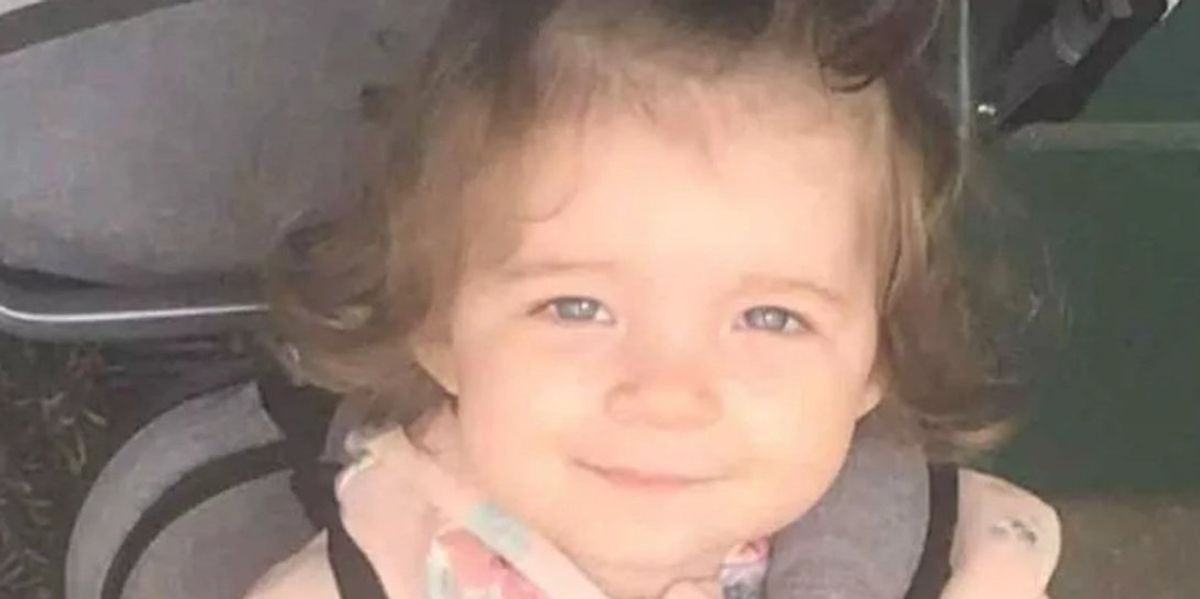
Cleveland Police said it made 'multiple' attempts to apprehend Harrison Simpson, but were 'unsuccessful'
Police failed to detain a "serial" abuser for 18 months who then went on to kill two-year-old Isabelle Welsh.
Harrison Simpson, 22, was convicted of murder and child cruelty at Teeside Crown Court this week, with Ms Justice Norton handing him a minimum sentence of 28 years in prison on Thursday.
Isabelle's mother, Alexandra Walker, 26, was also convicted of her daughter's murder and was given a minimum sentence of 21 years.
Describing the situation as "far from adequate", Cleveland Police admitted there was a warrant for Simpson's arrest which was issued by Teesside Magistrates' Court in March 2024, which the force did not carry out.
This left Simpson to freely meet Walker and her young daughter last summer.
Three months later, Isabelle was killed after suffering weeks of abuse at the hands of the pair.
Isabelle, who, before meeting Simpson, had been described as a happy little girl, sustained 21 broken bones before collapsing at her home in Thornaby, Teeside, on September 13, 2026.
The warrant for Simpson was handed out once he failed to attend court due to breaching a non-molestation order, an injunction protecting victims of domestic abuse, The Sunday Times reports.
After reports Simpson had harassed and threatened another woman, believed to be a former partner, the non-molestation order was put in place.
Neither Cleveland police nor social services knew Simpson had begun dating another woman, Walker.
It said: "Multiple inquiries and arrest attempts were carried out to try to locate and arrest him but these proved unsuccessful.
"We recognise the time Simpson had an outstanding arrest warrant is far from adequate."
Simpson led a "campaign" of sexual and physical abuse against the toddler before her death, where she sustained an "unsurvivable" brain injury.
She was shaken violently, with her head hitting against a hard surface on the morning of September 13.
The judge said she was sexually assaulted around the time the fatal blow was inflicted.
It was not established who was with the child when she sustained her fatal injury, but Walker claimed she had been heavily drinking on the night of her daughter's murder.
The judge described there being "a wall of silence" around what happened.
CCTV cameras set up in the house captured Walker smoking a cigarette around the time her child had collapsed and was dying.
She searched online for "Why would my toddler be bleeding?" rather than calling an ambulance.
Walker only raised the alarm once her stepfather came to the house and insisted the child get medical attention.
Almost two weeks before Isabelle's fatal injuries were inflicted, Walker took the child to hospital with a broken leg, raising concerns among medical staff.
The mother then delayed returning to hospital for a check-up, jurors heard.
Ms Justice Norton said, "tragically", a nurse who expressed concerns for the toddler's safeguarding was "over-ruled" by doctors who believed Walker's lies.
The girl was able to go home to her mother, who was known to social services after previously being a victim of domestic abuse.
The nurse told the jury Walker "kind of lunged" at her when she mentioned the toddler's well-being.
She said Walker "stated it that was totally unnecessary and totally over-the-top that I was going to safeguarding, and she said she was taking (Isabelle) home", demanding to see "another doctor".
Isabelle returned to hospital, 11 days later, fatally injured.
The nurse who raised the alarm broke down in tears as she recalled seeing the two-year-old "covered from top to toe in bruises".
A post-mortem examination found the child had sustained 21 broken bones, including her skull and spine, 97 soft tissue injuries and a bleed on her brain.
Walker and her daughter were contacted by a local safeguarding hub, run by the council, on two occasions in the four weeks before the toddler's murder, but this resulted in no further action.
A health visitor made contact four days before the toddler was killed but, "unfortunately", did not enter the family home, prosecutor Richard Wright KC said.
Following the child's murder, a rapid review was triggered by a joint safeguarding partnership run by Stockton-on-Tees and Hartlepool councils.
The review found the local authorities' decision not to further investigate the girl's safeguarding was "appropriate with hindsight".
Since 2019, the safeguarding partnership has carried out 30 rapid reviews, an investigation into the council's actions if a child known to them has been seriously injured or killed.
In a statement, Cleveland Police said: "In line with openness and transparency, we informed Isabelle’s family of the circumstances surrounding the outstanding warrant early on in the investigation.
"A review of this was immediately conducted upon his arrest for murder.
"This review, along with a determination to continually improve our processes around suspect management, has led to a number of recent changes, such as ongoing improved visibility across the force around outstanding warrants, a comprehensive data system which tracks all outstanding warrants, and stringent oversight, including a governance group led by a superintendent.
"Those outstanding warrants posing the highest risk are reviewed daily by senior management."
Majella McCarthy, chair of the Hartlepool and Stockton-on-Tees safeguarding children partnership, said: "This is an incredibly upsetting and tragic case, and our thoughts are with Isabelle’s family.
"A multi-agency rapid review was carried out following Isabelle’s death to identify and reflect on the facts of the case, and the outcome of that rapid review was submitted to the national Child Safeguarding Practice Review Panel, which agreed with its conclusions.
"The associated action plan was implemented by the partnership with immediate effect, and the agencies involved have put in place measures to address any actions relating to them where applicable. The action plan is being monitored and reviewed by the partnership."