Vladimir Putin and his friends in Belarus have been accused of funnelling African and Middle Eastern men into the West
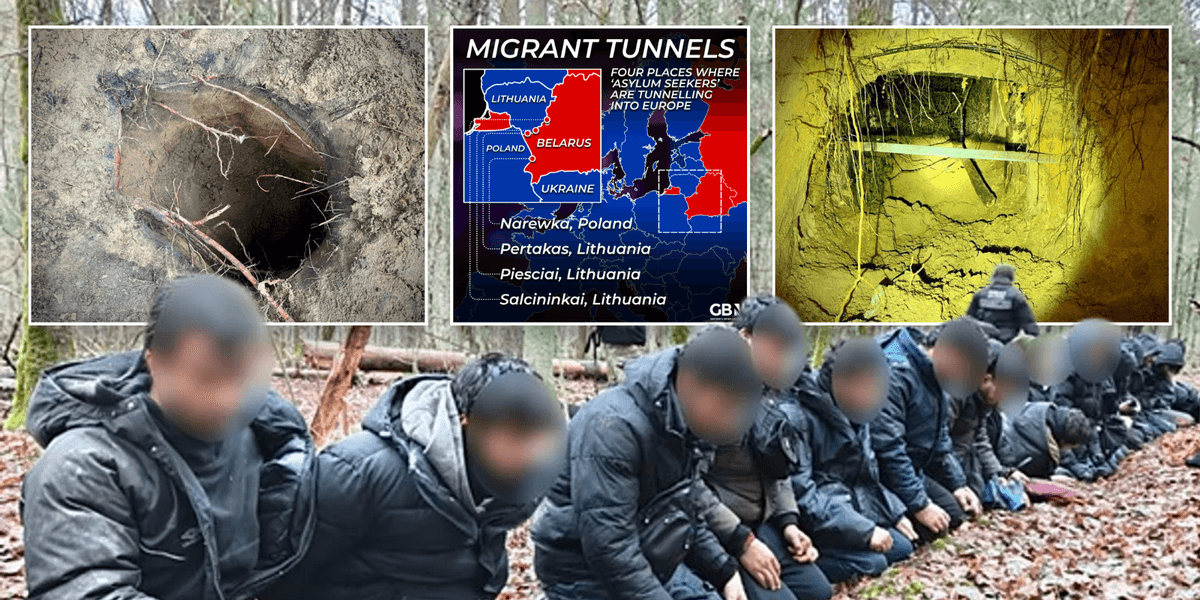
A growing number of "migrant tunnels" are being dug below Europe's eastern border so "asylum seekers" can invade Europe from behind the old Iron Curtain.
Dozens of tunnels have been unearthed by Lithuanian and Polish border guards in the last year alone with recent evidence suggesting the issue is becoming more common.
Vilnius and Warsaw both suspect the crisis is only getting worse after discovering four new tunnels in the last two weeks.
GB News has obtained evidence of one of the latest tunnels dug under the border fence by Afghan illegal immigrants in the past few days, which had not even been discovered by Lithuanian border guards.
More than a dozen tunnels have been unearthed by authorities since the beginning of the year.
Belarusian dictator Alexander Lukashenko is accused of being complicit in helping thousands of illegal migrants breach its borders and flood a close Nato ally of Britain.
While his allies in Moscow have long been feared to be destabilising Europe by driving asylum seekers - mainly from the Middle East and Africa - to cross the frontier.
Russia and Belarus have denied these accusations a number of times.
But after the migrant tunnels were exposed by GB News, The People's Channel has now mapped four places marking the forefront of Mr Lukashenko's migrant plot.
Pertakas, Lithuania
Near Pertakas, right in the south of Lithuania, an unfinished tunnel about 11 metres long was found in late July, where the border with Belarus is marked by a stream.
Around 20 would-be invaders were spotted fleeing back to Belarus when Lithuanian border guards approached.
The structure was supported by logs and equipped with buckets to dig out sand.
In Lithuania, illegal border crossings are punishable by fines, arrest and up to two years in prison.
Pieščiai, Lithuania
Just one hour's drive east sits the village of Pieščiai in the Varėna district of Lithuania.
Officials detected signs of underground activity on July 23 in the area and called upon Poland's Border Guard unit for support.
Polish officers utilised specialised equipment to locate the tunnel.
The Lithuanian State Border Guard Service said: "The tunnel, approximately one metre in diameter, extended about five meters from the border with Belarus into Lithuania.
"It had no exit yet, and migrants and others had no way to get through."
Šalčininkai, Lithuania
Another 64 miles east is Šalčininkai, a city in Lithuania on the Belarussian border.
Here, 38 illegal migrants were detained at the end of May after they travelled through a tunnel beneath the border fence dividing the two countries.
Thirty-six men and two women emerged from the tunnel then vanished into the forest, triggering a large-scale search by Lithuania’s State Border Guard Service.
The manhunt involved a helicopter, tracking dogs and drones.
All the illegal migrants were eventually captured, with most of them identifying themselves as Afghan nationals and two claiming to be from Iran.
Narewka, Poland
Further south than the Lithuanian tunnel sites is Narewka, in eastern Poland.
Last December, Polish border guards discovered a covert 60-metre-long smuggling tunnel near the village.
More than 180 migrants crossed into Poland through the hidden tunnel, again vanishing into the thick forest nearby.
Polish border guards, police, and soldiers were scrambled to track down the invaders, and eventually detained 130 of them.
They went on to capture nine more migrants - but nine months later, around 40 are believed to be at large in Poland.