Thank you for subscribing!
Visitors to the website, which remained accessible from within Britain, could make donations via a payment page
Palestine Action continues to raise money and recruit supporters for direct-action training in targeting more than 200 companies and locations across Britain, a new investigation has found.
The organisation was proscribed as a terrorist organisation more than a year ago.
The probe claims Palestine Action is operating an online presence under the name Palestine Action Global, an international platform launched by the network to bypass local counter-terrorism laws.
The Henry Jackson Society, a right-wing think tank that published the investigation, has written to the Home Secretary, demanding answers on whether enforcement failures or legislative gaps have enabled the banned group to maintain its digital operations.
Visitors to the website, which remained accessible from within Britain, could make donations via a Stripe payment page, the American payments firm.
The site additionally accepts cryptocurrency and invites those willing to give over £1,000 in cash to get in touch for vetting before a payment method is arranged.
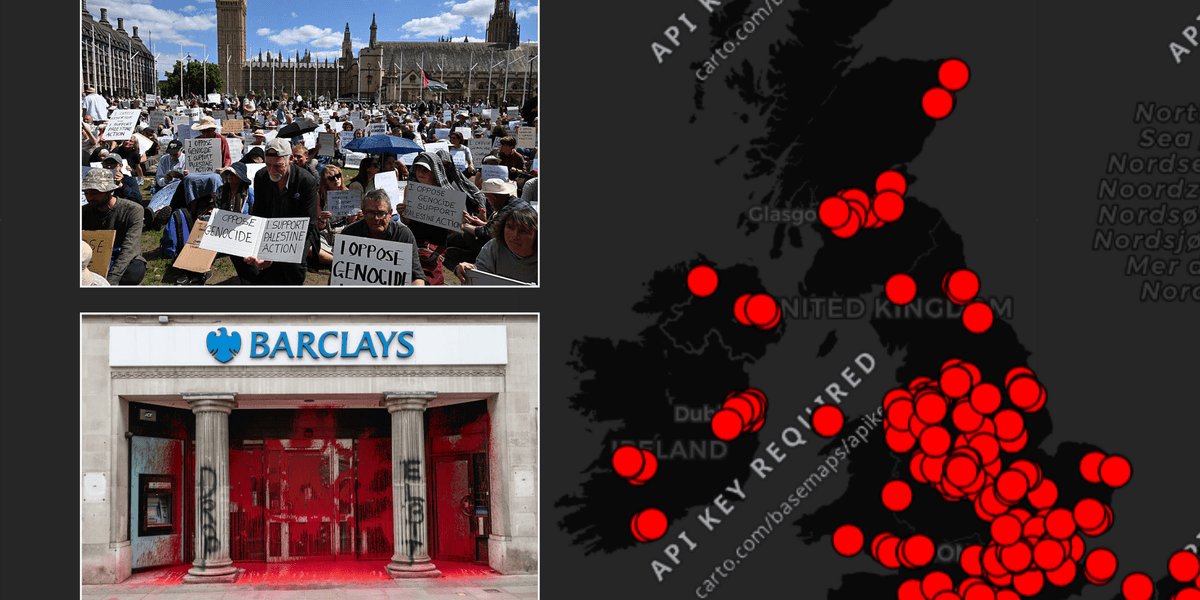
The Palestine Action Global website features an interactive map pinpointing more than 200 companies and locations across Britain that the group links to Israel's defence sector.
It also promotes online workshops focused on direct action, according to the think tank's findings.
An Instagram account associated with the site had attracted nearly 9,000 followers and was funnelling users towards both the workshops and the website.
Over the preceding six months, the site drew an estimated 31,000 visits.
A 14-page document titled the "Underground Manual," bearing Palestine Action's original branding, provides detailed guidance on establishing autonomous cells, choosing targets, conducting reconnaissance and planning attacks designed to "disrupt, damage or destroy."
It counsels participants to minimise forensic traces, dispose of evidence and avoid carrying personal mobile phones.
The government's own guidance makes clear that simply adopting a new name does not shield an organisation from a proscription order, provided police and prosecutors can establish it is, "for all practical purposes", the same banned entity.
After the High Court found the Home Secretary's decision unlawful in February, the Court of Appeal overturned that ruling.
A further appeal brought by co-founder Huda Ammori is scheduled to reach the Supreme Court in November.
In June, Palestine Action activist Samuel Corner was imprisoned for striking Sergeant Kate Evans with a sledgehammer during a raid on an Elbit Systems factory near Bristol, fracturing her spine.
Washington imposed counterterrorism sanctions on Palestine Action last week, with the US describing the measures as a complement to Britain's ban on the organisation.
Alan Mendoza, executive director of the Henry Jackson Society, said: "Proscribed terrorist organisations must not be allowed to operate in Britain, let alone raise funds through mainstream payment systems."
A Home Office spokeswoman told GB News: "We are cracking down on terrorist groups that use online content to spread propaganda and incite violence."
They added: "We work closely with technology companies to support the swift removal of unlawful terrorist content, including material linked to proscribed organisations."
Palestine Action told the Telegraph: "Palestine Action is a global movement committed to direct action against the Israeli war machine.
"The network, which began in England, had expanded across the world, with several groups forming across continents.
"The ‘Palestine Action Global’ platform will allow us to grow the international movement and share our global actions.
"Palestine Action is only proscribed in the United Kingdom. Therefore, Palestine Action Global does not include any groups in that region.
"This means people in Britain and the North of Ireland are legally able to share and support this platform."