Had his plan gone ahead, warfare to this day would look markedly different
A Royal Navy commander plotted a chemical weapons attack against the United States in what would have been a world first at the time, it has been revealed.
A document unearthed from the bottom of a box at the National Records of Scotland has exposed what could have been the most devastating British assault on American forces.
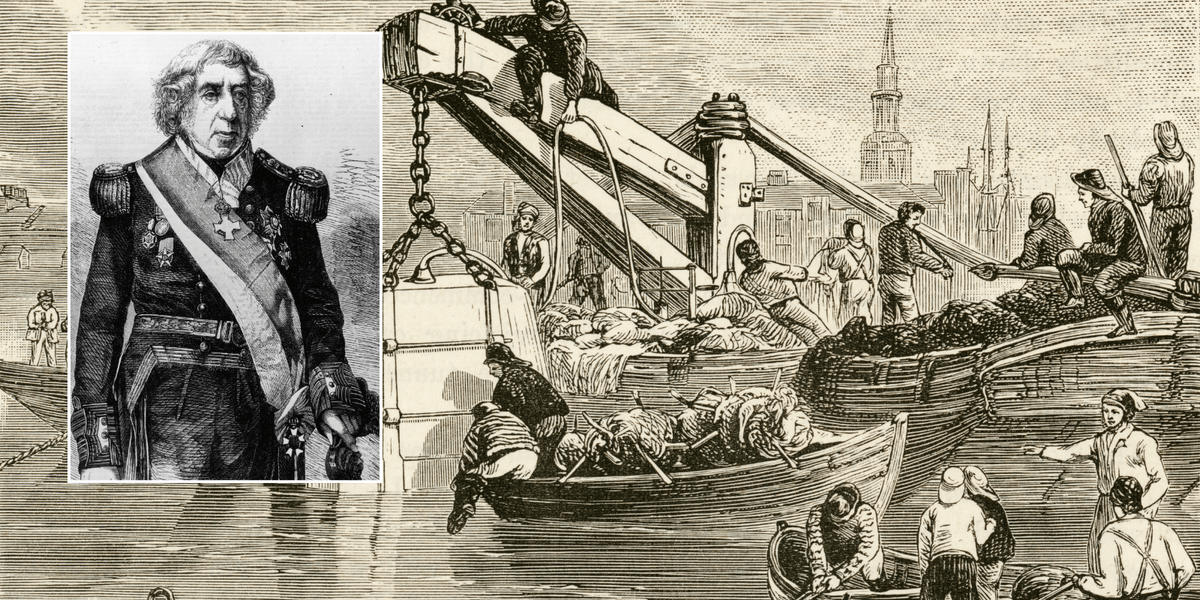
The 23-page memorandum reveals that Thomas Cochrane, a renegade Royal Navy commander, devised an audacious scheme to set alight vessels packed with sulphur, unleashing toxic fumes to disable crews of the American fleet.
Had it been carried out, it would likely have constituted the first chemical weapons attack in recorded history.
Cochrane was poised to sail across the Atlantic with his arsenal of weaponry when a stock exchange fraud conviction intervened, stripping him of his command and keeping him in Britain.
The memorandum, penned in 1844 by Mr Cochrane's secretary and bearing the commander's own handwritten annotations, was discovered by historian Peter Moore during research for a forthcoming book.
Cochrane was a Scottish aristocrat whose exploits during the Napoleonic wars earned him renown as one of the Royal Navy's most daring officers.
His real-life adventures proved so remarkable that Patrick O'Brian used him as the model for Jack Aubrey, the fictional captain later brought to the screen by Russell Crowe in the 2003 film Master and Commander.
Beyond his combat record, Cochrane was a restless innovator. Following a 1809 fire ship assault on Napoleon's Atlantic fleet, he devoted years to experimenting with unconventional armaments, devising concepts such as "rocket rafts," "explosion ships" and smoke screens.
The sulphur weapon idea occured during a visit to Sicily in 1811, where he witnessed the noxious gas produced by the island's sulphur mines.
As Mr Moore explained: "Something clicked in Cochrane's head that you could use this gas as a weapon of war. It would go straight through all defences — there would be no forts, no batteries or anything that could defend against it."
In 1812, Cochrane laid out his proposals before a "secret committee" comprising senior military figures and royals, among them the Duke of York and the Prince Regent, who would later be crowned George IV.
While Britain had previously contemplated deploying so-called "stink vessels" during the wars against Napoleon, the planned use of such weapons against the United States had remained entirely unknown until now.
The committee's verdict was emphatic. As Cochrane recorded in the memorandum, titled 'Statement of Claims': "[The committee] gave their opinion that under the circumstances detailed in my explanatory Paper, such mode of attack would be irresistible."
Yet the panel also recognised the dangers of the scheme becoming public knowledge, warning that "these plans if divulged, might prove perilous to our colonial possessions."
Cochrane was subsequently summoned to Carlton House by the Prince Regent himself and ordered to maintain absolute secrecy. "I obeyed," he wrote.
When hostilities with the United States commenced, Cochrane's uncle, Vice-Admiral Alexander Cochrane, received the appointment of naval commander-in-chief for North America.
Thomas was designated his flag captain, effectively his second-in-command, and assigned to take charge of HMS Tonnant.
In the memorandum, Cochrane made clear that his uncle "intended, in the event of circumstances proving favourable, to adopt" the new method of attack, and was particularly keen for his nephew to accompany him across the Atlantic for precisely that reason.
The precise target for the sulphur ships remains uncertain, though the memorandum hints at New Orleans, Baltimore or New York as possible locations.
Thomas Cochrane was on the verge of departing when the stock market scandal broke and he was found guilty of fraud, permanently derailing the operation.
Britain went on to burn Washington but suffered a crushing defeat at New Orleans before the war concluded in 1815.
Cochrane himself was convinced the outcome of the conflict would have been transformed.
"Most confident I am that had not my views at that time been so cruelly and unjustly frustrated by a false accusation (depriving me of my command and preventing my joining the Fleet) the result of the late American War would have been very different," he wrote.
Moore, who spent three years researching Cochrane and has also authored a history of Captain Cook's recently identified ship Endeavour, stressed the extraordinary implications of the discovery.
It would have been an unbelievably shocking moment if he'd used those sulphur vessels a century before the First World War," he said.
"Can you imagine if something like that had happened? It would have been one of the most shocking moments in military history, I think."
Despite the fraud conviction, Cochrane went on to forge distinguished military and political careers, serving as a mercenary admiral who established the navies of Chile and Brazil.