






Clowns have been seen entertaining illegal migrants in France as they wait to cross the Channel into Britain.
Volunteer clowns have descended to the frontline of the migrant crisis, Calais, to cheer up migrants as they wait to embark on the last leg of their journey.
Laurence Quetel, 67, alongside her team of entertainers did not seem to resonate with the queues on migrants at the Loon-Plage camp as hoped, the Telegraph reports.
As the clowns juggled and made slap-stick-style jokes, metres away were gangs of Kurdish people-smugglers gathering in tents, organising the next small boat crossing to the UK.
Ms Quetel, manager-turned clown, described the people-smugglers latest tactic, the "mega dinghy" as a necessary evil.
She said: "My first feeling was, I was happy that 230 people arrived in one batch without people dying... The second [feeling] was 's**t, how can they put them on there?'."
Removing her red nose before speaking to the Telegraph, she described how the smugglers cram women and children into the middle of the small boats, which come under significant strain, sometimes collapsing because of this.
"And you hear so many horrible stories, you have women and their kids who are separated from their husbands," the former manager at global electrical company, Philips, said.

Ms Quetel and her colleague at a migrant camp in Dunkirk in July, describing it as a 'beautiful and cheerful day'
|FACEBOOK / LAURENCE QUETEL
"So no, I am not happy with those big boats but if they did not have a big boat they could not go anywhere," she added.
France and Britain were left shocked on Monday morning after GB News revealed a 230-strong "small" boat had crossed the Channel.
Coined as a "mega dinghy", the vessel carried more people than a Boeing 737 and was larger than a London bus.
Ms Quetel began her clown career for migrants in 2016, when there was a surge of Syrian refugees coming to Europe to flee civil war.
LATEST DEVELOPMENTS
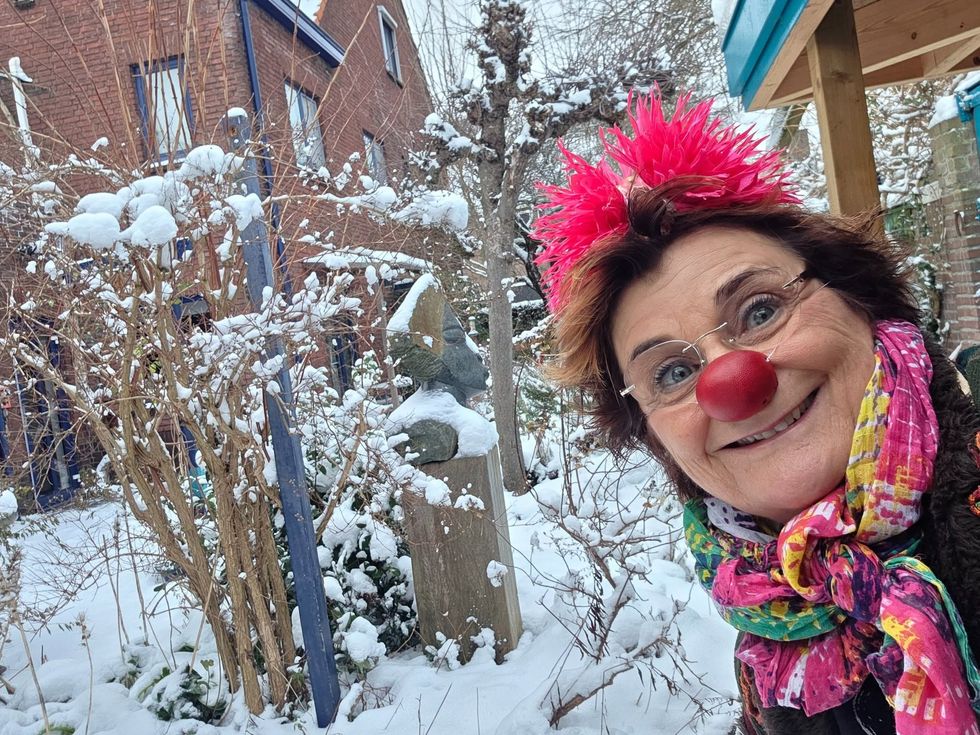
Ms Quetel trained as a clown in 2012, first being a hospital entertainer in the Netherlands
|FACEBOOK / LAURENCE QUETEL
She initially trained as hospital clown in the Netherlands, then setting up her own clown company, Inside Clown, in 2012.
On the company's website, an account of a trip to Grande-Synthe migrant camp, Dunkirk in 2025 can be found.
Ms Quetel wrote about how she adopted the clown name "Holala" and found the experience "nerve-wracking" due to there being "many adult men".
She wrote: "I found it nerve-wracking to stand alone in front of so many people —many adult men—but most were so open and friendly towards Holala that the tension soon disappeared."
The entertainer continued: "On Saturday afternoon, I visited refugee children at a shelter as the clown Holala.
"The children and Holala—the taxi driver of a magical wheelbarrow—traveled singing to England (of course!), Paris, and Hong Kong!
"The destinations were chosen by the children, and Holala got to push the wheelbarrow and sing. They often asked me to drive faster… et voilà, a fun clown dilemma!"
Ms Quetel and her two fellow clowns, Anne and Jeroen, have spent the past week at Loon-Plage working alongside Salam Nord, a Calais-based aid organisation that provides free food to migrants.
Describing her work, Ms Quetel said: "When I am here, I take a ball and I look at another pair of eyes, I suddenly know there is a communication where I can throw the ball, they take the ball and then I see the human being as an individual.
"This is a human thing and this is a beautiful thing to see."
She continued: "Despite all the hell they are going through, despite the rats, despite the fact they are treated like s**t, if you just have that micro-second, suddenly we are all back together.
"And that makes me so happy because I am an old woman and I am conscious of the value of it."
Daily life at Loon-Plage is bleak, with the rat-infested camp scattered with piles of rubbish.
Criminal gangs effectively control the site, splitting it into two distinct zones — one for migrants and aid workers, the other for smugglers.
Violence is a recurring problem at Loon-Plage, driven by periodic clashes between rival Kurdish and Afghan smuggling networks competing for control of the coastline.
On July 28 last year, a man in his thirties was shot seven times in what is believed to have been a gang-related killing.
A month earlier, two people died and six more were injured, including a woman and a two-year-old child, in a separate shooting.
Aid agencies and the gangs maintain an uneasy working relationship, with volunteers permitted to distribute food, medicine, washing facilities and life jackets.
According to one well-placed Kurdish source, this access comes with an unspoken expectation that volunteers overlook the gangs' criminal activity.