

You are about to be charged £0.00






United States' embassies in Israel, Qatar and Jordan have issued fresh security alerts.
The embassies, located in Jerusalem, Doha and Amman, urged US citizens in the regions to remain highly vigilant and prepare for potential flight cancellations, airspace closures and other travel disruption.
US President Donald Trump said the military is "striking Iranian targets near the Strait of Hormuz" momentarily, which is likely connected to why the embassies have issued warning.
Writing on Truth Social, he said: "The United States is, as we speak, striking Iranian Targets near the Strait of Hormuz.
"The strikes are large and powerful, and in retaliation for the Iranians’ failed attempt at adding sea mines to the Strait, which currently has no mines - they have been completely removed or detonated! - and the Iranians shooting eight missiles, all successfully knocked down, at our Military Base in Jordan.
"If the failed Nation of Iran retaliates for this very justified attack, they will be hit again at a much harder and higher level, but it will not be the biggest attack of them all, that is waiting in the wings and, when it is over, there will be very little left of the Islamic Republic of Iran!"
The embassies said the new alerts were "due to tensions in the Middle East, the security environment remains complex with the potential for unforeseen escalation".
The embassies said "US diplomatic facilities, including outside the Middle East, have been targeted.
 Iranian missiles heading towards US military sites in Jordan | REUTERS
"Iran and groups supportive of Iran may target other US interests overseas or at locations associated with the United States and Americans throughout the world, including US businesses and other institutions."
This comes after the US launched what officials described as a "limited, precise action" against Iran on Sunday.
It is the first US strike against Iran in over a month.
American forces targeted Larak Island, with officials saying the Islamic Revolutionary Guard Corps (IRGC) troops had been observed preparing to deploy sea mines into the Strait of Hormuz.
LATEST DEVELOPMENTS
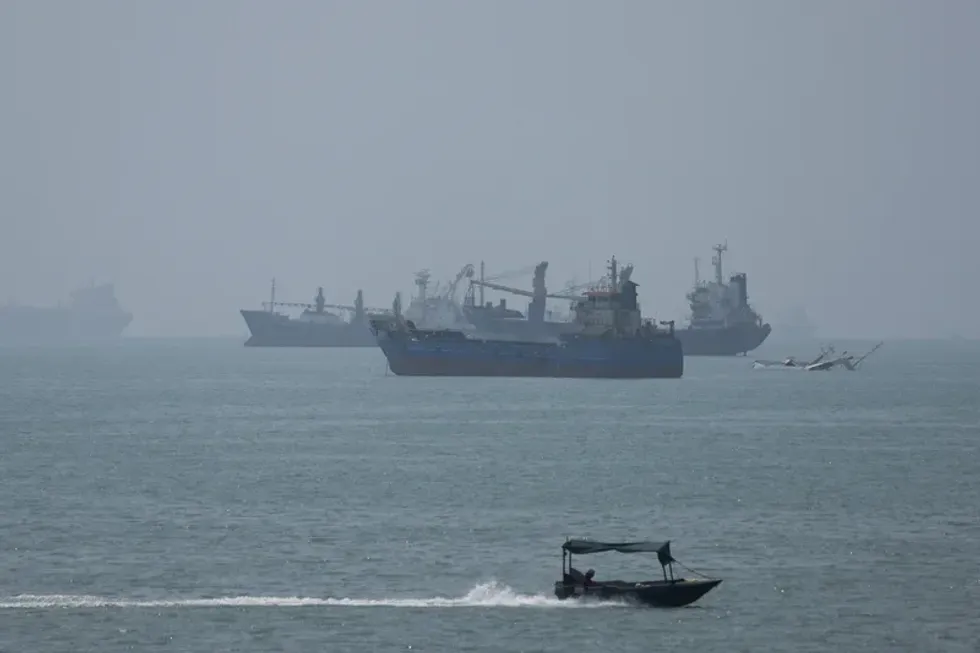
Vessels seen transiting through the Strait of Hormuz near Bandar Abbas on Friday
|REUTERS
In response, the IRGC warned the US "will pay for the attack" on "both economic and military fronts." Iranian state media also reported that several soldiers had been killed in the strike.
Larak Island lies within the Strait of Hormuz, close to Qeshm Island and the major port city of Bandar Abbas.
US Central Command (Centcom) said the strike targeted "minelaying forces posing an imminent threat" to the waterway, adding on social media: "In essence, Iran created the threat and the US military eliminated it to protect civilian mariners, commercial shipping, and the free flow of global commerce."
Iran has previously required tankers to divert past the island for inspection, charging fees of up to $2million (£1.5million) to pass.
The strike follows comments made last week by Mr Trump, in which he declared the Strait had been fully cleared of mines.
He warned any vessel found placing new mines would be "immediately and systematically destroyed".
Mr Trump has said the US Space Force is tracking "every square inch" of the waterway, describing a "zero tolerance policy on mine placement".
Control of the Strait, and its wider economic implications, has become a central issue in the ongoing conflict.
Last week, Washington launched what it called "Operation Economic Outcast".
This is a shift in its approach toward economic pressure on Tehran following reports of poor conditions endured by US sailors aboard the USS Abraham Lincoln.
Mr Trump has repeatedly claimed the Strait of Hormuz falls under US control, at one point suggesting it could become American "territory".
On Friday, the White House said Centcom's assessment confirmed "what Democrats and the Fake News have spent months denying: the United States — not the Islamic Republic of Iran — controls the Strait of Hormuz".
The IRGC Navy quickly disputed the claim, insisting it retained "full control" of the waterway and accusing Washington of attempting to manipulate oil markets.