Thank you for subscribing!
The targeting of Pride was a tragedy that represented a failure of epic proportions, writes political commentator Rakib Ehsan
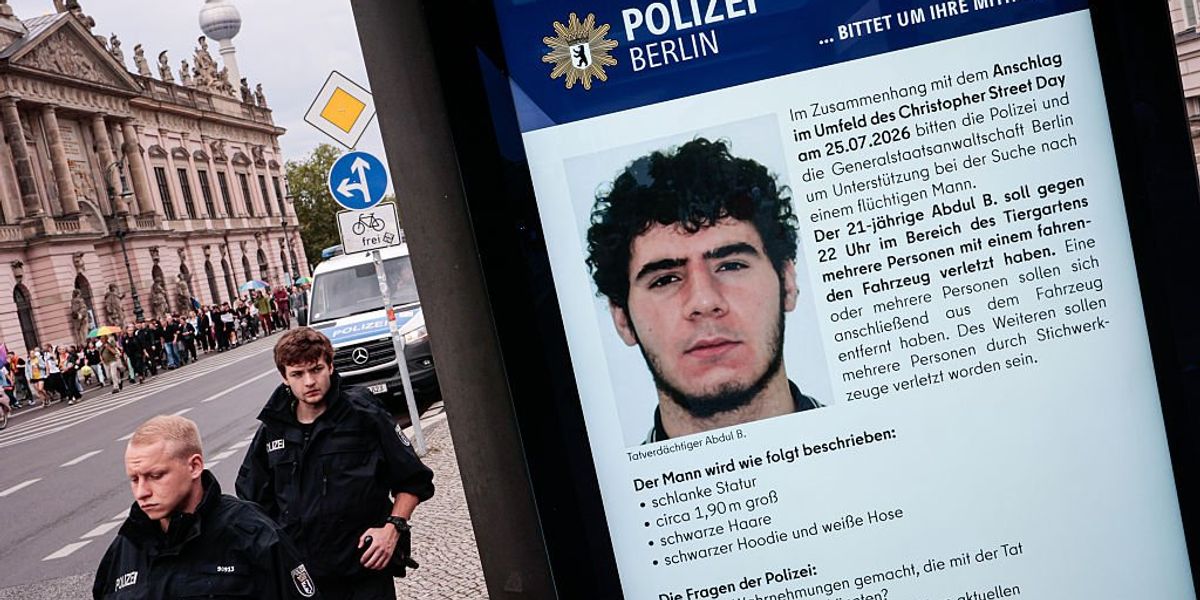
The deadly terror attack at Berlin Pride on Saturday night, which left one woman dead and at least 29 others injured, provides yet another brutal reminder the primary global terror threat comes in the form of Islamist extremism.
The main suspect, 21-year-old Abdul Ballout, was a German citizen of Lebanese heritage who was shot dead by police the following day after approaching them with a bladed weapon in an allotment garden.
The nation's interior minister, Alexander Dobrindt of Bavaria’s Christian Social Union (CSU), has revealed Ballout was known to the authorities due to his history of criminality, radicalisation and association with the German capital's Islamist scene.
Indeed, prosecutors have said back in 2025, Ballout tried to join Islamic State in Syria, passing through Turkey and Lebanon.
It is believed he met several members of the Salafist jihadist militant organisation in his country of origin, where he was arrested in July 2025 and sentenced to three months in prison for incitement to religious and sectarian conflict.
After returning to his country of birth, Ballout was arrested at Berlin Brandenburg Airport and put in pre-trial detention.
Just two months ago, a court in Berlin sentenced him to a juvenile sentence of one year and ten months for “preparing a serious act of violence endangering the state”.
This sentence was suspended while prosecutors were challenging the verdict on the grounds that Ballout had been shown far too much leniency – meaning he was released and subsequently placed under the supervision of a probation officer.
While Ballout’s family's migratory background remains somewhat unclear, Germany’s Lebanese-origin population began to grow significantly following the start of the civil war in Lebanon in 1975 – with this being a steady flow of migration until its end in the early 1990s.
Sizeable Lebanese-heritage communities reside not only in Berlin but also in other cities such as Essen, Bremen and Hanover.
The story of Lebanese integration in Germany is mixed for a population which is now estimated to be more than 180,000 in the country.
There are certain segments of the German-Lebanese population which are essentially extended family clans which have self-segregated and evolved into parallel communities which are hostile towards state institutions and do not necessarily share the mainstream’s liberal democratic values.
Hezbollah, the Lebanese Shia Islamist political party with a paramilitary wing, has traditionally been one of the main active political forces among German-Lebanese people – even though it was banned in the country back in 2020, with the police carrying out raids on mosques and centres linked to the group.
The Berlin Pride Islamist terror attack is yet another sorry European tale of failed integration, law-and-order softness and complacency over Islamist extremism.
As an unapologetically socially conservative Muslim, I firmly believe that there has been LGBTQIA+ overreach in our public institutions and the likes of Stonewall have had far too much influence at the heart of government.
There is also a sense the Pride movement, as well as its associated flags and emblems, is, at times, forced on the wider population.
But these are matters that should be thrashed out by law-abiding civil society, debated in democratic arenas and expressed through peaceful protest – the Islamist terrorist violence unleashed on Berlin Pride was utterly despicable and has no place in a civilised society.
This was a tragedy that represented a fundamental system failure of epic proportions – it could have been avoided because Ballout, who clearly posed a dangerous threat, should not have been free to carry it out in the first place.
Germany, like other European countries, including our own, must re-evaluate its law-and-order policies concerning the prevailing terror threat of Islamist extremism – and the collective public safety of law-abiding citizens must be prioritised over the individual rights of radical convicts.