Thank you for subscribing!
the former First Minister of Northern Ireland has criticised the US President's intervention
First Gordon Brown, now Donald Trump. Northern Ireland does not need outsiders casually deciding its constitutional future for us.
I am beginning to wonder whether commenting on a united Ireland has become the latest fashionable pastime for politicians who neither live in Northern Ireland nor appear to understand the Belfast Agreement.
A fortnight ago it was Gordon Brown declaring Irish unity “inevitable”. Now President Donald Trump has joined him.
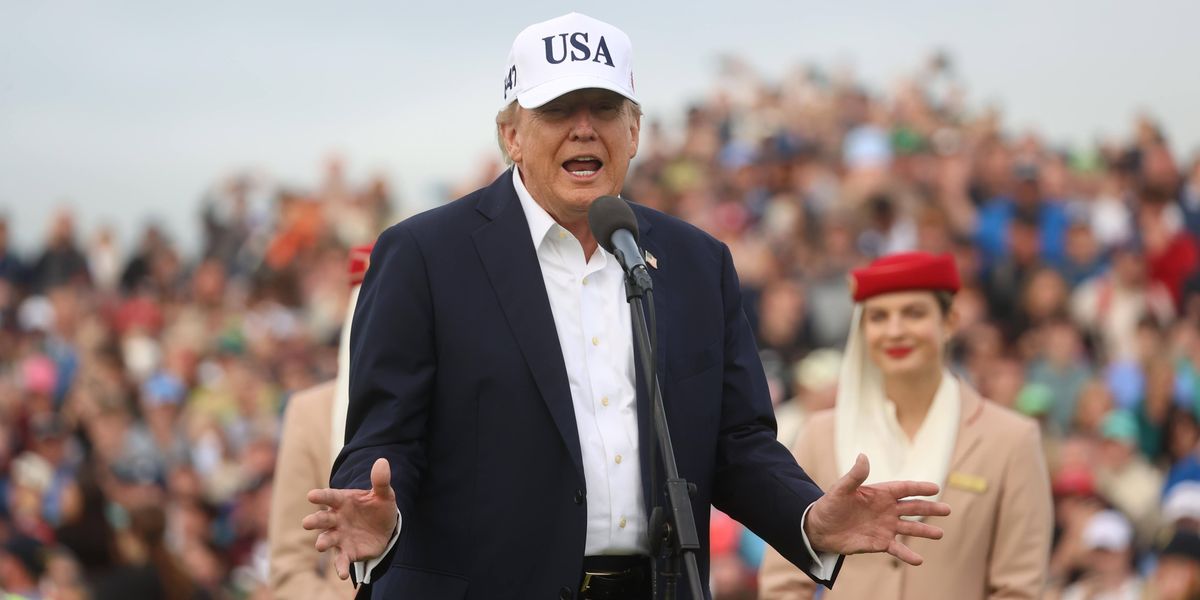
Speaking in Dublin today, President Trump said he would “love” to see Ireland unified, that he believed it was “going to happen eventually” and that it would be “a fantastic thing”.
He did at least concede that the United Kingdom might “have something to say about it”.
I am tired of politicians with little connection to the everyday realities of Northern Ireland casually speculating about our constitutional future, particularly when those comments appear designed principally for political audiences elsewhere.
Gordon Brown should know better. He was Chancellor when the Belfast Agreement was reached in 1998.
Perhaps we should also remember that America goes to the polls in the midterm elections on 3 November.
There is a substantial Irish-American population in the United States and generations of American politicians have understood the political value of displaying their Irish credentials. With control of Congress at stake in November, it is hardly unreasonable to wonder whether President Trump's sudden enthusiasm for a united Ireland has rather more to do with American electoral politics than with any detailed understanding of Northern Ireland.
Irish America is not, of course, one homogeneous voting bloc. Nor would I suggest that constitutional politics in Northern Ireland will decide the US midterms. But politicians understand symbolism, and few symbols play better with sections of the Irish-American electorate than an American president appearing to champion the cause of Irish unity.
Northern Ireland's future is far too important to become a campaign soundbite aimed across the Atlantic.
There is also considerable irony in Sinn Féin welcoming any intervention from this particular President.
Sinn Féin has boycotted President Trump's White House St Patrick's Day celebrations because of his administration's policies towards Israel. Yet I suspect there will be rather less hostility towards him now that he has endorsed Sinn Féin's central constitutional objective.
Apparently Donald Trump is beyond the pale until he says something Sinn Féin wants to hear.
The Belfast Agreement settled precisely how Northern Ireland's constitutional future should be determined.
The Agreement recognises the legitimacy of whichever constitutional choice is freely exercised by a majority of the people of Northern Ireland. Northern Ireland remains part of the United Kingdom unless and until a majority of its people votes otherwise.
The legislation implementing the Agreement is equally important. The Secretary of State must order a border poll if it appears likely that a majority of those voting would express a wish for Northern Ireland to cease to be part of the United Kingdom and form part of a united Ireland.
That is not a minor technicality. It is one of the foundations upon which the political settlement was built.
The Agreement does not say that Donald Trump decides when Irish unity is inevitable. It does not say that Gordon Brown does. It does not say that Sinn Féin does.
There is currently no demonstrated majority for constitutional change.
In the absence of that, politicians should concentrate on making Northern Ireland work rather than continually destabilising it by predicting its demise.
Nor is Irish unity some inevitable consequence of geography.
That was the extraordinary weakness in Gordon Brown's argument and it remains so today. Geography is not political destiny.
Northern Ireland is politically, economically, socially and culturally intertwined with the rest of the United Kingdom. Our NHS, welfare state, Armed Forces, currency, taxation system and much of our economic life operate within the UK.
There are also serious questions about what leaving the United Kingdom would actually mean.
The Republic of Ireland remains militarily neutral while the United Kingdom is one of NATO's principal military powers. At a time when Europe faces its most dangerous security environment for generations, people in Northern Ireland are entitled to ask precisely what constitutional change would mean for their defence and security.
Those questions cannot simply be wished away beneath slogans about an inevitable united Ireland.
Most importantly, however, President Trump, Gordon Brown, Sinn Féin and everyone else need to remember something fundamental.
Its constitutional future belongs to the people who live here.
The Belfast Agreement was a compromise. Nationalists accepted that Northern Ireland's status could not be changed without majority consent. Unionists accepted that if a majority ever freely chose a united Ireland, that democratic decision would have to be respected.
Those who claim to support the Belfast Agreement should therefore stop trying to rewrite its terms.
President Trump is entitled to his personal opinion. So is Gordon Brown.
And until they say otherwise, Northern Ireland remains an integral part of the United Kingdom.