Thank you for subscribing!
The United Kingdom is not a temporary arrangement awaiting demolition, the US commentator writes
I am a Trump loyalist of the first order, so I never expected to write this: I was shocked to hear President Trump talk about Irish reunification as though Northern Ireland’s future were inevitable.
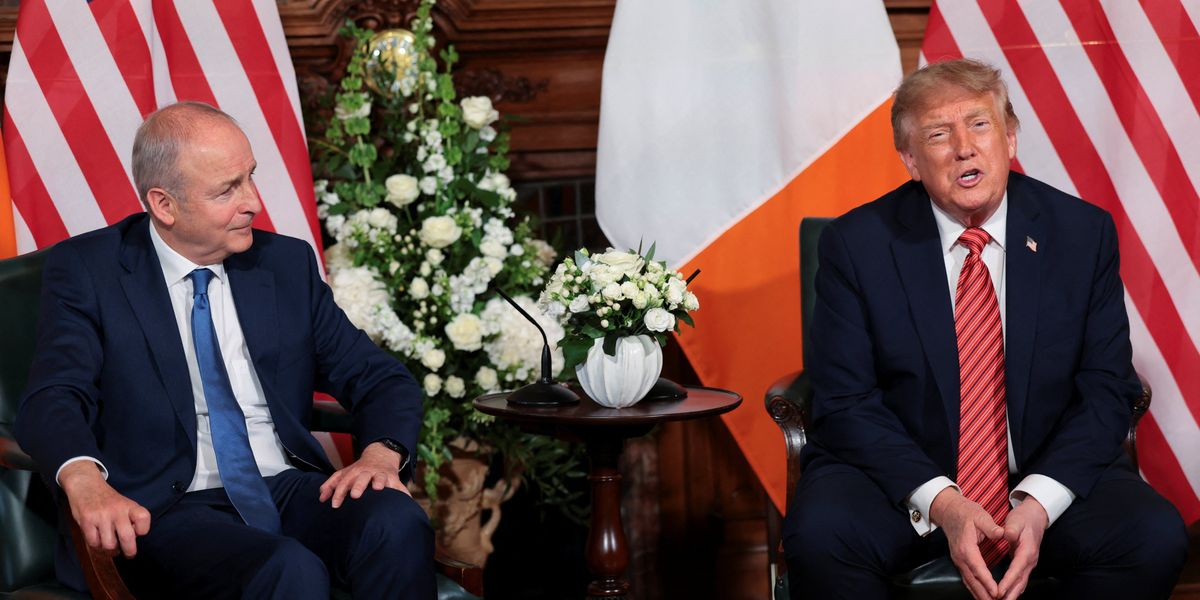
During his visit to Dublin, Mr Trump said he would “love to see” Ireland unified.
He called it “fantastic”, a “great feather in everybody’s cap” and said it was “going to happen eventually” — so it “may as well happen now”.
He acknowledged the UK would have something to say, then asked: “How can it be bad?”
I'm normally an ardent supporter, but hearing that, I could only cringe.
Did nobody brief the President on Northern Ireland’s history?
Partition followed generations of conflict over sovereignty, identity, religion and allegiance. The six counties selected for Northern Ireland contained an overall unionist majority, alongside a substantial nationalist minority.
The Troubles cost more than 3,500 lives. They were not ended by one side being declared the winner.
The main phase was largely brought to an end by the Good Friday Agreement and the political process that followed. Its foundation was consent.
Northern Ireland remains part of the United Kingdom unless a majority in a border poll chooses otherwise.
A poll is not triggered because an American president thinks reunification would be “fantastic”.
The Secretary of State must direct one if it appears likely that a majority of those voting would choose for Northern Ireland to leave the United Kingdom and form part of a united Ireland, subject to the statutory rules governing such a poll.
The Agreement requires consent freely and concurrently, North and South.
No border poll has been called, and none has been held since the Good Friday Agreement. That is the present democratic reality.
The 2021 census recorded more people from a Catholic background than from a Protestant or other Christian background, but neither group formed a majority. That does not change the constitutional position. Religion is not a referendum.
A Catholic can be British; a Protestant can support Irish unity; either can identify as Northern Irish. The census does not measure referendum voting or settle allegiance.
Nor is Irish unity simply arithmetic. It would raise questions about taxation, healthcare, education, policing, pensions, representation and citizenship.
It would affect people who regard themselves as British and do not want their identity subordinated to another state.
Anyone demanding a poll should explain why unity is desirable, how it would work and who would bear its costs.
Unionists are not an obstacle standing in the way of history. They are entitled to have their British identity and constitutional preference respected.
The Agreement protects the right to identify as British, Irish or both.
I do not believe Irish unity would be “fantastic”. I believe the United Kingdom is stronger, safer and more prosperous when its nations remain together.
Northern Ireland’s British identity is not an accident politicians are expected to outgrow. It is a living identity, held by hundreds of thousands, and deserves more than a presidential shrug.
I have spent much of my career defending the Special Relationship. It encompasses the Five Eyes intelligence cooperation, Nato and defence ties, nuclear cooperation and a relationship shaped by two world wars and the Cold War.
But friendship between nations also requires respect for sovereignty.
Imagine a British prime minister visiting Washington and declaring that California or Texas was eventually going to leave the United States.
Imagine him calling that “fantastic” and saying they might as well get on with it.
Americans would hear a foreign leader discussing the dismemberment of their country. Unionists deserve the same courtesy.
This is difficult to say because I have defended President Trump on principles that make his comments so disappointing.
I celebrate his insistence that borders matter, that nations must put their interests first and that sovereignty is not an embarrassing relic.
Mr Trump championed Brexit because Britain had the right to decide its future. Quite right.
That respect for self-determination must extend to people in Northern Ireland who identify as British.
Northern Ireland’s future must be decided through the consent mechanisms agreed by the people of these islands - not declared in advance by London, Dublin or Washington.
Nor should it be called inevitable by a world leader beside the Irish Taoiseach.
If the people of Northern Ireland eventually vote for a united Ireland, that decision should be respected. But until they do, the United Kingdom is not a temporary arrangement awaiting demolition.
Northern Ireland is not a prize or a demographic calculation. It is home to people whose British identity is as real as the Irish identity of their neighbours.
He understands that borders are not lines to be erased whenever politicians find the symbolism attractive.
Why, then, is the point lost that Northern Ireland’s future belongs to its people?
Until they - and only they - decide otherwise, Northern Ireland remains British.