
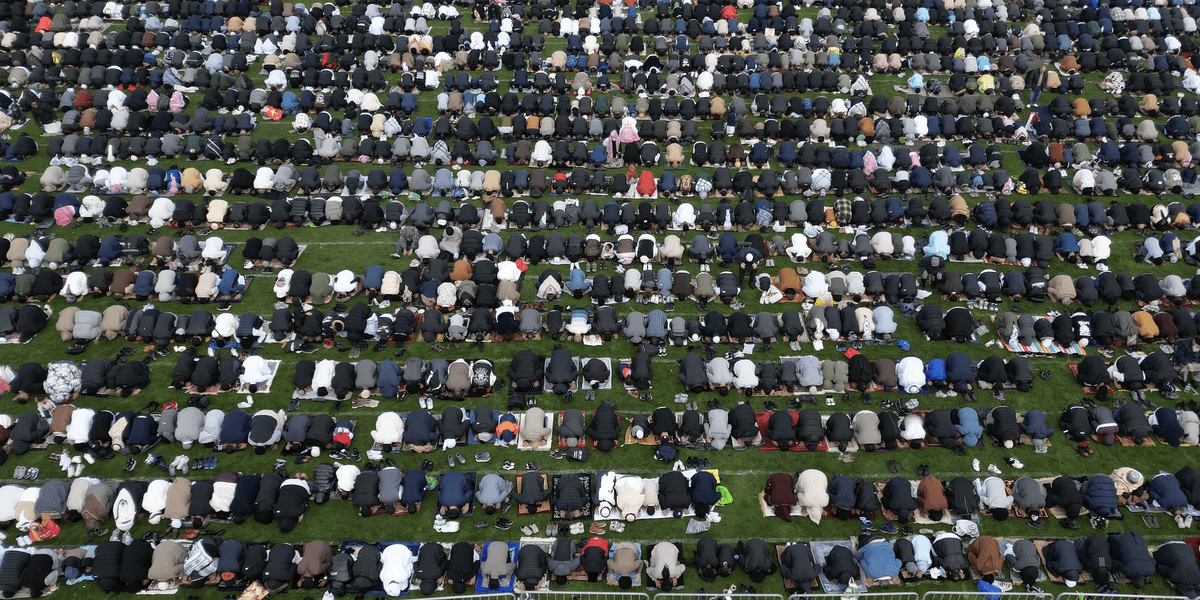
British-born Muslims are more likely to prioritise their faith than their foreign-born elders, writes the independent researcher and writer
When I completed my PhD back in 2018 on integration, never did I think it would become such a hotly debated topic in Britain.
Of course, even back then, we had long-standing problems surrounding admittedly sensitive matters of immigration, integration, and identity – with 9/11 and the subsequent so-called ‘War on Terror’ exacerbating social tensions in certain parts of the country.
This included my hometown of Luton, which witnessed the Islamist ‘Butchers of Basra’ demonstrations and the subsequent creation of Tommy Robinson’s English Defence League (EDL).
In some ways, Britain remains in a better position than many of its Western counterparts when it comes to cohesion and integration.
The former Archbishop of Canterbury, Rowan Williams, recently expressed his fears that there was something “demonic” in contemporary American political culture – he has a point.
While it should be noted that the ethnic-minority populations of Western Europe are incredibly diverse, it is safe to say that migrant integration outcomes are generally stronger in the UK when compared to European peers such as France, Germany, and the Netherlands (in large part due to the UK’s dynamic education system and flexible labour market).
Indeed, the March 2021 Sewell report on race and ethnic disparities concluded that “the success of much of the ethnic-minority population in education and, to a lesser extent, the economy, should be regarded as a model for other White-majority countries”.
But all is not well in the UK – being a relatively well-integrated and cohesive society in the western world is like being one of the better sides in the Europa League, as opposed to the Champions League.
One of the most under-reported developments in Britain is the fact that many younger Muslims are, in many ways, very well integrated – in terms of academic performance, holding well-paid professional jobs, and owning a home.
They tend to be very politically engaged – over both domestic issues and international affairs. But it appears that many are finding their true home in their Islamic faith – both disillusioned with the liberal secular individualism of modern
British society does not necessarily have the strongest ethnic identity connected to its faraway ancestral homelands. These younger British Muslims are educated, tech-savvy, well-resourced, deeply political, and have their religion at the heart of their personal being.
Modern Britain is at a crossroads – a curious mix of becoming more secular, less Christian, and witnessing the rise of an increasingly influential Islamic conservatism which is based on ‘selective integration’.
And truthfully, who could blame them when living in a society where there are an estimated 300,000 abortions a year, out-of-wedlock births have been normalised, and millions of the elderly often find themselves feeling lonely?
There needs to be fresh thinking on integration. One of the greatest challenges is whether a bridge can be built between traditional British nationalists and Islamic social conservatives who may share similar social concerns over various forms of moral decay, but are largely at odds over the growing presence of Islam in the UK.