Thank you for subscribing!
GB News also understands party officials are continuing to weigh up plans to stack the Upper House with up to 500 new members
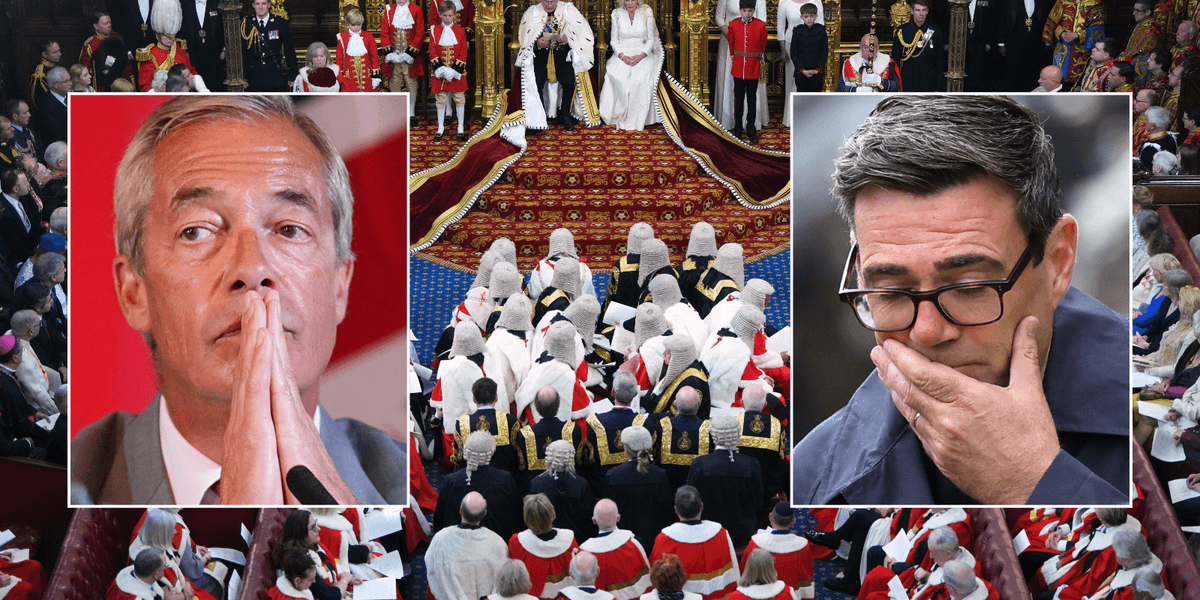
Andy Burnham has been told to allow Nigel Farage to appoint peers to the House of Lords after Sir Keir Starmer “unjustly denied” the Reform UK leader the right to nominate supporters for honours.
Sources from across the political spectrum said Mr Farage is entitled to complain about the “democratic disparity” in Parliament, suggesting it was unfair parties with fewer MPs in the House of Commons were represented in the 770-member-strong Upper House.
Reform UK currently has eight MPs – including Mr Farage – and two regional mayors, as well as control of 24 councils across England.
The party has also retaken the lead from Labour in the latest YouGov poll after Mr Farage was re-elected as MP for Clacton last Friday.
Despite inviting opposition parties to put forward candidates for peerages, No10 has yet to grant Reform UK a single seat in the Lords, with Mr Farage claiming Sir Keir was “part of a political establishment determined to crush dissent”.
His views were dismissed by John Healey, the Chancellor, who told LBC radio Parliament would not benefit from “more (Vladimir) Putin apologists”.
Downing Street is under no constitutional obligation to approve nominations for members of smaller parties before the House of Lords Appointments Commission vets them.
But Tom Brake – the former Liberal Democrat minister and Chief Executive of Unlock Democracy, a pressure group actively campaigning for an elected second chamber – admitted there is now a “strong case” for Reform UK backers being elevated to the crimson benches.
Speaking to GB News, Mr Brake said: “I think given the level of support for Reform UK around the country, given the number of local councillors and MPs, they are entitled to representation in the Lords.”
During his two-year reign as prime minister, Sir Keir recommended dozens of peerages to strengthen government representation in the Lords.
Between July 4, 2024, and July 20, 2026, no fewer than 78 Labour peerages were created – including former donors such as Lord Ali – while the Conservatives were given 42 new members and the Liberal Democrats 17.
Rafe Heydel-Mankoo, co-author of Our House: Reflections on Representation and Reform in the House of Lords, said Mr Burnham has “no excuse” for denying Mr Farage this time round and accused Labour of filling the chamber with “cronies”.
The historian told the People’s Channel: “It would be unprecedented for a party to form a Government and yet be so under-represented in the Lords.
“I think it is essential the party be given some sort of representation in the Upper House, (but) whether Mr Burnham will do that, of course, is another matter entirely.”
Currently, the Conservatives are the largest party group in the Lords, with 245 eligible peers, along with 217 Labour peers, 154 crossbench peers, 74 Liberal Democrat peers, 24 bishops and 56 other peers – including six from the Democratic Unionist Party, three from the Greens and two from Plaid Cymru.
In January, Reform UK lost its only peer after Lord Malcolm Offord – the party’s leader in Scotland – resigned his seat to run in May’s Holyrood election.
Lord Philip Norton, a Conservative life peer and Director of the Centre for Legislative Studies at the University of Hull, agreed all parties represented in the Commons ought to be reflected in the makeup of the Lords.
He told Britain’s News Channel: “I think the House would have no objection to having some Reform UK members, because we benefit from diversity in terms of background but then in terms of politics as well.
“(The Lords) add value because of the dimension of the experience and the expertise of members that can be brought to bear in scrutinising legislation.”
Lord Nicholas True, the Tory leader in the Upper House, also supports the idea of Reform UK peers, telling The Telegraph: “The beauty of (our) House is its complete freedom. So (if) any peer here wants to put down an amendment, that amendment must be heard. Having somebody from a party that is represented in the Commons to take a detailed part in examination and to put forward that party’s point of view, I think, is a sensible constitutional principle.”
Meanwhile, Reform UK is formulating plans to bypass the Lords to push through its radical agenda if it wins power amid fears peers will hold up its legislation.
GB News understands party officials are continuing to weigh up plans to stack the Lords with up to 500 new members to compete with the established parties – despite Mr Farage once calling for the abolition of the Upper House.
Danny Kruger, the Reform MP who has been put in charge of the party’s vision for Whitehall, told the Policy Unstuck newsletter he would revive cabinet committees as meaningful decision-making forums to speed up legislation and overcome the “essentially broken” model of governance.
Mr Brake commented: “It seems as though Mr Kruger is proposing a dictatorship where bills are rammed through and hundreds of peers are appointed so there are no objections in the Lords and those bills end up on the statute book. I think the public will look very bleakly on that prospect, because the public does not rate the Lords very highly as it is.”
Mr Heydel-Mankoo added: “There is no power preventing Mr Farage from appointing as many peers as he wants. That, of course, would create a political storm. It is essential for a government to have a large number of representatives in the Upper Chamber. A bicameral system is fundamentally important, I think, for proper democracy… otherwise, you just have crude majoritarianism.”
Under the Salisbury Convention, the Lords traditionally refuse to block bills which implement a manifesto commitment.
However, peers have the power to delay a bill for approximately a year and strike down clauses, resulting in proposals moving back and forth between the upper and lower chambers in a process dubbed “parliamentary ping-pong”.
In 2023, Rishi Sunak’s administration was forced to amend the Illegal Migration Act, adding more “safeguards” for children of asylum seekers, after the draft legislation suffered 20 defeats in the Lords.
Lord Norton reiterated the Upper House "is not the obstacle to making changes”, but stressed Reform UK will need some presence in the chamber “to marshal support for measures” among rival peers.
He said: “It is not an unprecedented situation for a government to come in and not have many members in the Lords. It is not an insurmountable obstacle. A principle in the Lords is no one party ever has an absolute majority of seats. You've got to carry others with the House. That's what gives the Lords leverage.”
A senior Reform UK source told the People’s Channel: “It is time for Nigel Farage to be given the opportunity to nominate peers based on the public vote and their high profile. It is only fair… and it has been unjustly denied to Ukip and the Brexit Party before Reform UK.”
A Downing Street spokesman previously said: “The process for appointments to the House of Lords follows established conventions and is guided by advice from the House of Lords Appointments Commission and other relevant bodies.
“While political parties may make representations regarding peerage nominations, decisions are made in line with long-standing procedures.”