
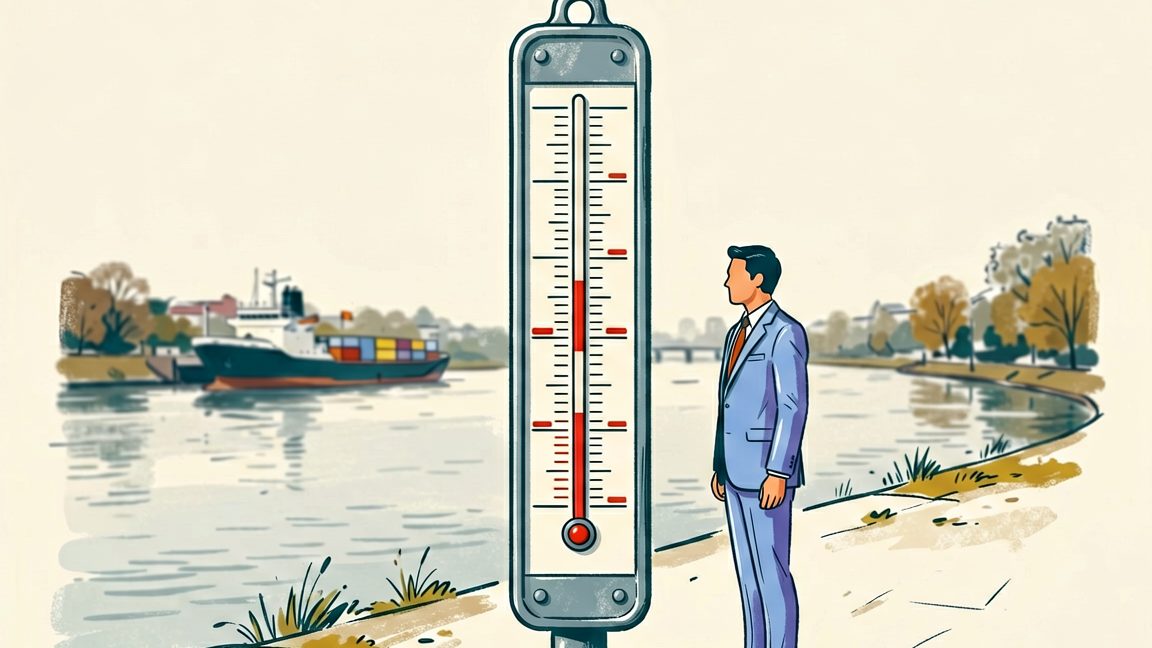
On the night of 17‑18 August 2026 the Rhine at Kaub recorded a water level of just 6 cm, the lowest reading since the start of detailed gauge records. Official data released by German authorities confirmed the figure, and the German inland‑shipping association immediately warned that traffic is impossible at single‑digit levels. The result was a complete halt to river freight on the Kaub stretch of the Rhine.
Record low water level confirmed by gauge data
The official gauge at Kaub showed a water level of six centimetres on the night of Friday to Saturday, 17‑18 August 2026. The measurement is described in Handelsblatt as "so niedrig wie noch nie seit Beginn der detaillierten Aufzeichnungen" – the lowest ever since detailed measurements began.
"In der Nacht von Freitag auf Samstag lag der Pegelstand offiziellen Daten zufolge nur noch bei sechs Zentimetern, so niedrig wie noch nie seit Beginn der detaillierten Aufzeichnungen." – Handelsblatt
Below six centimetres the navigation channel remains technically deeper, but the water is "definitiv zu flach für die Binnenschiffe" – definitively too shallow for inland vessels.
"Unterhalb der sechs Zentimeter liegt die Fahrrinne zwar noch etwas tiefer, doch für die Binnenschiffe ist das Wasser endgültig zu flach." – Handelsblatt
The German inland‑shipping association had previously warned that "bei einstelligen Pegelwerten kein Verkehr mehr möglich sei" – at single‑digit water levels, traffic is no longer possible.
"Der Binnenschifffahrtsverband hatte zuvor erklärt, dass bei einstelligen Pegelwerten kein Verkehr mehr möglich sei." – Handelsblatt
Immediate impact on river freight
Because the Rhine is split into a northern and a southern section at Kaub, the low water effectively isolates the two halves. Vessels that normally carry bulk chemicals, steel, automotive components and other industrial goods cannot pass the Kaub gauge. The halt was confirmed on 18 August, when the inland‑shipping association stated that traffic was impossible at the recorded level.
While the gauge itself records only the water height, the practical implication is that barges – the workhorses of European inland logistics – cannot navigate the stretch. The stoppage means that cargoes destined for downstream ports such as Rotterdam or upstream depots in Cologne must be rerouted to road or rail, increasing transport costs and adding pressure to already strained logistics networks.
Why the UK should pay attention
Germany’s Rhine corridor supplies a substantial share of the raw materials and intermediate goods that feed factories across Europe, including many that export finished products to the United Kingdom. When river freight stops, manufacturers that rely on just‑in‑time deliveries face the risk of production delays. For UK importers of German chemicals, automotive parts or steel, the disruption could translate into longer lead times and higher freight costs as shippers shift to trucks or trains.
The Handelsblatt article notes that "der Pegelstand des Flusses ... hat Auswirkungen auf zahllose Unternehmen in ganz Deutschland" – the river’s level affects countless companies throughout Germany. By extension, any British company that sources components from those German firms may feel the knock‑on effect. The situation also highlights the vulnerability of supply chains that depend on a single transport mode for bulk goods.
While the article does not quantify the exact volume of UK‑bound cargo affected, the strategic importance of the Rhine for European trade is well established. A prolonged low‑water episode could push German exporters to seek alternative routes, potentially increasing the share of sea‑borne freight that passes through the North Sea and then onto UK ports – a shift that would add handling steps and cost.
Timeline of events
| Date | Event |
|---|---|
| 2026‑08‑17 | Heat‑driven drought lowers Rhine water levels. |
| 2026‑08‑17/18 night | Gauge at Kaub records 6 cm, historic low. |
| 2026‑08‑18 | Inland‑shipping association confirms traffic impossible at single‑digit levels; shipping effectively halted. |
| Source: Handelsblatt, https://www.handelsblatt.com/politik/deutschland/klimawandel-welche-folgen-haben-duerre-und-niedrigwasser-fuer-die-wirtschaft/100246824.html | |
What remains unknown
The exact duration of the halt is not yet clear. While the gauge showed 6 cm on the night of 17‑18 August, water levels can fluctuate rapidly with weather patterns. The German authorities have not provided a forecast for when the Rhine will return to navigable depths, nor have they indicated whether emergency measures – such as water releases from upstream reservoirs – will be employed.
Another open question is the scale of the economic impact. The Handelsblatt piece confirms that traffic is impossible at the recorded level, but it does not give a monetary estimate of lost freight value or the additional cost incurred by shippers switching to alternative modes. Analysts will need to wait for data from the inland‑shipping association or from logistics firms to quantify the effect.
Finally, the longer‑term implications for climate‑driven water scarcity on the Rhine remain a subject of debate. The current episode is linked to a heat‑driven drought, but whether similar lows will become more frequent is not addressed in the source material.
Looking ahead
Stakeholders across the supply chain are monitoring the situation closely. German manufacturers are likely to seek contingency plans, while UK importers may need to renegotiate delivery windows with their German suppliers. The incident underscores the importance of diversifying transport routes and building resilience against climate‑related disruptions.
Until water levels rise above the critical threshold, the Kaub stretch will remain closed to inland vessels. The next gauge reading will determine when freight can resume, and with it, when the ripple effects on European and UK supply chains will begin to recede.