Thank you for subscribing!
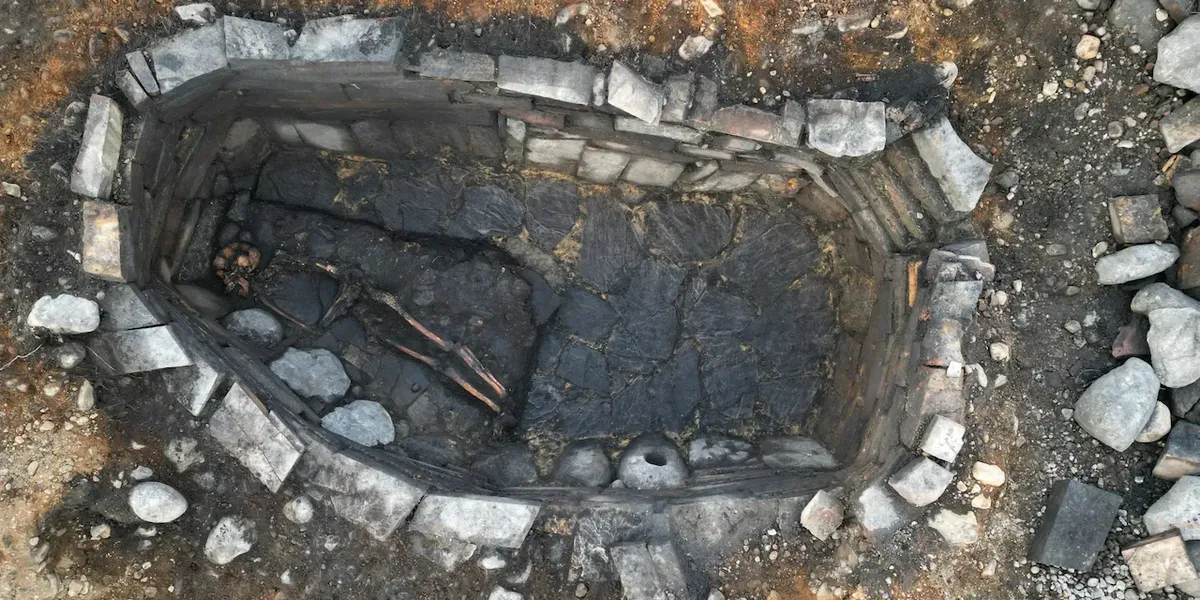
The skeleton is thought to have been deposited at the structure after its construction
Archaeologists have unearthed a puzzling stone-lined pit believed to date to roughly 2,000 years ago, in the Iron Age.
The oval structure, which measures approximately 3m in length, 2m across and 3m in depth, was uncovered during excavation work near Dornoch in the Scottish Highlands aimed at expanding a neighbouring quarry.
Inside, researchers found a prehistoric skeleton thought to belong to a woman, along with animal bones, burnt material including ash and charcoal, and half of a small soapstone bowl.
The pit featured expertly fitted stone walls, a floor of clay slabs, and shallow steps descending into it, yet its original function remains entirely unclear.
Lachlan McKeggie, director of Highland Archaeology Services, said: "The stones appear to have been expertly fitted together with no mortar to help hold them in place."
He noted that one wall stone had previously served as a mortar or grinder base, bearing a distinctive hollow worn into it before being incorporated into the structure.
Mr McKeggie stressed that the pit was unlikely to have been designed as a burial site, with the skeleton probably deposited there after its construction.
"It is a bit of a mystery. No one has seen anything like it before," he said, adding that it bore some resemblance to a souterrain or ritual well but did not conform to the typical shape of either.
He speculated that the structure might once have formed part of an above-ground building such as a roundhouse.
He said: "I like to imagine that it's an Iron Age hot tub but that is speculative. It will have been built with a purpose but we just don't know what that was yet."
The expansion of Evelix Quarry, which produces sand and gravel, received planning approval from Highland Council in December.
However, one stipulation attached to the consent was that an archaeologist must be present during groundwork, given the surrounding area's well-documented history of prehistoric finds.
It was during this mandated "watching brief" that the top of the pit first came to light.
Highland Archaeology Services initially weighed up whether the structure could be preserved where it stood, but ultimately concluded that exposure to weather conditions would destroy it after millennia spent safely underground.
The team instead carried out a thorough excavation, recording the pit in detail through notes, drawings, photographs and maps before removing its contents.
According to Mr McKeggie, the skeleton exhibited notable dental characteristics, including an underbite and significantly worn front teeth.
The remains have been dispatched to specialists who will attempt to establish the individual's age at death and how they died.
He said: "We have lifted everything, stored it, and are preparing it for dispatch. Eventually, once it has undergone a number of studies, it will be claimed by the Treasure Trove Unit and, hopefully, allocated to a local museum."
The Treasure Trove Unit, a small Edinburgh-based team of archaeological specialists, is responsible for overseeing the management of all historical objects discovered in Scotland.
Under Scots law, any newly found archaeological artefacts without a known owner automatically become Crown property, ensuring significant items are directed to public museum collections rather than private hands.