Thank you for subscribing!
The palace's Roman emperor owner was the final historical ruler to claim the ancient title of Pharaoh of Egypt
Archaeologists in Serbia have discovered a Roman emperor's lavish bath found hidden inside palace.
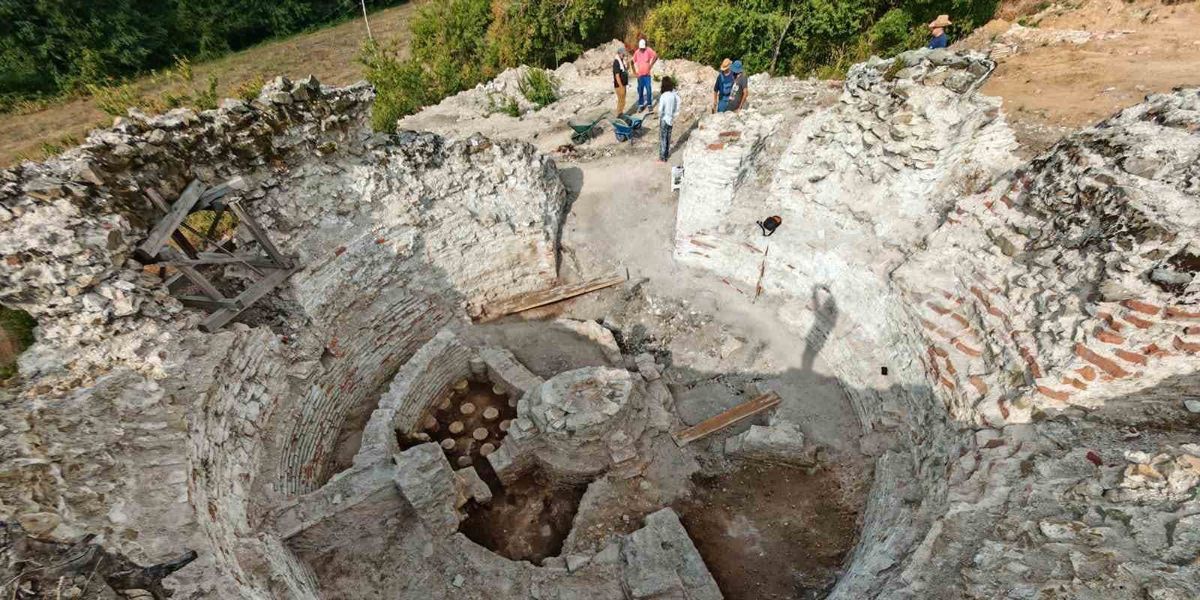
Excavating the fortified palace complex at Vrelo-Šarkamen in eastern Serbia, archaeologists have unearthed an opulent Roman bath concealed within the lowest level of a massive corner tower.
The bathing facility formed part of an imperial residence associated with Maximinus Daza, a Tetrarchy-era emperor who held power between 310 and 313.
Researchers from Serbia's Institute of Archaeology and the Museum of the Krajina, who led the latest phase of work at the early fourth-century site, said: "Its placement on the lowest level of the residential fortification's corner tower has no known direct parallel elsewhere in the Roman Empire."
The discovery was announced last week, adding to decades of investigation at the fortified residential complex.
The bath's layout follows the circular form of the tower itself, with a dome that once rose above the space featuring six roof openings to admit natural light.
Inside the facility, it is organised into distinct zones for bathing and relaxation on one side and technical operations on the other.
Three separate pools have been identified, alongside a sudatorium — a heated room functioning as a sauna.
The arrangement reveals a high degree of architectural planning, with the curved interior walls dictating the placement of each element.
An entrance on the eastern side links the bath to a paved corridor within the wider residence, though how occupants navigated a change in floor levels between the two remains unclear to the excavation team.
Beneath the bath's floors, a remarkably intact hypocaust system survives, offering researchers an unusually detailed picture of Roman heating technology.
Rows of small circular pillars held the floor aloft, creating channels through which hot air circulated to warm the rooms above.
A praefurnium — a dedicated furnace — supplied the heat and archaeologists also uncovered the stone base on which a copper boiler once sat.
The boiler itself has vanished, almost certainly stripped out because the metal was too valuable to leave behind once the building fell into disuse.
Intact Roman copper boilers are exceptionally rare - one well-known surviving example comes from Pompeii.
Service staff entered the technical area through a large western doorway, ensuring that furnace maintenance and fuel delivery remained entirely separate from the imperial bathing spaces.
The find builds on a rich history of discoveries at Vrelo-Šarkamen.
Some three decades ago, excavators working at the same complex uncovered an imperial mausoleum containing a remarkable collection of gold jewellery.
While the bath significantly expands understanding of the palace, several questions remain unanswered.
The function of rooms surrounding the tower has yet to be determined and the precise workings of the western service entrance still require investigation.
The well-preserved structures nonetheless give specialists a rare opportunity to reconstruct both the engineering and the everyday rituals of an imperial Roman bathing facility.
Further excavation is planned to establish how the bath integrated with the broader palace layout and how its singular tower-based design was used in practice.