Thank you for subscribing!
The find has astonished researchers with its scale and sophistication
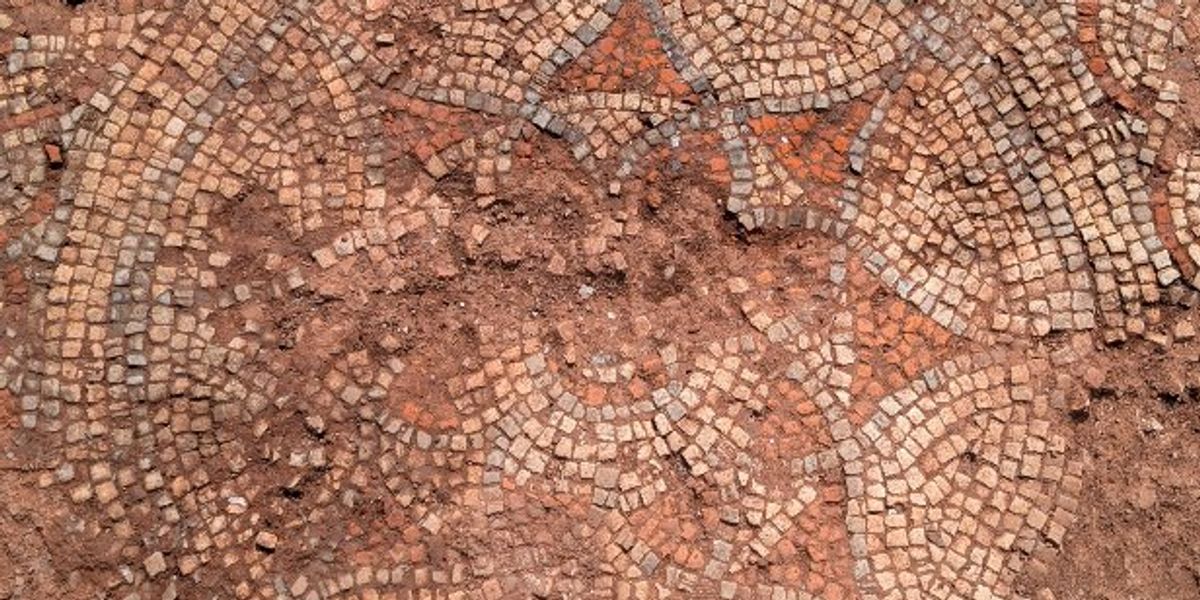
A remarkable fourth-century Roman villa has been unearthed beneath farmland in Devon, complete with what experts have confirmed is the most westerly polychrome mosaic ever discovered in a Roman villa in Britain.
The find, revealed today following a two-month excavation on land situated between the villages of Halberton and Sampford Peverell, has astonished archaeologists with its scale and sophistication.
Bill Horner, County Archaeologist and Historic Environment Manager at Devon County Council, said: "The polychrome mosaic is the most westerly example to have been found in a villa in Roman Britain. This, and the other trappings of Roman civilisation and evidence of affluence that have been found, show how much even this far-flung part of the province had been integrated into the Roman Empire."
Such lavish Roman dwellings are exceptionally scarce in this corner of the south-west, where only a small number of villas have previously been identified.
The 12-square-metre mosaic is composed of thousands of tiny stone cubes — each just 12mm across — in striking shades of red, white and dark blue-grey.
At its centre, the tesserae form a circular medallion depicting a stylised flower with eight overlapping teardrop-shaped petals. This is framed by interlocking squares and a twisted braid of paired knotted lines, a decorative motif commonly found in Roman floor designs.
Around the outer edges, coarser off-white limestone pieces were used, likely chosen to withstand heavier foot traffic in those areas.
Archaeologists believe the mosaic served as the floor of a dining or reception room — a space designed to impress visitors and reflect the status of its occupants.
Dr Susan Greaney, the project lead from the University of Exeter's Department of Archaeology and History, said: "From day one, it has offered us a wealth of interesting and sometimes surprising finds in addition to this striking polychrome mosaic."
Beyond the main dwelling, the team uncovered a substantial bathhouse featuring a minimum of two plunge pools constructed from opus signinum — a waterproof Roman concrete — along with walls adorned with painted plaster.
Dr Greaney said: "We did not expect to find such an elaborate bathhouse, for example. This villa was undoubtedly home to people of wealth and high standing."
Among the most striking individual finds was an intaglio — a blue glass ornament carved with an image of the goddess Victory, originally mounted in a ring and employed to press seals into wax documents.
A finely crafted copper alloy bangle was recovered resting directly atop the mosaic surface, whilst a silver-plated spoon emerged from one of the villa's rooms.
Pottery discoveries included an indented beaker for serving drinks, a Samian ware mortarium bearing a lion's-head spout found near the baths, and a large storage vessel.
The Share project — Saving Halberton's Ancient Roman Environment — is jointly led by the University of Exeter and Cotswold Archaeology, with backing from a National Lottery Heritage Fund grant.
The site was originally identified in 2004 by local metal detectorist John Hill, whose initial discoveries prompted the broader investigation.
Dan Sausins, the Project Officer leading Cotswold Archaeology's team, said: "The mosaic is naturally the standout discovery, but the metal artefacts recovered have also been outstanding and are a great advert for responsible metal-detecting, with detectorist John Hill — who originally identified this site — a key part of the success."
Dozens of community volunteers joined 65 university archaeology students and professional staff to excavate two large trenches across the site.
The initiative also operates as a partnership with Devon County Council, the Tiverton Archaeology Group and the Sampford Peverell Society.
Specialists are now in the process of carefully lifting the mosaic so it can be conserved and ultimately exhibited at Tiverton Museum of Mid-Devon Life, alongside the other recovered artefacts.
The excavation revealed the villa was considerably larger than initially anticipated, with evidence suggesting it was extended multiple times from its original modest rectangular form. Rooms were appended at both the northern and southern ends, whilst traces of a timber staircase hint that portions of the building may have risen to two storeys.
A rainwater gulley and additional walls discovered at the rear point to practical spaces likely used for storage or kitchens.
This summer's dig represents the first of three planned annual excavations, with subsequent seasons set to explore the wider estate on adjoining land.
Jacqi Hodgson, of Devon County Council, said: "This has been a once-in-a-lifetime chance for local people to get involved in a groundbreaking excavation of a Roman villa."