Thank you for subscribing!
A lunar strike at this scale may not be seen for another 132 years
An asteroid larger than St Paul's Cathedral smashed into the Moon in a rare "once-in-a-lifetime" collision, Nasa has revealed.
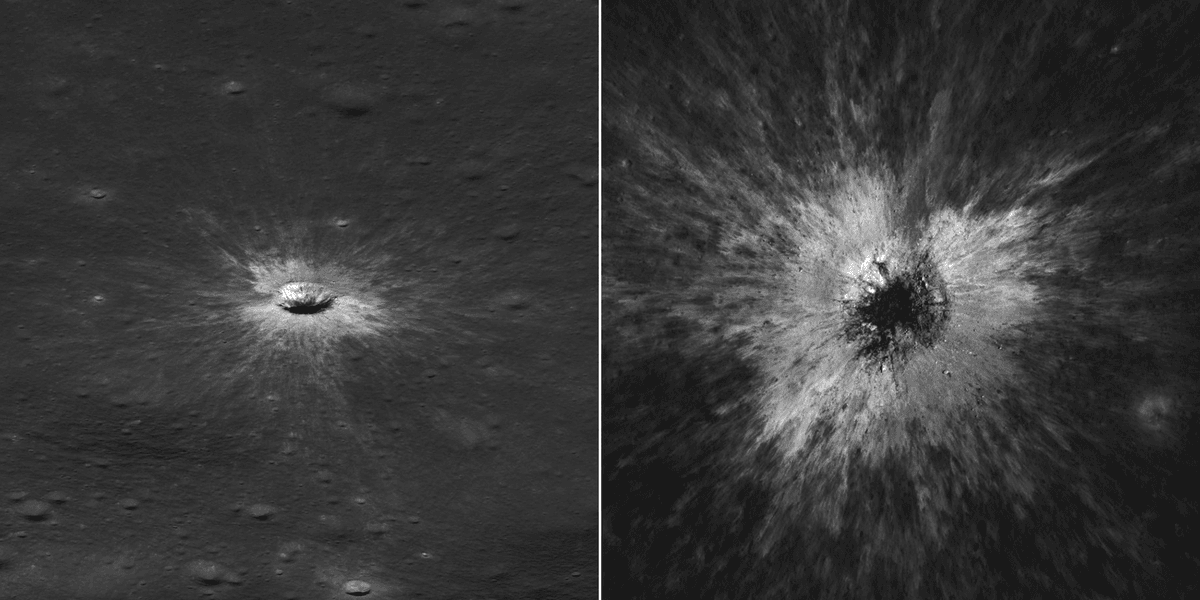
Robert Wagner, a scientist with Nasa's Lunar Reconnaissance Orbiter (LRO), was scanning a giant map of the Moon in May 2024 when he noticed an unusually large bright spot circled by a dark halo.
"I just stopped, dropped everything, and started looking into what that spot was," he has now revealed.
Researchers later determined it was a crater that spanned the length of two football pitches.
The massive indent is around 728 feet (222 metres) wide and up to 14 feet (43 metres) deep and created by a powerful impact.
The largest newly-formed crater, such an impact is estimated to only occur once every 132 years, researchers said.
Although newly-observed and analysed, the crater likely formed sometime between April 11 and May 22, 2024 after a comet or asteroid the size of a building up to six storeys high struck the surface, Nasa said.
"This event constitutes a statistically rare, effectively once-in-a-lifetime observation," scientists wrote in one of two studies on the subject in the journal Science Advances.
The crater has now been named after the late Thomas McGetchin, a former director of Houston's Lunar and Planetary Institute, is three time larger than the previous record holder.
But the actual collision escaped real-time detection by telescopes on Earth and in space.
LRO's wide angle images were not identified until August 2025, with more detailed images gathered last autumn, followed by confirmation of the discovery earlier this year.
The lunar strike agitated the surface of the Moon for more than 66 miles.
LATEST SPACE NEWS:
Dust and rocky soil was also thrown at a higher angle than expected, according to Mark Robinson, chief scientist for LRO's cameras and lead author for one of the studies.
In a separate study, a four-mile-wide cold spot around the crater was identified.
This is consistent with a loosening of the Moon's soil - the cooling happens because the impact disturbs a layer of loose rock, dust and soil around the crater, researchers said.
The area's density is then decreased and, therefore, less able to store heat, researchers said.
The extent of the cold spot proves impacts can modify the surface of the Moon far beyond the crater itself, the scientists added.
Mr Robinson told Sky News researchers now plan to calculate the risk of ejected crater material striking Nasa's planned Moon base.
But those plans may be delayed after Blue Origin's New Glenn rocket exploded on its launchpad.
Jeff Bezos's agency was granted an $188million contract for several missions crucial to the Moon base, including transporting two lunar rovers to the lunar surface in 2028.
Nasa administrator Jared Isaacman said in June it would "take some serious time" for the New Glenn launchpad to be repaired, but added its 2028 deadline was "within the realm of possible for recovery".