Nasa has urged Britons not to film the phenomenon on their phone as the once-in-a-generation marvel unfolds overhead
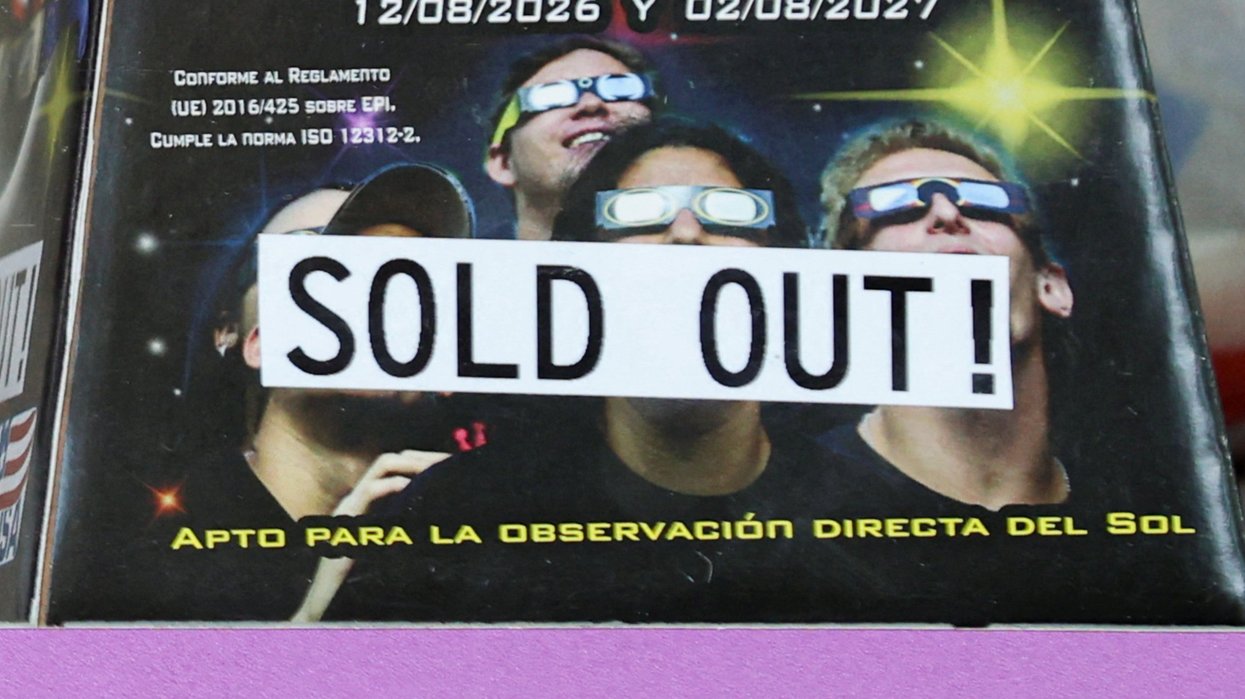
Britons may be unable to safely look at tonight's solar eclipse after specialist glasses went out of stock.
But those who do want to observe Wednesday's partial eclipse - the most significant since 1999 and the closest to totality until 2081 - can still do so.
Experts have warned enthusiasts to avoid looking directly at the phenomenon without specialist eyewear and not to use normal sunglasses or dark goggles.
These shades do not give enough UV protection when gazing directly at the sun, according to the Royal Astronomical Society.
Instead, those who lack specialist specs can use a colander to observe the partial eclipse, creating a series of images on a white piece of paper.
Eye specialist David Jones, , consultant ophthalmologist at the Royal Cornwall Hospital Trust, admitted this was his preferred way to look at the Sun.
"If you hold the colander to the Sun and you look away from the Sun, protecting your eyes, you can make not just one picture of the Sun but a hundred all at once," he told the BBC.
To view the eclipse through a colander, viewers can place a blank piece of paper behind the utensil and view a kaleidoscope of shadows unfold below.
Britons can also make a simple pinhole projector to view the eclipse, where more than 90 per cent of the Sun will be covered by the Moon.
Experts suggest poking a small hole through a piece of card or paper using the tip of a ballpoint pen.
While facing away from the Sun, hold the card in one hand and a blank piece of paper in the other.
Then, line up the two so that the Sun becomes visible on the paper and view the phenomenon.
SOLAR ECLIPSE - READ MORE:
This will block out all the surrounding light, creating a clearer image of the eclipse.
This is done by cutting out a piece of paper and attaching it to the bottom of the box.
Then, after taping the box shut, cut out a small square on one half to see the paper at the bottom with one eye.
On the other half, cut another small square and a piece of foil large enough to cover the square - then poke a small hole in the middle of the foil.
Nasa has told viewers not to video the eclipse on their mobile phones, warning that the sensors in a phone camera could be damaged without a special solar filter.
"To take images when the Sun is partially eclipsed, you'll need to use a special solar filter to protect your camera, just as you'll need a pair of solar viewing glasses (also called eclipse glasses) to protect your eyes," Nasa said.
This year's eclipse will begin at 6.17pm for those in London, Bristol and Cardiff.
After the 1999 total solar eclipse, the Royal College of Ophthalmologists reported around 70 cases of people experiencing vision problems from looking up, the UKHSA said.