Thank you for subscribing!
The extraordinary configuration places 44 Nysa among the rarest and most unusual asteroids known to science
A mysterious three-lobed asteroid appears to have its own moon, scientists have revealed.
The asteroid known as 44 Nysa was discovered nearly 170 years ago, back in 1857.
Using some of the world's most powerful ground-based telescopes, researchers have finally been able to determine the asteroid's shape.
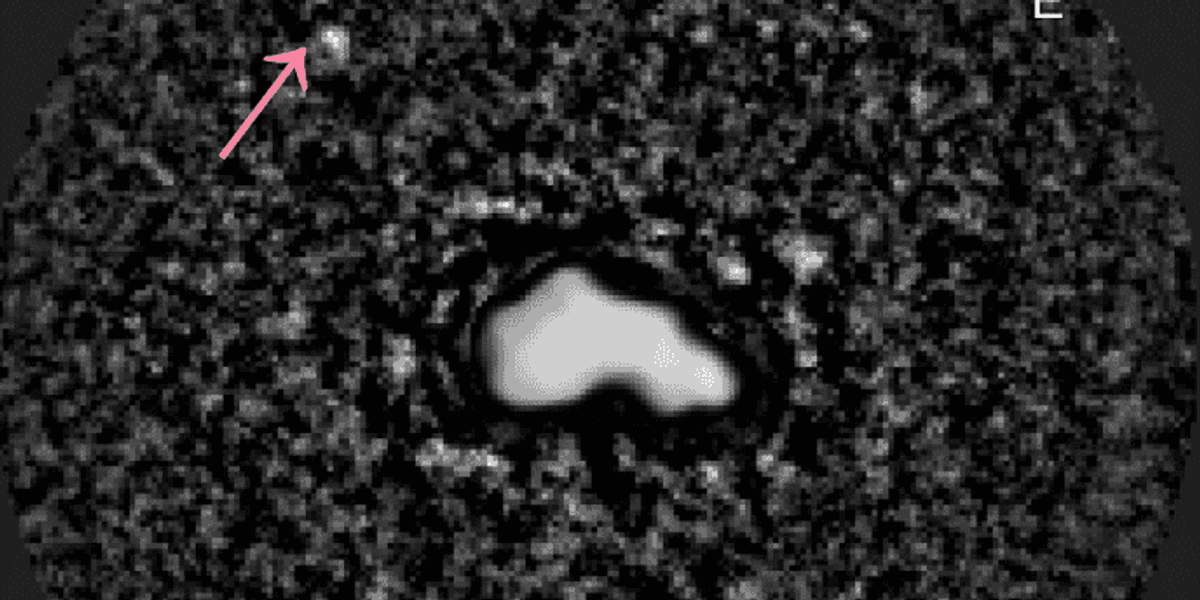
The object appears to consist of three distinct lobes, each connected to the others by slender structural necks.
This extraordinary configuration, potentially making it a so-called contact trinary, places 44 Nysa among the rarest and most unusual asteroids known to science.
Classified as an E-type asteroid, 44 Nysa belongs to a comparatively uncommon category of space rocks characterised by high concentrations of the mineral enstatite.
It orbits the Sun within the main asteroid belt, the vast region situated between Mars and Jupiter.
With a mean diameter of roughly 75 kilometres, it ranks among the largest members of its class.
It is also the most luminous E-type asteroid currently known to astronomers.
These qualities, its considerable size and exceptional brightness, have long made it an attractive target for observation, though only now has the technology existed to properly discern its remarkable shape.
Kate Minker and her colleagues at the Lowell Observatory in Arizona carried out the research, employing the Large Binocular Telescope in Arizona and the Very Large Telescope based in Chile.
From the observational data gathered, the team constructed a three-dimensional model of 44 Nysa.
This revealed the asteroid's triple-lobed structure, with each segment joined to its neighbours by narrow necks holding the whole body together.
Asteroids comprising two lobes are found with some regularity, but trinary configurations are far less common, making this discovery particularly noteworthy among planetary scientists.
How 44 Nysa came to acquire its unusual form remains uncertain.
One possibility is that it was once a more conventionally shaped body, subsequently deformed through repeated collisions with other space rocks.
Alternatively, the three lobes may originally have been separate objects that gradually drifted together and fused.
Whichever explanation proves correct, the asteroid's interior must possess considerable structural strength to have remained intact.
Adding further intrigue, the observations suggest 44 Nysa possesses a diminutive moon measuring approximately one kilometre across.
Tracking this satellite's orbit in future studies could yield valuable insights into the asteroid's internal composition and ultimately shed light on how it formed.