Thank you for subscribing!
A photograph captured by Nasa's Curiosity rover has sparked renewed speculation about aliens
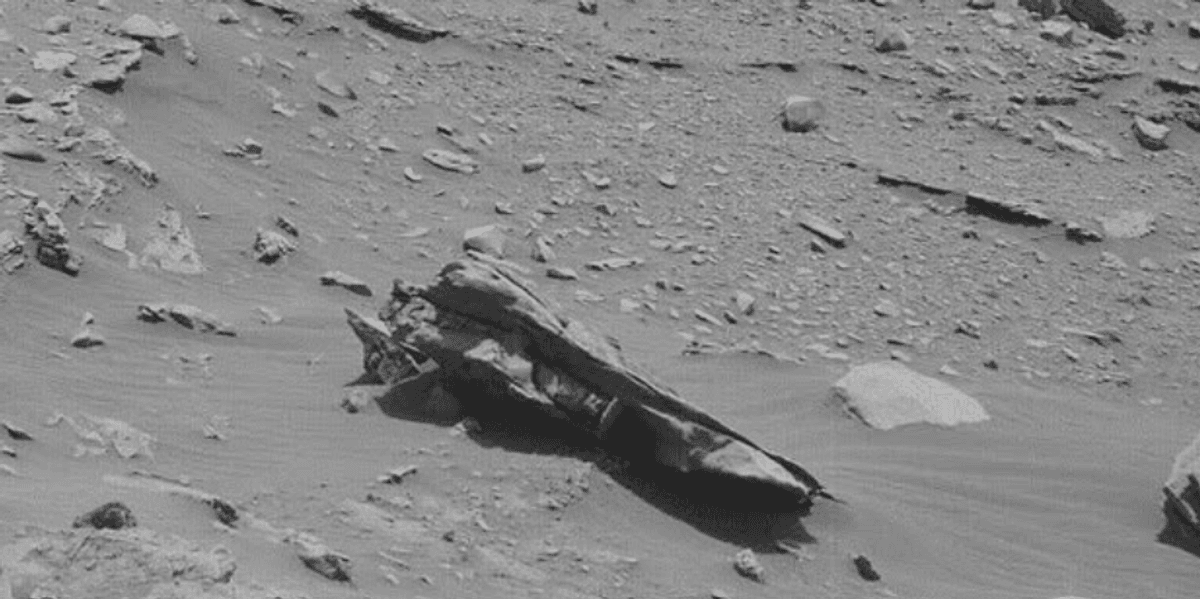
A photograph captured by Nasa's Curiosity rover has sparked renewed speculation about ancient extraterrestrial warfare after a UFO researcher claimed the image depicts an unexploded alien weapon.
Scott C Waring, who investigates unidentified flying objects, shared the resurfaced picture showing what he believes to be a missile from another world resting on the Martian terrain.
According to Mr Waring, the object serves as proof that a catastrophic battle once decimated a flourishing civilisation on the Red Planet.
He has further suggested that space agencies have chosen not to comment on the discovery owing to its possible military importance.
The UFO researcher has even proposed such a find could attract government attention, with nations potentially competing to retrieve and examine what he characterises as sophisticated alien weaponry.
Mr Waring has estimated the mysterious formation extends slightly beyond eight feet in length and could potentially be an undamaged specimen of technology from beyond Earth.
The researcher maintains governments would be eager to acquire such an artefact for the purpose of studying sophisticated weaponry, although he has provided no supporting evidence for these assertions.
He has raised questions about which nation might be first to reach the object and what function it originally served in his theorised extraterrestrial conflict.
Nasa, meanwhile, has not classified the formation as anything beyond a component of the natural Martian landscape.
The space agency has consistently maintained that it possesses no evidence indicating the presence of life from other worlds on Mars, either currently or in the planet's history.
Nasa's own assessment offers no support for Mr Waring's extraordinary claims, with the American space agency providing no suggestion the formation represents anything beyond a naturally occurring rock.
Scientists have long observed the Martian surface has been sculpted over billions of years through volcanic processes, impacts from meteorites, and continuous erosion by winds.
These geological forces are capable of creating rock formations that can appear remarkably artificial in shape and structure.
Previous discoveries that sparked similar claims about alien artefacts on the Red Planet have been subsequently attributed to pareidolia, the psychological phenomenon whereby humans perceive recognisable patterns or familiar objects in random formations where they do not genuinely exist.
The space agency has yet to discover any indicators of biological activity on Mars, whether from the present day or the distant past.
The peculiar formation has generated fresh discussion on social media platforms, with some believers arguing the rover has discovered remnants of an alien battlefield whilst doubters maintain it is merely another Martian rock.
Alternative explanations from social media users have included suggestions the object could be debris from an extraterrestrial spacecraft rather than a weapon.
One Facebook user described the formation as elongated with what appeared to be two separate sections, noting one seemed vacant whilst the other looked as though it might hold items, suggesting it resembled some form of aircraft with missing components.
This is not Mr Waring's first recent claim involving Curiosity imagery, as earlier this month, he shared another photograph taken inside Gale Crater he insisted depicted a dwelling structure on Mars.