Thank you for subscribing!
The new images show the scene of the crash in unprecedented detail
Nasa has revealed the exact place where a SpaceX rocket crashed into the Moon at the start of the month.
A Nasa spacecraft orbiting the Moon photographed a fresh crater left behind by a SpaceX rocket that slammed into the lunar surface on August 5.
The defunct Falcon 9 upper stage hit the Moon at roughly 5,400 mph after drifting through space for more than a year, striking with a force equivalent to nearly three tonnes of dynamite.
The brief, intense flash produced by the impact would have been nearly impossible for amateur astronomers to see, even with powerful telescopes.
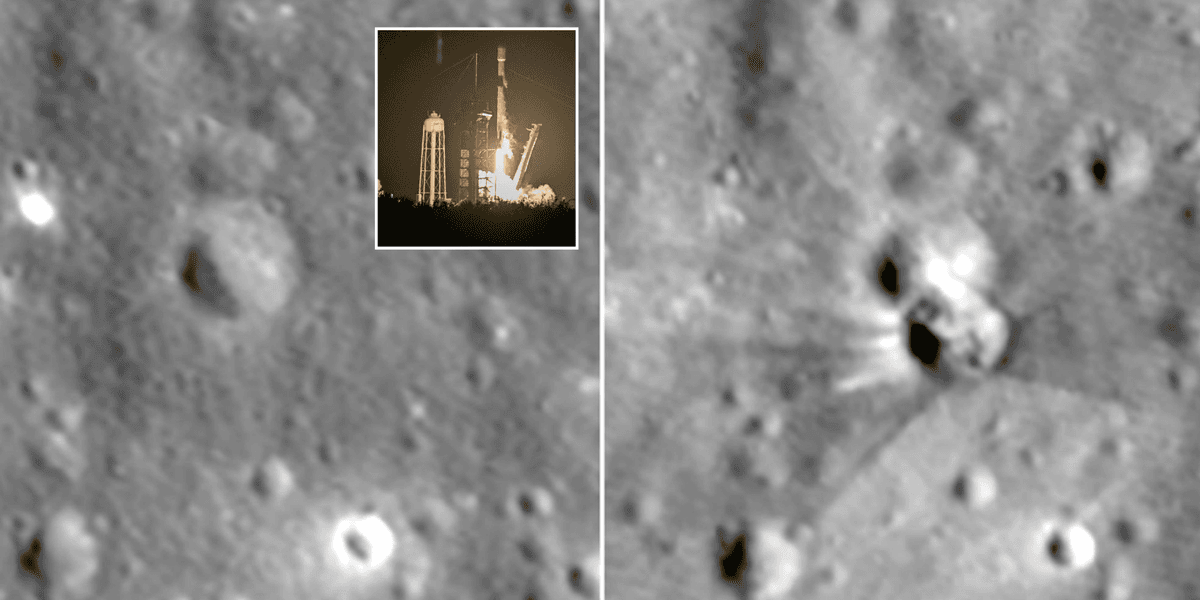
Now, before-and-after images released by Nasa show the impact site in unprecedented detail.
The crater measures approximately 60 feet wide and is believed to be less than 10 feet deep, space scientists say.
Visible streaks of both dark and bright material radiate outward from the crater - just like butterfly wings.
The darker rays consist of weathered dust and rock dug up from roughly 1.5 feet below the surface, material long altered by solar wind, cosmic rays and micrometeorite strikes.
Brighter streaks closer to the rim are composed of fresher material thrown up from deeper underground by the force of the collision.
Nasa's LRO team pinpointed the crater's centre at coordinates 19.4759°N, 266.7138°E, at an elevation of approximately 511 metres.
The orbiter's Narrow-Angle Camera was used to capture these details, capable of resolving features as small as three feet across.
Nasa's Lunar Reconnaissance Orbiter took the photographs over August 11 and 12, roughly one week after the collision, from an altitude of 60 miles while travelling at one mile per second.
LATEST SPACE NEWS:
Engineers had to tilt the spacecraft so its cameras would point toward the crater as it passed overhead.
The orbiter completes a pole-to-pole lunar orbit every two hours, but it took six days for the crash site to rotate into view.
Throughout the process, timing was critical — firing the camera just 10 seconds too early or late would have shifted the target by 10 miles.
South Korea's Danuri spacecraft was first to photograph the impact site, with its prediction proving accurate to roughly 0.6 miles.
The Falcon 9 rocket originally launched in January 2025, carrying a pair of private lunar landers equipped with experiments and a small rover as part of NASA's drive to commercialise Moon exploration.
In a statement on August 5, SpaceX said: "We actively work to be as responsible as possible with hardware left in space to ensure space safety, including for more complex missions.
"In this case, over time, solar activity and gravity led the second stage toward the Moon.
"Impacts like this are rare, but they can happen with objects in these types of orbits, and we worked with NASA on the optimal disposal solution."
The incident was only the second known unintentional rocket impact on the lunar surface.