


Archaeologists have uncovered a hidden monument just three miles from Stonehenge that may have served as its predecessor.
The site in Bulford, Wiltshire, consists of two wooden poles positioned 120 metres apart.
Scientists believe these poles formed a precise alignment with the rising sun at the summer solstice and the setting sun at the winter solstice.
Reconstructions of the ancient sky demonstrate the structure was accurate to within just one degree.
Dating places the monument at approximately 5,000 years old, making it 500 years older than Stonehenge itself.
The Bulford site represents one of the earliest known sun-aligned structures in the British Isles.
Dr Fabio Silva, an archaeologist from Stone x Sky and the Skyscape Academy, says: "Rather than marking the beginning of a story, Stonehenge now more clearly appears to have emerged from traditions and practices with much deeper roots in this landscape."
While Phil Harding, an archaeologist at Wessex Archaeology and former Time Team presenter, shed light on a link between the two sites.
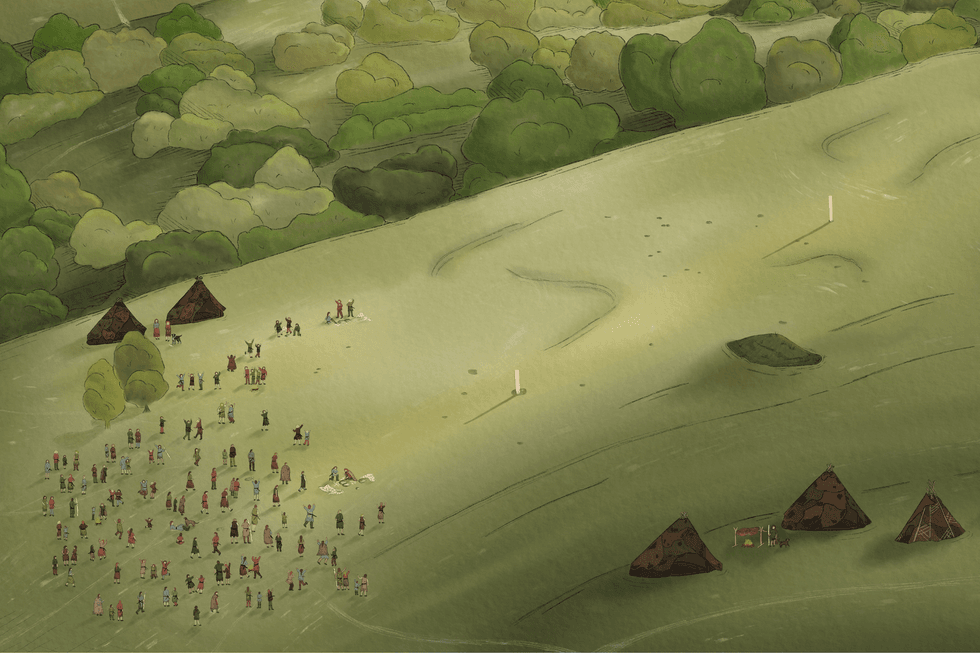
The site in Bulford, Wiltshire, consists of two wooden poles positioned 120 metres apart
|PA
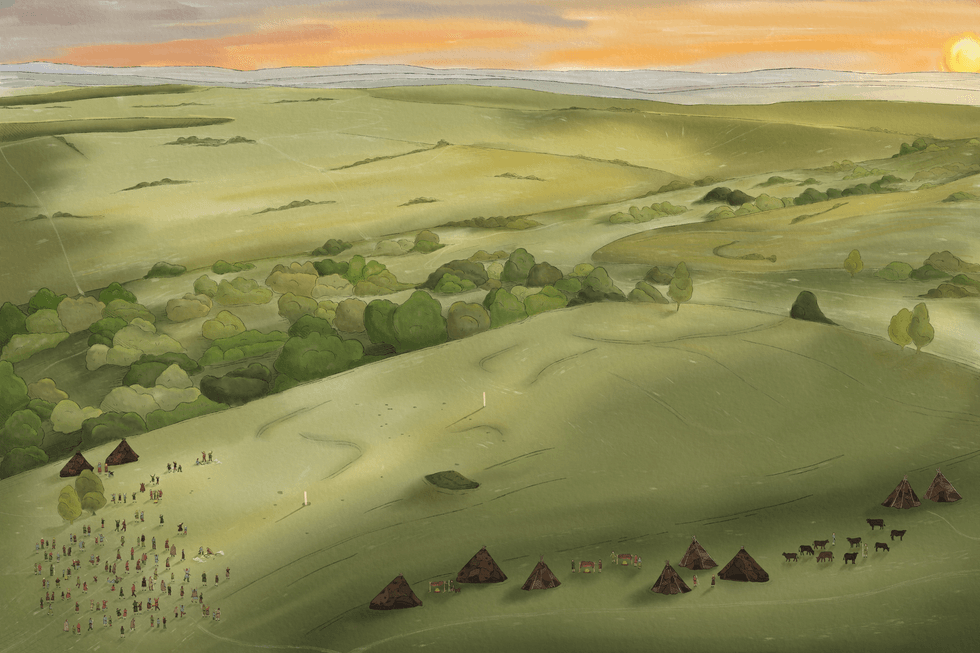
The poles were almost perfectly aligned with the rising summer sun and the setting winter sun
|PA
"Even if the people who visited Bulford are not buried at Stonehenge, there is every possibility that the people who visited Bulford may have also visited Stonehenge, and may even have been involved in the construction of Stonehenge," he said.
The Bulford pits date to roughly the same era as Stonehenge's earliest earthworks.
Archaeologists also found a rare disc-shaped knife there below the earth.
They now believe it has taken on fresh significance following the new research.
STONHENGE - READ MORE:

PICTURED: Wessex Archaeology's Phil Harding and Dr Matt Leivers at Stonehenge
|PA
Mr Harding unearthed the round blade buried vertically in a pit, positioned almost exactly along the solstice alignment.
"It's an absolutely exquisite object," he said. "That is a difficult craft to exercise to that level of perfection.
"It's almost inconceivable that you would just throw it away."
Mr Harding now believes the disc may have symbolically represented the sun itself.
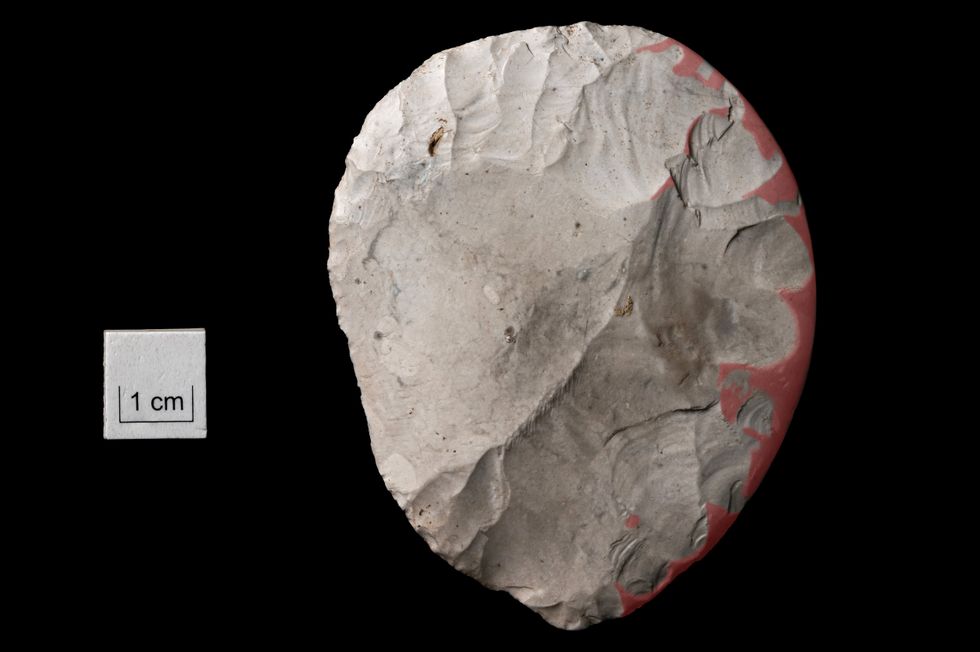
Mr Harding described the round blade as an 'absolutely exquisite' object
|PA
He suggests it was deliberately placed in what functioned as a viewing station for solstice observations.
Scholars continue to debate the precise purpose of Stonehenge and similar monuments like the Bulford poles.
However, their solar alignment strongly indicates a spiritual or religious function beyond just keeping time.
Dr Matt Leivers, a senior research manager at Wessex Archaeology, said: "When we talk about the solstice, we're talking about religion. About how prehistoric peoples understood the cosmos, the world, and their place in it."
"What we see at Bulford, and later at Stonehenge, is a way of celebrating and marking the passage of time, but it's also about making sure the world keeps working as it should.
"It's likely their way of saying to their deities, please keep us in mind, keep us warm and safe. It's a religious event. That's why it's so important."