
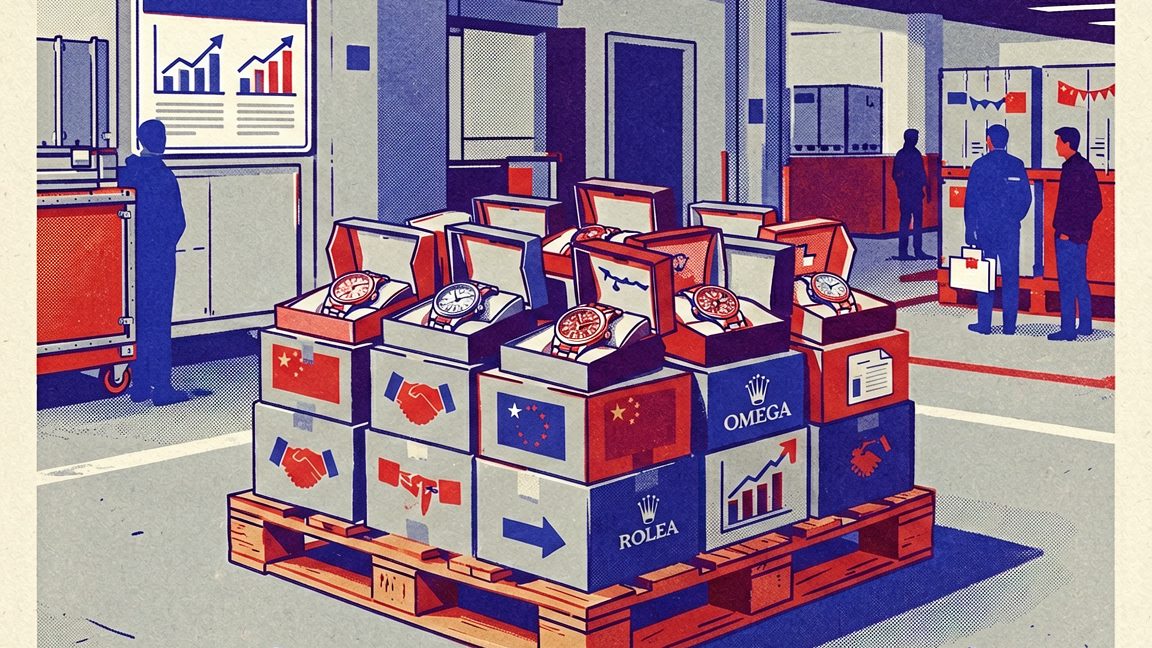
Switzerland and China are negotiating an expanded free‑trade agreement that would give Swiss exporters near‑full duty‑free access to the Chinese market. The Swiss economy ministry estimates the deal could generate about CHF 244 million in additional customs savings each year and give Swiss firms a tariff advantage of between 5 % and 35 % over EU rivals.
What the expansion would change
The current 2014 Switzerland‑China free‑trade agreement exempts roughly half of Swiss exports from Chinese tariffs. Under the proposed expansion, "mittelfristig nahezu 100 Prozent der Exporte aus der Schweiz zollfrei auf den chinesischen Markt gelangen" – in other words, in the medium term almost 100 % of Swiss goods would be duty‑free in China (FAZ – Wirtschaft). That would eliminate the remaining tariff barrier that still applies to about half of Swiss export value.
Quantifying the fiscal impact
The Swiss economy ministry puts the extra customs‑saving potential at "rund 244 Millionen Franken" per year (FAZ – Wirtschaft). The figure is presented as an annual estimate, not a one‑off windfall, and is based on the additional share of exports that would become tariff‑free under the expanded agreement.
Because the estimate is a forward‑looking projection, the ministry does not break it down by sector, but the same source notes that the main beneficiaries would be watch, machine and pharmaceutical producers. Those industries together account for a substantial share of Swiss export earnings, so the savings figure is anchored in the expected increase in duty‑free volume.
Tariff advantage over EU competitors
China already grants Swiss imports almost zero tariffs, while EU exporters still face duties. The FAZ – Wirtschaft article states that "Maschinenbauer mit Zollsätzen von fünf bis 20 Prozent und Luxusgüteranbieter sogar mit bis zu 35 Prozent" must pay tariffs, meaning Swiss machine makers would enjoy a 5‑20 % advantage and Swiss luxury‑goods producers up to a 35 % edge (FAZ – Wirtschaft).
Those percentage differentials are calculated on the tariff rates that EU firms currently face, not on the Swiss rates – which are already near zero. The advantage therefore translates into lower landed costs for Swiss firms and potentially higher price competitiveness in the Chinese market.
Sector focus: watches, machines and pharma
"Davon profitieren vor allem Uhren-, Maschinen- und Pharmaproduzenten" (FAZ – Wirtschaft). Swiss watchmakers, for example, rely heavily on the Chinese market, which accounts for a large share of their overseas sales. Removing the remaining tariffs would directly improve margins on those sales.
Machine manufacturers – ranging from precision tools to industrial equipment – also stand to gain. The 5‑20 % tariff gap means that a Swiss‑made machine that currently costs CHF 100 000 in China could become effectively CHF 80 000–95 000 cheaper than a comparable EU‑made machine, depending on the exact duty rate applied to the EU product.
Pharmaceutical exporters, which already benefit from a relatively high degree of regulatory alignment with China, would see the same duty‑free treatment, further strengthening their price position against EU rivals that must add tariff costs on top of regulatory compliance.
Why the deal matters for Swiss‑China trade balance
Under the 2014 agreement, "unter dem bestehenden Abkommen ist nur gut die Hälfte der Schweizer Ausfuhren von Zöllen befreit" (FAZ – Wirtschaft). The proposed expansion would therefore correct an "Ungleichgewicht im Handel" – a trade imbalance where China already enjoys near‑zero tariffs on Swiss imports while Swiss firms still pay duties on a sizable share of their exports to China (FAZ – Wirtschaft).
Eliminating that imbalance could boost Swiss export volumes, improve the trade surplus with China, and reinforce Switzerland’s position as a high‑value‑added exporter to the world’s second‑largest economy.
Political and procedural backdrop
The expanded agreement is still under negotiation and must be ratified by the Swiss parliament before it can take effect. The source does not specify a timetable for ratification, but the language "mittelfristig" suggests a medium‑term horizon rather than an immediate implementation.
Because the estimate and tariff‑advantage figures come from the Swiss economy ministry, they reflect the ministry’s own assessment of the economic impact, not an independent third‑party study. No other source in the packet provides a conflicting view.
What remains unknown
The research packet does not contain a breakdown of the CHF 244 million savings by sector, nor does it give a precise date when the expanded duties would become effective. It also does not disclose how the savings figure was calculated – for example, whether it assumes a particular growth rate in export volumes or a static trade pattern.
Stakeholders such as the Swiss watch association or the machine‑tool industry have not been quoted in the source material, so their specific expectations are not documented here. Further comment from trade‑policy experts would be needed to assess the broader macro‑economic implications, such as potential reactions from EU partners.
Bottom line for businesses
For Swiss exporters, the prospect of near‑full duty‑free access to China promises a clear fiscal benefit – an estimated CHF 244 million in annual customs savings – and a competitive edge of up to 35 % over EU rivals on certain product categories. Companies in watches, machinery and pharmaceuticals should monitor the parliamentary ratification process closely, as the timing of any change will affect budgeting, pricing and supply‑chain decisions.
| Metric | Current (2014 agreement) | Projected (expanded agreement) |
|---|---|---|
| Share of Swiss exports duty‑free in China | ≈ 50 % | ≈ 100 % |
| Annual customs‑saving potential | Not applicable | CHF 244 million |
| Source: FAZ – Wirtschaft (quoting Swiss economy ministry) | ||
Until the agreement is formally ratified, the figures remain projections. Nevertheless, the data points to a potentially material shift in the competitive landscape for Swiss exporters facing Chinese demand.