Thank you for subscribing!
Sir James Dyson has unveiled his first toothbrush at an event in Paris.
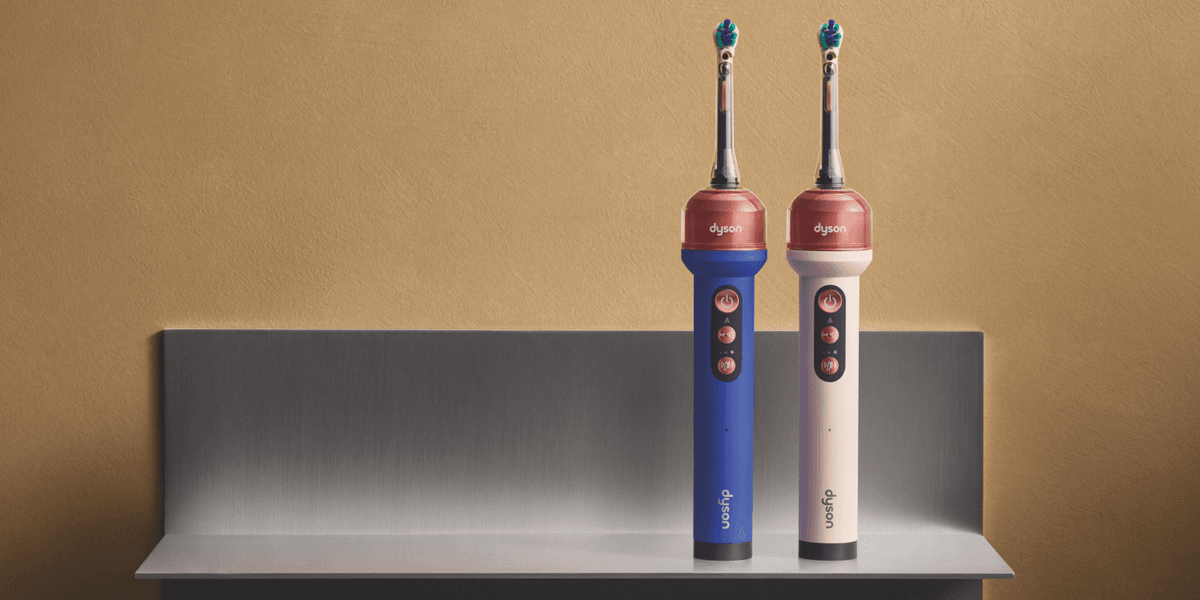
Dubbed Dyson CameraJet, this one-of-a-kind device combines an electric toothbrush with a water flosser. As you brush, a built-in camera captures 28 images every second to identify, track and predict gaps between your teeth. When it passes a gap, the CameraJet will fire a conical-shaped spray to sweep away plaque.
This £419.99 electric toothbrush is the result of six years of research and prototypes from 661 Dyson engineers. Those engineers roped in researchers at the National University of Singapore to develop an artificial plaque to test the efficacy of the bristles on its custom-designed brush head and the conical jet of mouthwash.
James Dyson, the 79-year-old founder and chief engineer, said: "Flossing is an awkward and time-consuming chore. Few of us do it even though we know we should.
"Dyson engineers and scientists have spent well over a decade understanding oral care regimes and how nasties build up in the mouth. Our research has shown that people consistently miss the areas where plaque forms: the gaps between teeth.
"We wanted to solve three fundamental problems: how to see those gaps, remove plaque, how to improve cleaning performance while brushing.
"By combining a camera, machine learning, precision fluid dynamics, advanced brushing technologies, connectivity and WiFi, Dyson CameraJet introduces an entirely new way to keep your mouth healthy."
Sir James Dyson built his company after creating the first bagless vacuum cleaner. Since then, the British success story has expanded into a slew of other household appliances, including hairdryers, mops, handheld fans, straighteners, robot vacuums, purifying fans, and headphones, to name just a few.
The CameraJet marks the first time Dyson has entered the dental care market.
First up, Dyson had to design a brush head for its electric toothbrush. Its engineers settled on a dual-bristle design with a contoured shape to clean the gumline as well as lift surface stains for whiter teeth. Teeth aren’t flat, so Dyson engineers decided that its brush head couldn't be either.
Each brush head comes equipped with its own RFID tag, identifying when it was connected to the toothbrush, how many cleans it has completed, and alerting you when it's time to be replaced. When a new brush head is attached, the cycle starts again.
Dyson has used this RFID technology before with its haircare products, enabling the latest generation of its Supersonic hair dryer and Airwrap to remember the exact heat and airflow settings you prefer to use with each attachment. Dyson will charge £29.99 for two replacement brush heads.
It's not just the dual-bristle design that's new for the CameraJet; Dyson is also using variable sonic oscillation — a fancy way of saying its vibrations change in frequency, intensity, or pattern — with its brush head.
During the development of the CameraJet, Dyson engineers checked slow-motion footage of some of the market-leading sonic toothbrush heads and found bristles can sometimes stall. This occurs when the bristles jam against a tooth, especially in hard-to-reach areas. This limits efficiency and was something Dyson was keen to avoid with its brush.
As you alter the angle of the toothbrush, Dyson CameraJet alters oscillation, keeping bristles in motion and helping to prevent stalling — even when the bristles are pressed tight against the side of a tooth in a hard-to-reach spot. According to the British company, external tests show its new variable sonic oscillation can remove up to 69% more plaque than market-leading premium electric toothbrushes in hard-to-reach areas.
As well as brushing your teeth, the CameraJet lives up to its name with a minuscule camera equipped with a macro lens and 100,000 pixels of resolution. Every second, this camera captures 28 images of your teeth. Dyson’s Artificial Intelligence (AI) machine learning algorithm analyses all of this pictures, and within 100 milliseconds of the camera spotting a gap between your teeth, the device triggers a conical burst of mouthrinse to floss while you brush.
Dyson CameraJet runs on 16 million lines of code and a machine learning system trained on 470,000 dental images collected during its six-year development. By the end of a two-minute brush, the Dyson CameraJet will have brushed every tooth and flossed between the gaps – promising to be a real time-saver.
Engineers worked with 30 dental professionals globally during development, and discovered that traditional water flossers most often use a needle-like jet of water. But when tested on the proxy plaque developed in conjunction with researchers from the National University of Singapore pierced a hole but failed to remove it all.
Dyson has settled on a conical-shaped spray, which offers wider coverage to sweep away plaque at once, while being optimised at a lower pressure to be gentler on gums and enamel. That spray is delivered via a 12.5ml mouthrinse tank, dubbed the Dyson Anti-Gravity Tank.
It uses a diaphragm pump and pressure chamber that can deliver a controlled, uninterrupted jet in any orientation inside your mouth. That might sound over-engineered, but unlike the conventional straw-in-a-cup-style systems on the most popular water flossers on the market, which draw in air and lose performance when tilted, Dyson’s Anti-Gravity Tank eliminates air pockets and prevents the device from firing blanks.
This is especially important when cleaning the back of the teeth, where the device is often horizontal.
Dyson has created a docking station that also charges the device between cleans and provides a dedicated place to store it upright. Power is delivered via USB-C, so you can travel with your Dyson CameraJet and the same charging cable used for your iPhone, iPad, Samsung Galaxy smartphone, Kindle, Nintendo Switch, and more.
A travel case is included in the box, so you can use the full Dyson Dental System at home or on the go.
The CameraJet uses 2.4GHz Wi-Fi and Bluetooth to communicate with the same MyDyson companion app used to manage its haircare, headphones, and vacuums on iOS and Android. With the app, you can tap into a live feed from the built-in camera to view a high-quality endoscope view, similar to what your dentist sees, so you can inspect your teeth.
The MyDyson app also lets you choose between auto-detect and manual mouthwash jetting modes, as well as adjust the brushing intensity to your chosen comfort level.
The Dyson CameraJet is available today for £419.99. It ships in two colourways: Ceramic Ultra Blue and Ceramic Pink.
In the box, you'll find the Dyson CameraJet toothbrush, a charging dock, a travel case, Dyson-developed toothpaste, and a bottle of Dyson's custom-designed mouthrinse, which are both engineered to work together for what the British brand calls "a complete brushing, precision-flossing and mouth-rinsing routine".