Thank you for subscribing!
APPLE PRESS OFFICE | MICROSOFT PRESS OFFICE | OPENAI | GB NEWS
If you want the best way to run Word, you might want to look at a Mac
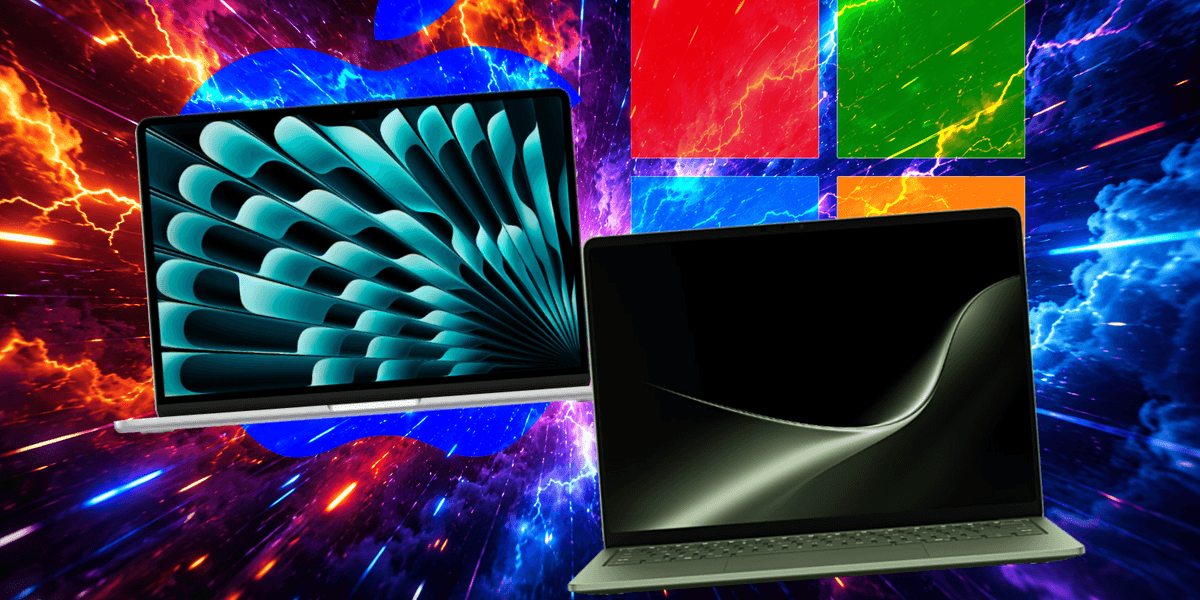
Want the best laptop to run Microsoft apps, like Word and Outlook? You should probably turn your back on the Microsoft Surface Laptop and pick up a MacBook instead. Yes, it's true — the latest laptops designed and built by Microsoft are slower at opening their own applications than rival technology brand Apple.
YouTube channel PhoneBuff conducted a series of scientific tests, pitting these rival laptops against one another. And the results are pretty awkward for Microsoft.
Using a robotic arm to eliminate all human error, PhoneBuff discovered that the latest iteration of the bestselling MacBook Air can open up a 500-page Microsoft Word document in 7 seconds. For its part, Microsoft's own Surface Laptop 8, equipped with 16GB of RAM, takes 12 seconds to launch the same file. That's nearly twice the amount of time needed to crunch data inside Microsoft's flagship productivity app.
Things get worse for Microsoft when you consider the MacBook Air costs £150 less than the Surface Laptop.
Following its recent price rises, the MacBook Air starts from £1,299 in the UK. For that, you'll take delivery of a 13-inch model with the latest-generation M5 system-on-a-chip, coupled with 16GB of RAM. Meanwhile, the Surface Laptop (8th Edition) — which also underwent a price rise in recent months due to global component shortages — starts at £1,449 for the entry-level model with the 10-core Snapdragon X2 Plus chipset and 16GB of RAM.
Watch the full test below
The gap in performance between these two rival laptops extends well beyond Microsoft Word. During its testing, PhoneBuff showed what happens when trying to extract the same 6GB file on both machines.
MacBook Air managed to unzip everything in just a fraction under 10-seconds, while the Surface Laptop takes nearly four times longer, finishing the task after 42-seconds.
"This was consistent across all of our trials," the host claims.
The MacBook Air also trounced its Microsoft-built rival when it comes to Adobe Premiere Pro, the professional video editing suite, where the PhoneBuff team launches the application, creates a new project, imports high-resolution clips, applies stabilisation and a colour grade, then exports the finished product. It's a lot of work for any chipset.
From start to finish, MacBook Air takes 1 minute 46 seconds, while the Surface Laptop takes 3 minutes 19 seconds. That's a substantial difference — a much wider gap between these two devices compared to the 6-seconds between them when processing the same still image in Photoshop, another stress test conducted by PhoneBuff.
Gaming offered a bright spot for the Surface Laptop. Running titles via Prism, the translation layer to get unsupported apps running on ARM-based architecture, on the Surface Laptop matched the performance of the MacBook Air at native resolution, without frame generation or upscaling.
With both of those features enabled, Apple regains its lead against the Windows 11-powered rival.
Web browsing proved the lone area where both laptops delivered identical performance.
If you're hunting for the most powerful laptop for your money, here's where things get interesting. Battery life flipped the script entirely. During a two-hour productivity test cycling through Word and Excel with Spotify running, the Surface Laptop used just 16% of its battery. MacBook Air with M5 burned through 24% over the same period.
That's a proper difference for anyone spending full days away from a plug socket. The battery advantage held up across light office work, typing bursts, and spreadsheet tasks.
Heavy workloads like video editing narrowed the gap, but for everyday document work, Windows laptops lasted longer.
If you're after the most powerful PC for your money, the hardware isn't letting you down. Windows itself is the bottleneck. Similar tests from PhoneBuff show an identical five-second penalty across different processors from rival brands and based on disparate architectures.
Dell's Intel-based XPS 13 and the Qualcomm-powered Surface both took 12 seconds to open Word, but MacBook Air with either M5 chip or MacBook Neo, with its repurposed iPhone processor, both clocked just 7 seconds.
The culprit is WebView2, a component Microsoft built into Windows 11 since 2021. It wraps the Chromium browser engine into core Windows features like Search and Settings, spawning background processes that eat up memory and processor cycles before you've even launched an app.
Testing has found Windows 11 machines using up to 70% of their RAM whilst idle.
Microsoft has owned up to the problem. Pavan Davuluri, the company's Executive Vice President for Windows and Devices, announced on July 31 that ditching WebView2 for native Windows code is now their top priority.
The fix involves three moves: overhauling how Windows manages memory system-wide, shifting components from WebView2 to the WinUI 3 framework, and improving Chromium's efficiency where it can't be replaced yet.
The improvements should start rolling out this autumn, so maybe the next time these two machines are pitted against one another, the competition will be a little closer.