The site accounts for six of the UK’s estimated 12 days of gas storage capacity
The UK’s largest gas storage site will close next year without Government intervention, the owners have warned.
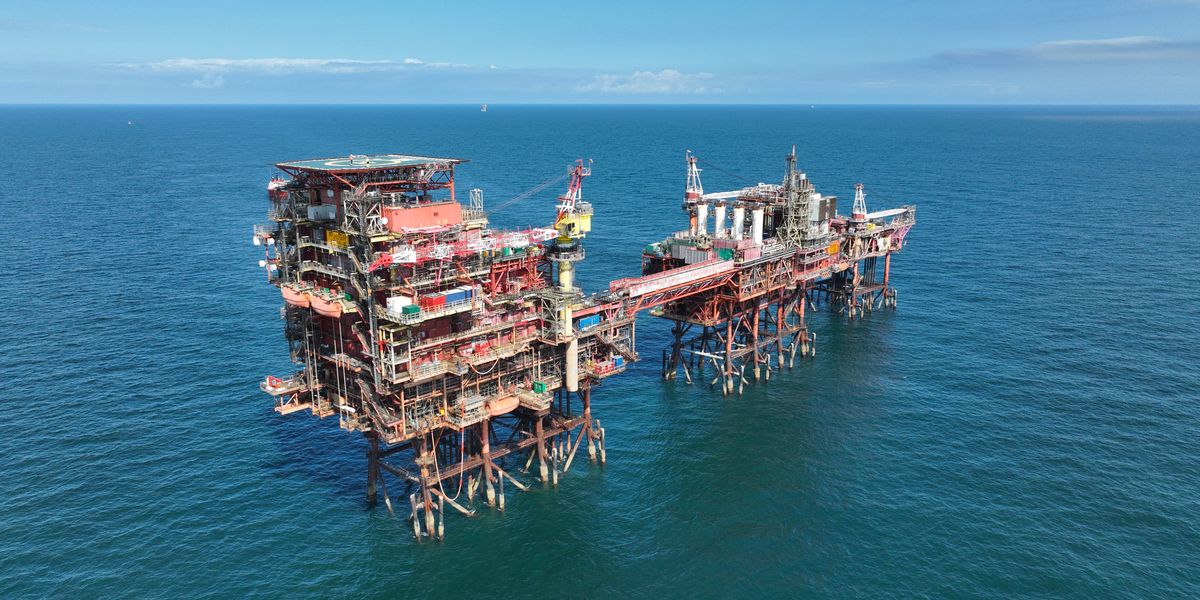
Centrica, which operates the Rough gas storage facility in the North Sea, has said it will not seek to continue production beyond April 2027.
Without a £2billion redevelopment, the “important strategic asset” is at the limit of what it can deliver, said chief executive Chris O’Shea.
Rough accounts for half of the UK’s gas storage capacity. Centrica says an expanded facility would bolster UK energy security, lower our exposure to volatile prices and support jobs.
But it wants price guarantees on its gas from the Government to ensure the expansion is economically viable.
The Government has previously said it is open to discussions, but that the expansion is a commercial decision for Centrica.
Mr O’Shea said: “I want to make the point - this is not just a commercial decision for Centrica. The decision is also about whether the Government wants to keep this important strategic asset open.”
Rough, which sits off the Yorkshire coast, started life as a gas field, but, once supplies were depleted, the undersea reservoirs were used for storage.
It was closed in 2017 but partially reopened in 2022, after the invasion of Ukraine sent gas prices spiralling.
It accounts for six of the UK’s estimated 12 days of gas storage capacity.
This is considerably less than European nations, with Germany’s capacity said to be seven times higher. Matters came to a head during the start of the Iran conflict, when energy prices spiked.
In March it was claimed Britain only had two days of gas storage. The Government vehemently denied this, pointing out the country drew gas from a wide range of sources, including imports from Norway.
But Centrica says Rough would give the cushion of domestic storage and “strengthen the UK’s energy security”.
With investment, Rough could store 54 billion cubic feet of gas, almost double its current 30 bcf capacity. This would provide the equivalent volume to heat 2.4 million homes and would give the UK the buffer of 30 days of storage, Mr O’Shea has said.
Rough could also be used to store hydrogen, a fuel considered key to the UK hitting its Net Zero targets.
The company is seeking a “cap and floor” pricing mechanism, meaning if energy prices dropped, its revenues would be topped up.
But if they rose too high, the price would be capped. Mr O’Shea said this would “help create the conditions which will unlock £2billion of investment”.
The storage site returned to profit in the first half of 2026 with adjusted earnings of £57 million. But Mr O’Shea said it was not sustainable under present conditions.
He said: “Rough performed well in the first half, but that cannot be sustained. We’re now at the limit of what the asset can deliver.
“We have not injected gas this summer. Reservoir pressure continues to decline and, by this winter, Rough will be close to exhausted - producing less than 2 per cent of what it could deliver if redeveloped.
“Rough can strengthen the UK’s energy security, reduce exposure to volatile international markets, support hydrogen storage, and bring significant investment and thousands of skilled jobs to the East of England.
“A regulated asset base model remains the right mechanism to unlock this. But time is running short.”
Centrica said its production consent with the North Sea Transition Authority (NSTA) expires in April 2027 and that it does not intend to apply for an extension.
“We don’t intend to seek an extension for that because, although you can still get a trickle of gas for a long time, it makes no economic sense,” Mr O’Shea said.
Oxford economist Professor Sir Dieter Helm has said that the changing energy mix as the UK heads towards Net Zero had altered the financial picture for storage. But this meant we could run out just when we needed it most, he warned in March.
He said: “In Britain, energy storage issues are very much to the fore when it comes to renewables.
“The Government backs pumped-hydro storage, and it is active in promoting grid-supporting batteries. But on gas it is silent.
“Even the Rough storage facility is under pressure. In the ‘bad old days’, there were big seasonal swings.
“Hence a gas storage facility could be filled cheaply in summer, and then sold down at higher prices in winter.
“The economics of renewables with zero marginal costs and the rapid decline of energy-intensive industries have undermined this.
“Hence the commercial case for storage has collapsed. The result is that just when we need storage, we will have almost none.”
Centrica said this morning that it plans to axe a further 800 jobs on top of 500 cuts announced last month as part of efforts to overhaul its customer services and support teams.