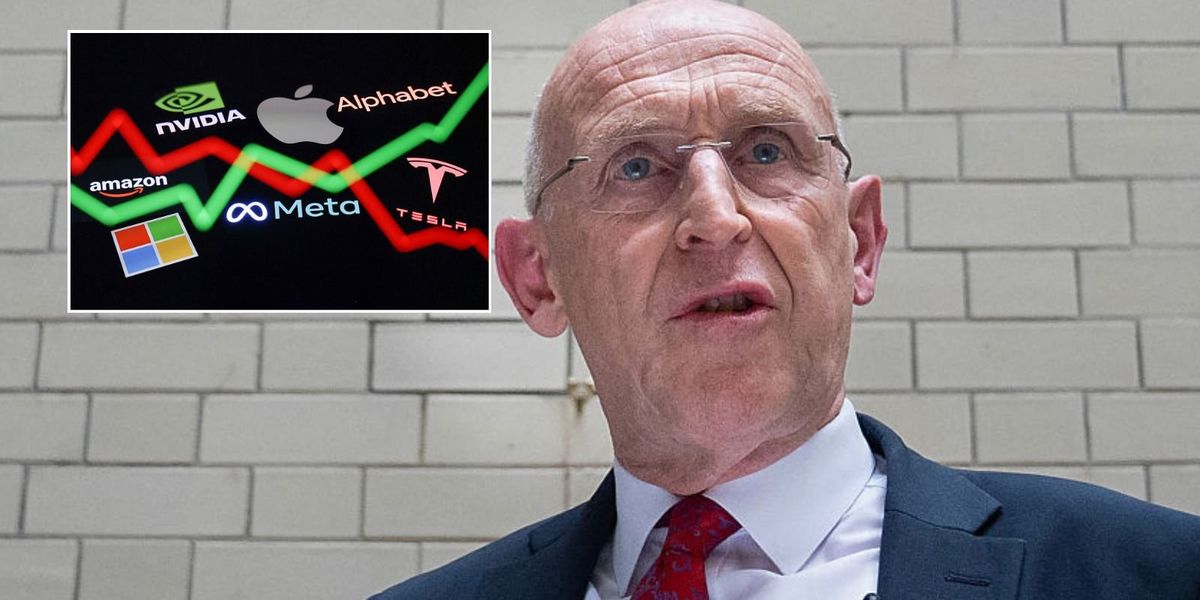
Some £6.1trillion in pension capital is being invested into American 'Magnificent Seven' tech firms instead of in British industry, a think thank has warned
The Labour Government is being urged to stop the pension funds of hard-working Britons from "leaking" into US tech giants amid concerns of an artificial intelligence (AI) stock market bubble.
Investment think-tank New Capital Consensus has proposed that Prime Minister Andy Burnham's new administration take action against what it describes as an "overseas leak" of Britain's £6.1trillion pool of private investment capital.
Its new report, *Diversifying Investment Flows*, argues that pension savings are being disproportionately channelled towards the so-called Magnificent Seven, the dominant US technology corporations that now represent 22.4 per cent of the global index.
The organisation is pressing ministers to deploy tax measures that would discourage the continued outflow of retirement funds into American equities and instead redirect capital towards domestic productive investment.
The warning comes amid growing concern that UK savers' money is overwhelmingly benefiting overseas markets rather than supporting economic growth in the regions where those savers actually live and will eventually retire.
Among the report's central recommendations is a proposed 10 per cent exit tax on accumulated gains within defined contribution pension schemes that fail to maintain at least 30 per cent of their assets in UK investments.
Alongside the stick, New Capital Consensus offers a carrot: dividend tax relief would be made available to funds committing a minimum of 10 per cent of their portfolio to what the think-tank terms "UK regional productive assets".
Taken together, the twin measures are designed to create a fiscal framework that penalises capital flight whilst rewarding schemes that actively support investment in Britain's regional economies.
Ashok Gupta, director of New Capital Consensus, said: "UK savers want to see their money improving the areas they will most likely retire in, but this just isn't happening."
He urged the incoming administration to confront both the dominance of US-oriented capital flows and what he described as "unproductive secondary trading" if it is serious about reviving regional development and stimulating economic growth.
Mr Gupta stressed that tax policy alone would not suffice, calling for a comprehensive overhaul of the investment system.
The investment expert added: "The system requires multiple redesign principles that perform in concert, including rethinking benchmark construction, changing how funds are automatically invested by default, and greater transparency over how and where our pensions are invested."
James Bentley, the director at Financial Markets Online, offered a broader market perspective that reinforces the case for caution around US tech exposure.
He described AI stocks as looking "dangerously frothy" and warned that the Federal Reserve's prolonged period of holding rates steady may be nearing its end.
Mr Bentley noted that three dissenting members of the Fed's rate-setting committee had voted for an immediate increase, potentially setting the stage for a September hike that "could knock consumer spending hard."
He characterised the current rally in US equities following the Fed's fifth consecutive rate hold as "likely to be fleeting," adding that the central bank's unusually brief statement "should not be taken to mean all is well".