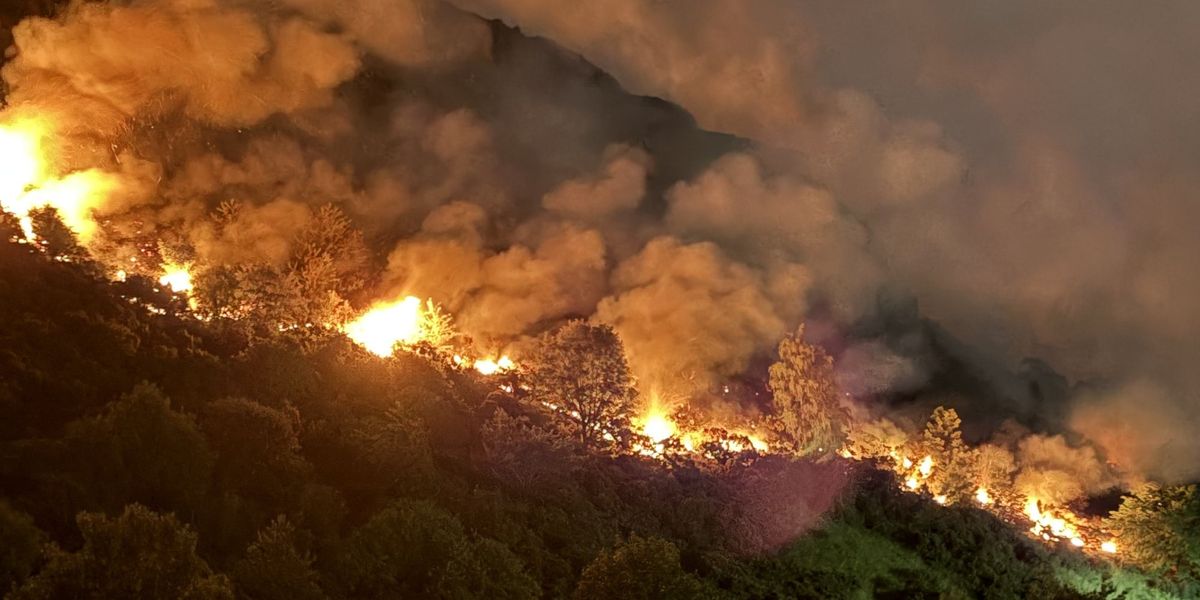
Assistant chief officer John Henderson of the Scottish Fire and Rescue Service said crews will remain for 'a couple of days'
Fire crews are expected to remain at the site of a large wildfire at Arthur's Seat in Edinburgh "for a couple of days" after flames tore through the grassland for the second time this summer on Sunday evening.
Plumes of smoke could be seen as far as Fife as the fire broke out below Salisbury Crags in Edinburgh at 6.40pm, with flames still burning on Monday morning as areas were scorched black.
Six fire engines were sent to tackle the fires overnight, with the Scottish Fire and Rescue Service confirming there were "no reported casualties," as Police Scotland closed nearby roads to all vehicles.
The iconic landmark attracts more than 3.5 million tourists a year, with the wildfire hitting just weeks after a separate blaze forced hikers to flee the scene.
During the recent heatwave, emergency services received more than 180 emergency calls from residents as a fire broke out on the highest peak in Scotland.
The Scottish Fire and Rescue Service and Scottish Wildfire Forum extended the Very High risk of wildfire warning to the end of this week, encompassing the central Highlands, southern and eastern Scotland.
Harrowing footage of the fire over the weekend emerged on social media, depicting the ascent to Arthur's Seat swamped with roaring flames aglow in the night.
Speaking to BBC Radio Scotland, assistant chief officer John Henderson of the Scottish Fire and Rescue Service discussed the response in Edinburgh, as well as the work ongoing to tackle a wildfire in the Cairngorms, which has been burning since last week.
He said: “In terms of size on the ground, the fire up in the Cairngorms region is about six-and-a-half square kilometres – so a relatively large fire. The fire on Arthur’s Seat, at the minute, is about 0.01 square kilometres.
“Protracted wildfire incidents, they’re weather-driven, we deal with them in partnership, they take a protracted period of time to deal with them.
“We tend to be there for protracted periods of time, even after the fire is extinguished to make sure that we’re maintaining the hotspots.”
Speaking on the incident at Arthur's Seat, Mr Henderson said: “The feeling from the ground there is that we’ll probably be there for a couple of days, continuing to tackle that and dampen out hotspots from those.”
The cause of the fire remains unknown, with crews focused on containing and extinguishing the blazes before an investigation can be launched.
The fire officer urged the public to be sensible when outdoors, and that “we don’t advocate any open flames”.
“So, no sources that could start a spark - so no use of barbecues, no open fires, nothing along those lines, and really tidy up after yourself”, he added.
Meanwhile, John Swinney has echoed the advice, urging people to “be vigilant” when outdoors.
The First Minister spoke out ahead of a visit to the Cairngorms National Park, with the two incidents showing the “devastating impact wildfires can have on landscapes, properties and people’s lives”.
He made clear that the “dangers cannot be underestimated” from such incidents, and added: “I am urging everyone to keep vigilant when they are outdoors and check if the area they are visiting is at risk of wildfires before igniting any flames.
“Even in areas where there is no alert, people should be very aware of the need to light and extinguish fires and flames responsibly and discard all waste properly, including glass bottles which can easily start grass fires.”
He said that Scottish Fire and Rescue Service crews, Police Scotland, land managers, volunteers and other organisations “have been absolutely outstanding tackling this substantial fire” in the Cairngorms.
“I want to thank them for keeping people, properties and our natural environment safe,” the First Minister added.
Helicopters have been “waterbombing” the area as part of efforts to tackle the blaze, with fire appliances, all-terrain vehicles, and a wildfire support unit also involved in the operation.
Mr Swinney said the Scottish Government would continue to work with the fire service and others “to ensure they are appropriately resourced”, including with specialist wildfire units, and helicopter support where needed.
The First Minister added: “People in affected areas should follow the advice of emergency services, avoid active fire locations and exclusion zones and stay updated with guidance from the SFRS and local authorities.”