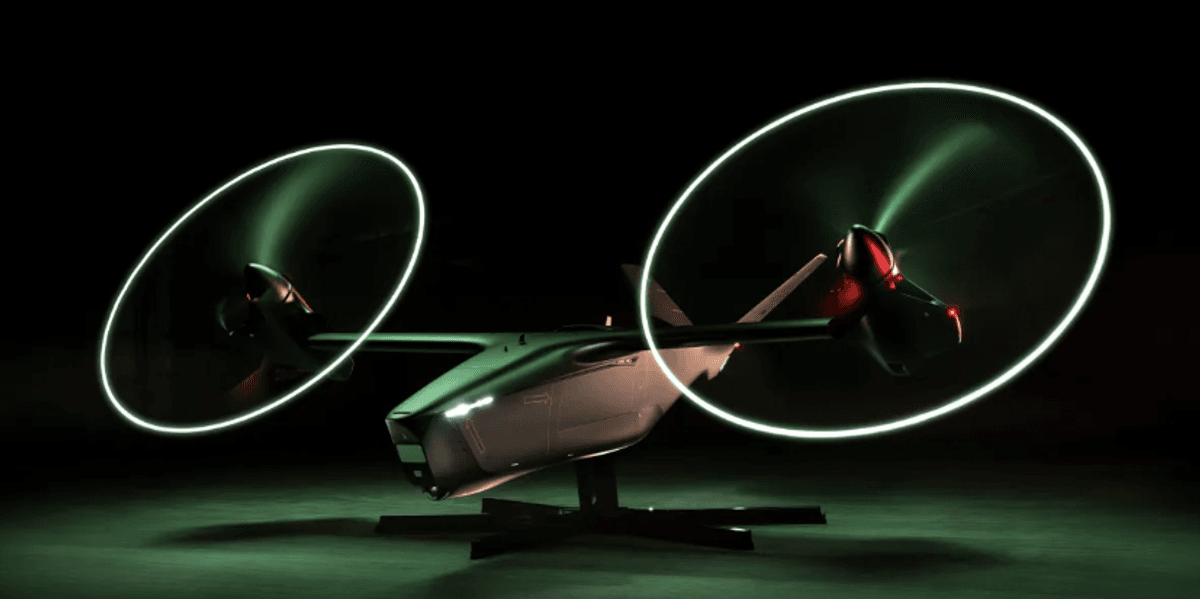
The British Army has unveiled new autonomous gunships will form a “ring of steel” around Apache helicopters in hopes of increasing defensive firepower.
The “wingman” drones were unveiled by a defence minister at the Farnborough International Airshow yesterday and are heavily armed to protect pilots flying traditional aircraft.
Up to six of the large Thunder drones would fly low near the attack helicopters during combat.
Aviators in command centres on the ground can control the fleet of drones from the ground, according to American designers at Anduril Industries.
Each drone can carry up to 10 Hellfire missiles, or 76 rockets that fire from foldout doors.
The Thunder drone can also work as a deployment drone, as it can hold up to 16 tube-launched kamikaze drones, or store up to 12 anti-drone interceptors from its nose cone.
The drone is a hybrid-electric aircraft and is mainly designed to work in tandem with Apache helicopters to give the pilot a protective shield, as well as strike targets at a greater distance, increasing the pilot's line of sight.
Shane Arnott, Anduril’s engineering chief, said that the Thunder shall “provide a protective ring of steel” against air defence weapons, such as man-portable missiles and one-way attack drones.
The drone uses rotor blades that tilt to allow it to transform to a fixed-wing aircraft, and has a range of thousands of nautical miles.
It is set to be deployed for the first time in 2027, and is one of four contenders for the army’s Project NYX, a programme that aims to develop a “loyal wingman” drone for Apache helicopters.
Mr Arnott described the drone as “an increased magazine” that could take on the riskiest missions and increase the number of munitions available to pilots.
The drone uses electro-optical, light detection and radar sensors, which allow it to fly undetected at or below tree level, before “popping out” to attack targets.
Mr Arnott continued to say: “This is built to survive the near surface fight that’s become the ugliest of all war fighting domains.
“It is the most dangerous place on the battlefield today. Ukraine’s been a great example where early on, there were horrific losses for the rotorcraft fleet.
“And that was because they were flying high, they were flying during the day.
“This is not our first rodeo. The perception system at the vehicle level, we believe, is the most advanced on any autonomous system today.”