Thank you for subscribing!
The proposed Arrow Valley Solar development would cover an area equivalent to almost 2,500 full-size football pitches
Residents in a cluster of picturesque villages on the Warwickshire-Worcestershire border are furiously opposing plans for a vast solar farm they fear could transform some of England’s most fertile countryside into an industrial landscape.
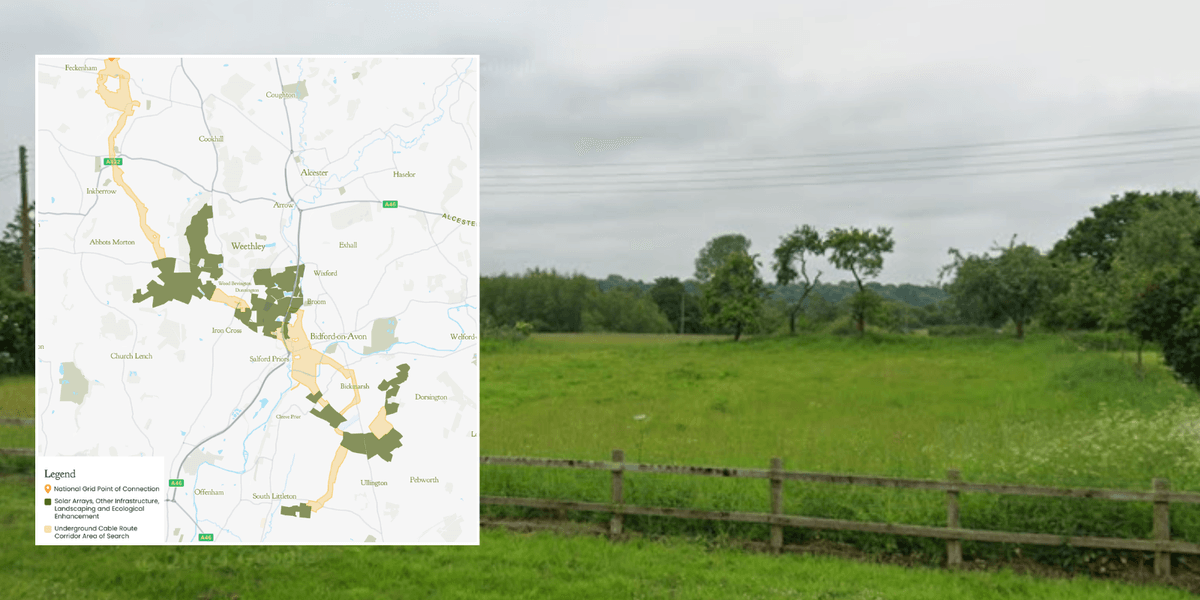
The proposed Arrow Valley Solar development would cover about 4,353 acres - an area equivalent to almost 2,500 full-size football pitches - across four zones and at least 11 parishes.
Developers say the scheme could generate up to 500 megawatts of electricity, enough to supply around 235,000 homes each year and would also include battery storage facilities and a network of underground cables connecting the different sections.
Because of its scale, the project is classed as a Nationally Significant Infrastructure Project, meaning it requires development consent rather than conventional planning permission - therefore the final decision will rest with the Secretary of State.
A public consultation is due to begin at the end of this month.
For residents of villages including Salford Priors, Abbots Morton, Broome and Cleeve Prior, the prospect of thousands of solar panels spreading across farmland has prompted fears over the impact on the landscape, wildlife and local communities.
Paul Wareing, 68, who lives in Salford Priors with his wife Joanna, told the Daily Mail: “It will destroy our green and pleasant land."
The semi-retired former government project manager described the proposed development as a “giant industrial estate”, and warned that panels and battery installations could bring glint, glare and other visual impacts to the surrounding countryside.
The scheme includes tracker panels, some reportedly as large as double-decker buses, which move to follow the sun.
Much of the area forms part of the Vale of Evesham, an important agricultural region known for fruit, asparagus and other crops.
David Smith, 68, a retired electricity board worker from Abbots Morton, said panels could be installed "only yards" from his home.
He also raised concerns about drainage, arguing that the construction could damage underground pipes beneath fields currently used for crops.
Land for the project is expected to come from several landowners, including the 6,000-acre Ragley Estate, which has agreed to lease 200 acres for at least 30 years, according to a landowner involved in the scheme.
The farmer, who declined to be named, said rising costs were making traditional agriculture increasingly difficult.
“I’m losing money growing crops,” he said, adding that sheep would be able to graze beneath the panels if the project proceeded.
Concerns have also been raised over the effect on heritage sites and rural views. At Weethley, villagers fear the outlook from St James’s Church could be substantially altered.
Church warden Dr Jane Cornwall said the building was valued for its peaceful surroundings and was used by a mindfulness group.
Despite uproar, not everyone locally opposes the development - as with one Dunnington resident who said the panels would largely be on estate land and would not be visible from nearby homes, while supporting the wider expansion of renewable energy.
Project Development Manager Jamie Gleeson said Arrow Valley Solar was being designed to respect the area's environment, character and history.
He said the project was intended to help meet rising demand for secure, home-grown renewable energy, and would be informed by environmental and technical assessments and consultation with local communities.
The proposal comes amid a rapid expansion of large-scale solar projects across England.
Earlier this year, the government approved the 800MW Springwell Solar Farm, which will cover 3,163 acres between Lincoln and Sleaford.
A decision is also expected shortly on the proposed 4,361-acre Great North Road solar park in Nottinghamshire.
Opponents of Arrow Valley argue that the transition to low-carbon power should not come at the expense of productive farmland and the character of rural communities.
While supporters say developments of this scale will be necessary if Britain is to increase domestic renewable generation and strengthen energy security.