Thank you for subscribing!
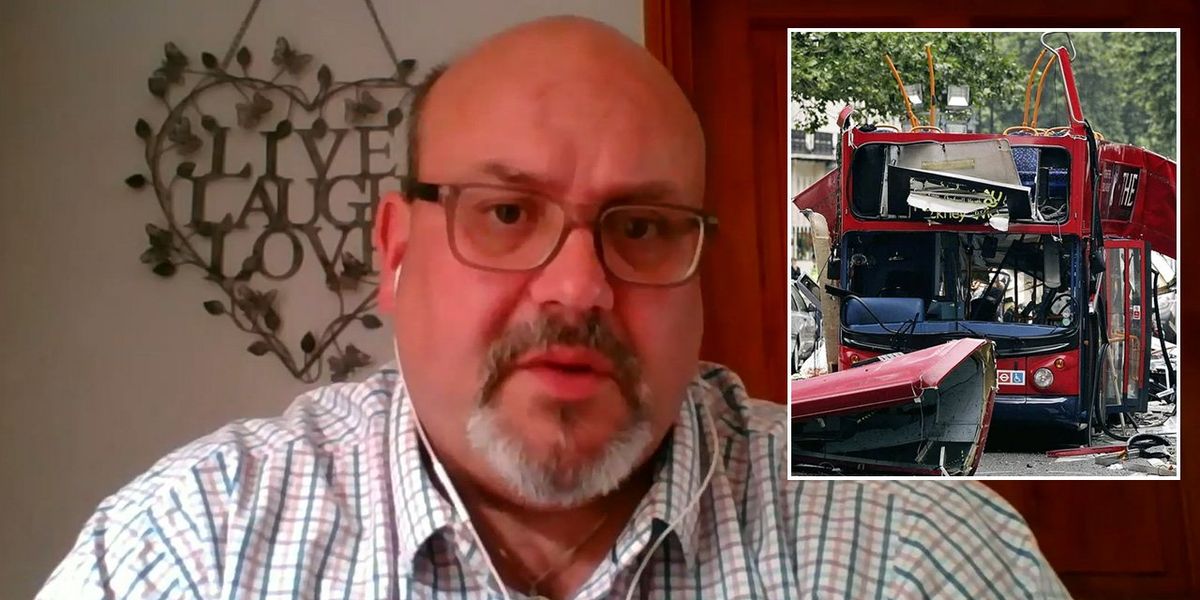
The four coordinated attacks on July 7, 2005, killed 52 people and injured more than 770 others
A survivor of the July 7 London bombings has told GB News the terrorism threat in the UK is "real", as the nation marks its first-ever victims' remembrance day.
Speaking to GB News, Dan Biddle stressed that we "must remember" those lost and those who survived such horrific attacks.
Hundreds of victims, survivors, bereaved families and emergency responders will gather in central London today for a special ceremony and a two-minute silence.
The occasion marks the first-ever Terrorism Victims' Day in the UK, to remember those affected by terror attacks across the country.
On July 7, 2005, Dan Biddle was one of the survivors aboard London's transport network when four suicide bombers killed 52 people and injured more than 770 others.
Mr Biddle was in touching distance of attacker Mohammad Sidique Khan when the bomb went off, which blew him out of the train carriage and onto the tracks.
He lost both of his legs, an eye and his spleen as a result of the attack, and also struggles with complex PTSD.
Speaking to GB News, Mr Biddle argued that days such as this are "needed" to "remember the lives that have been drastically affected" by terrorism in the UK.
He said: "I think that we need to remember the people that have lost their lives and those that have had their lives drastically affected by terrorism in this country.
"For me, it's a bit of a double-edged sword as well, because as a survivor of 7/7 and campaigning to try and get a public inquiry into 7/7, it does lead me to ask that if we would have had a public inquiry, would we have needed to have this day and could it have prevented other terrorist attacks from happening if we would have investigated what went wrong that day?"
Mr Biddle warned that 20 years on from the attack he survived, the "threat of terrorism" is still "real" in the UK today.
He told GB News: "I think days like this are needed because the threat of terrorism is real. For me, it wasn't something I expected. I'd got on a train to go to work, and my life was changed immeasurably in ways I could have never have dreamed of.
"And I think it is important that we remember these atrocities, but also to learn and to understand how this comes about. One of the big things for me as well is that I don't feel that the way we look at terrorism has greatly changed from the days of the IRA, but the methodology used by terrorists now is completely different."
He continued: "I don't think that if you go to an underground station, I was at Edgware Road a little while ago, and there's still signs up saying if you see an unattended bag or package, report it.
"Well, unfortunately, the mechanism of terrorism nowadays, they don't put a bag down and walk away. They carry it, they sit with it, they detonate it, they go with it.
"So I don't think we're addressing it in the right way, and I hope that the days like today will draw attention to that, and also to let people realise that as a country, we do remember the loss of life and just the terrible atrocities that have happened."
Criticising the Government further, Mr Biddle argued that the 7/7 attack is "not remembered" on its anniversary every year, only on the "milestone anniversaries".
He said: "For me, I live with the effects of 7/7 every single day, and I do think that as a terrorist attack, 7/7 was kind of largely brushed under the carpet by Government by the way that it's remembered, it doesn't get mentioned every anniversary. It's only the big ones.
"So I think it is about kind of letting the nation know that these happen, people lose their lives. People have their lives changed in ways that they couldn't dream of, but also that it's a real threat. It's a current threat constantly."
Mr Biddle concluded: "I was one of those people that thought, 'oh, that'll never happen to me', and in 21 years later I'm in a wheelchair, I've got no legs, I've lost an eye, and I suffer from complex post-traumatic stress disorder.
"Nobody is free from the threat of terrorism because it's indiscriminate. They don't care who they kill, they don't care where they do it, so therefore, keeping that in the public psyche, I think is important."