The UK is outside the EU’s solidarity pool, but not outside the consequences of its weakness, writes the Executive Director of The Henry Jackson Society
A border ceases to be a border when those charged with defending it are prevented from turning back those crossing it.
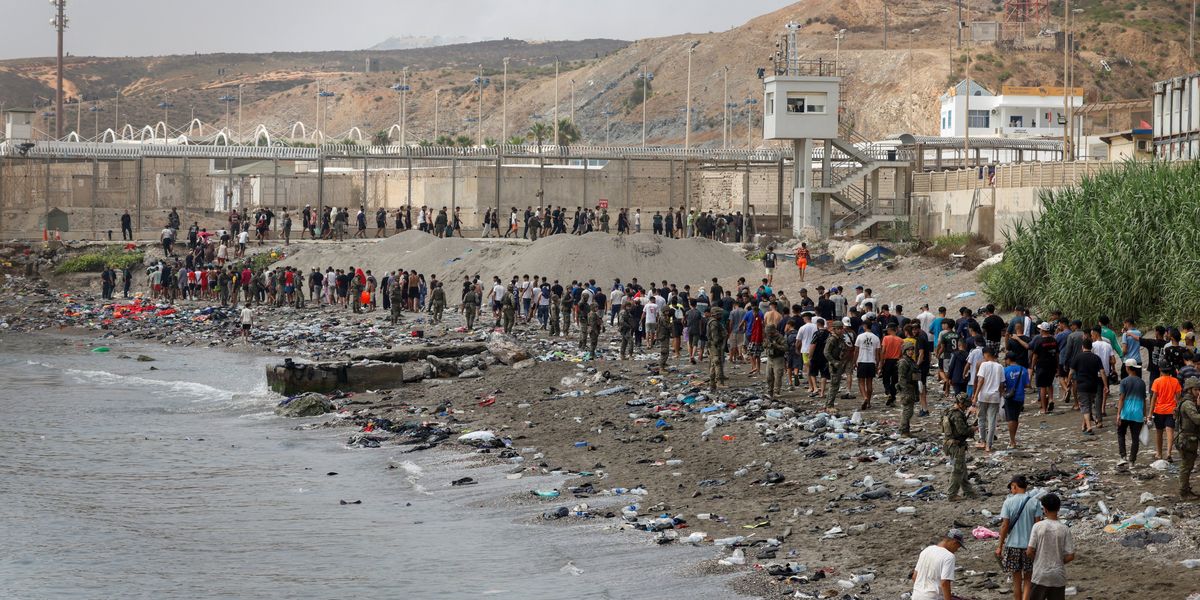
That is the lesson of the catastrophe in Ceuta, Spain’s enclave on the North African coast.
Around 50,000 illegal migrants entered in barely 24 hours, overwhelming the authorities and forcing a military deployment.
Roughly half have since returned voluntarily to Morocco. But that does not alter what happened: A European border was overwhelmed.
When tens of thousands force their way across frontiers in a single day, “influx” is an anaemic word. It is an invasion in every practical sense.
Spain is entitled to expect Morocco to police its side of the frontier and prevent such scenes. Yet Madrid cannot evade its share of the responsibility for what happened.
For on July 8, Spain’s Supreme Court confirmed that the legal powers allowing the immediate return of illegal entrants in its North African departments of Ceuta and Melilla did not apply to migrants intercepted while swimming round the border defences.
The law could only be applied to people overcoming physical “elements of containment”, such as fences.
The judges held that a natural boundary like the sea rendered the powers unwieldable. The ruling did not give migrant swimmers a right to remain. But it replaced immediate rejection with the slower, ordinary immigration process. That distinction may matter in a courtroom; to the smuggling networks exploiting it, reaching the water meant gaining an entry foothold.
Tens of thousands took advantage of the chaos to make their own dash to a better life. The situation of some of the migrants is undoubtedly desperate. But compassion cannot require a state to surrender the power to decide who enters its territory.
The Spanish judges responsible may well not control how their signals are interpreted, but they are certainly responsible for the incentives those signals create. They must now rue the consequences of their short-sighted interpretation. Of course, this is not merely a Spanish disaster.
Europe’s supposedly common external border has proved anything but secure and Italy, Denmark and Finland have demanded that Spain be suspended from the EU’s Schengen visa-free travel zone on account of its failure.
Unfortunately for them, the horse has already bolted. Under the EU’s new Pact on Migration and Asylum, the consequences of illegal migration are meant to be shared across all member states in order to mitigate the burden on border states.
Even before this new crisis, Spain had already been designated a country under migratory pressure and in need of common assistance.
As a result, other EU members will be on the hook either financially, operationally or by having to accept some migrants themselves, all in the name of “solidarity”. Those who sing the siren song of EU re-entry in the UK should take note they would be committing us to this same form of common insanity. Yet remaining outside the EU does not insulate us from Europe’s border failures.
Migrants who reach mainland Spain and travel north can eventually join the flow towards the French coast.
This week, video footage showed French officers standing yards away haplessly as migrants launched a dinghy towards the UK, their rules forbidding intervention once people were in the water.
As a result of their ineptitude – and it is worth remembering that successive British Governments continue to fund the French as a reward for their failures – on Wednesday alone, 752 people crossed the Channel in nine boats.
The UK is outside the EU’s solidarity pool, but not outside the consequences of its weakness. When Europe abandons deterrence at its first frontier, Britain can expect the pressure to arrive at its last.
Given our own border control failures, who can really believe that Europe’s nightmare will not also become ours?