The special relationship has never rested upon warm words alone, writes the Republican Overseas Chairman
Additional contributions by Republican Overseas UK board members Lady Elliott and Malin Baker Bogue
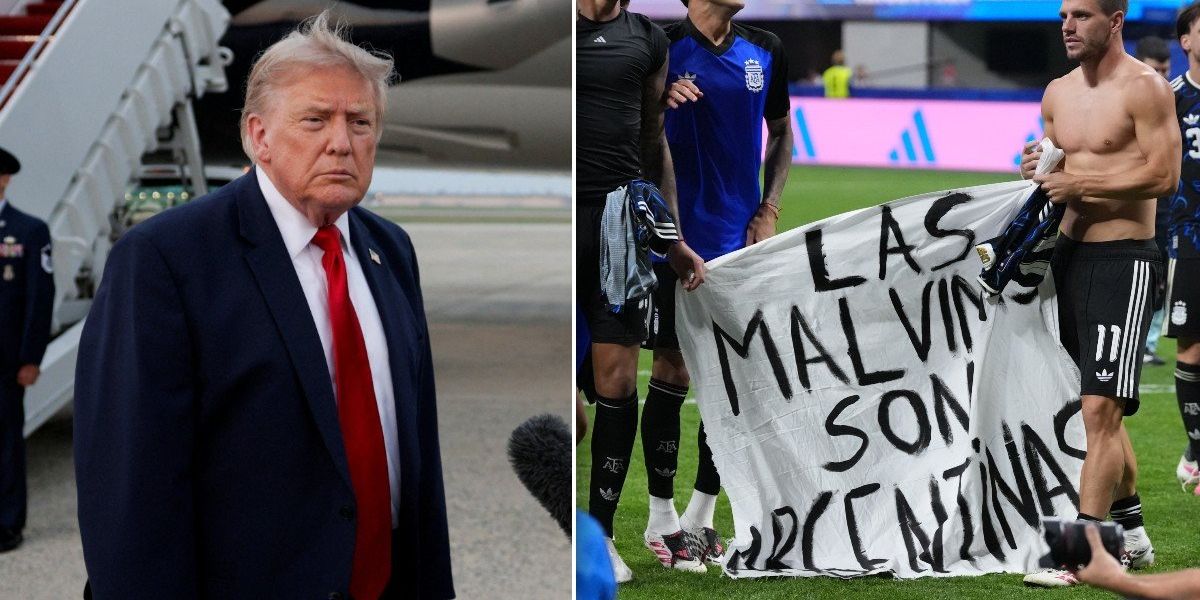
The Argentinian football team’s banner claiming the Falklands are Argentinian and the following statement by President Milei saying they are “getting closer everyday” to recovering them, is absolutely ridiculous and unacceptable.
The Falklands, South Georgia and South Sandwich Islands have never been Argentinian and have always been British. Any claim otherwise is make-believe and violates British sovereignty.
This is a time for the allies of Great Britain, particularly the United States, to stand up and defend their ally’s sovereign territories in the face of political bullying and intimidation. However, not just because it is the right thing to do, but because it is in their best interest too.
For Britain and the United States, sovereignty over the Falklands, and another British territory, the Chagos Islands, is not a nostalgic relic. It is an essential component of the strategic architecture that underpins our shared security. To weaken Britain's position in either territory would diminish the collective security of the democratic world, at the very moment when Britain should be playing a vital role defining Nato’s next chapter and the European contribution to global security.
At a time when authoritarian powers are testing the resolve of the West on multiple fronts, this is precisely the wrong moment for either Britain or America to signal uncertainty about sovereign territory which underpins our common defence.
As members of the Republican Party, we believe that peace is best preserved through strength, credible deterrence and dependable alliances.
American leadership is not just about the size of its armed forces, but also the confidence of its friends and the certainty of its commitments.
That is one reason why the British-American special relationship has endured for so long. It is a practical partnership between two nations who have repeatedly stood together in defence of freedom.
Those who dismiss this as sentimental patriotism misunderstand both history and geopolitics. Great powers have always depended upon geography. We face a cunning and competitive China, an aggressive Russia and an increasingly unstable international order, and that means geography matters more, not less, than it did at the end of the Cold War.
The special relationship has never rested upon warm words alone. It rests upon shared capabilities, shared intelligence, shared values and shared geography. British Overseas Territories form part of that wider security network. They provide staging posts, surveillance, maritime reach and political stability across regions where stability is increasingly scarce.
They strengthen not only Britain's security, but America's ability to deter conflict without having to fight it.
The sovereignty of a Nato and Five Eyes ally over the Falkland Islands is a much stronger security position for the US. The US and UK have a shared security architecture and joint operational capability that goes beyond any individual leader of either country. The Falklands protect the shipping lanes between the Atlantic and the Pacific and is a key position for the allies in projecting power in the Antarctic. The Mount Pleasant Complex anchors the UK - and therefore Five Eyes - intelligence, communications and cyber capabilities in the region. It is therefore critical both for Nato and Five Eyes capability in the South Atlantic. In an era of instability, it would be a grave error to put that in jeopardy over our operational disagreement with an outgoing Prime Minister.
Also, consider the joint UK-US military base Diego Garcia in the Chagos Islands. It is difficult to think of another military facility whose importance has been so consistently underestimated. From the liberation of Kuwait to the campaign in Afghanistan and the wider need to combat terror abroad, Diego Garcia has served as one of the indispensable pillars of Anglo-American power projection in the Middle East. Today, its value has only increased, as the Indo-Pacific becomes the principal theatre of strategic competition. It sits astride vital sea lanes connecting Europe, the Gulf and Asia. It supports intelligence, logistics, and maritime surveillance as well as the more well-known long-range air operations. Its contribution to the security and trade prospects of both Britain and America is unique and irreplaceable.
Revisionist powers pay close attention to whether Western democracies still possess the confidence to defend their own legitimate interests. Every unnecessary concession carries consequences far beyond the territory immediately concerned. We are extremely proud that the US stood with advocates for UK security against this extremely irresponsible proposal to surrender the Chagos Islands.
Exactly the same principle applies six thousand miles away in the South Atlantic, and is why we feel compelled to speak up today in defence of British territories.
Recently, some Republicans abroad have suggested that the Trump Administration should reconsider their instinctive support for Britain's sovereignty over the Falkland Islands (as reported in The Spectator) because of their lack of support for the Iran War. As board members of Republicans Overseas UK, we firmly disagree.
We share the dismay at Prime Minister Starmer’s reticence to allow US allies to use UK bases in operations in the Middle East, where agents of the former Ayatollah’s regime long plotted and executed attacks on both our nations. But we respectfully believe that the proposed change of course on the Falkland Islands would be compounding the problem, and visiting the consequences upon innocent British citizens who live there and overwhelmingly want to remain British.
If there is concern for the passion Argentinians may feel on the subject, we recognise the fundamental right of the Falkland Islanders who voted by 99.8 per cent (with 92 per cent turnout) that their loyalty is with the UK. Conservatives have long defended the principle that Governments derive their legitimacy from the consent of the governed. That principle should not become negotiable in the South Atlantic because of discontent over prior actions in the Indian Ocean and Middle East.
We believe President Donald Trump, who cares deeply about and prioritises security and stability in America’s own hemisphere, will recognise that a change in sovereignty over the Falkland Islands would be detrimental to that overriding objective.
As conservatives, we are delighted by the new economic direction that President Javier Milei has taken in Argentina. We have huge hope for a bright future for that country and its people, and for an Argentina that can be a strong democratic ally to both the US and the UK. But hope is not the same as enduring allyship.
The United States has always been strongest when it has worked alongside capable democratic allies that shoulder responsibility for their own defence. Britain is foremost among those allies. China has spent the past two decades expanding its political, commercial and strategic footprint across Latin America. Russia continues to cultivate influence throughout the region. Iran has sought partners there as well. Against that backdrop, encouraging the weakening of one of America's oldest ally's sovereign position would, however unintentionally, advance the interests of those who would like nothing more than to see the Anglo-American alliance lose confidence in itself.
Citizens in both countries should recognise that defending these territories is not simply an act of loyalty to a friend. It is an investment in the security, credibility and deterrent strength upon which both our nations continue to rely. The free world has never benefited when its democracies have doubted themselves. It has prospered when they have possessed the confidence to stand their ground.