The Foreign Secretary being let off the hook says more about America's priorities, writes US-UK relations expert Lee Cohen
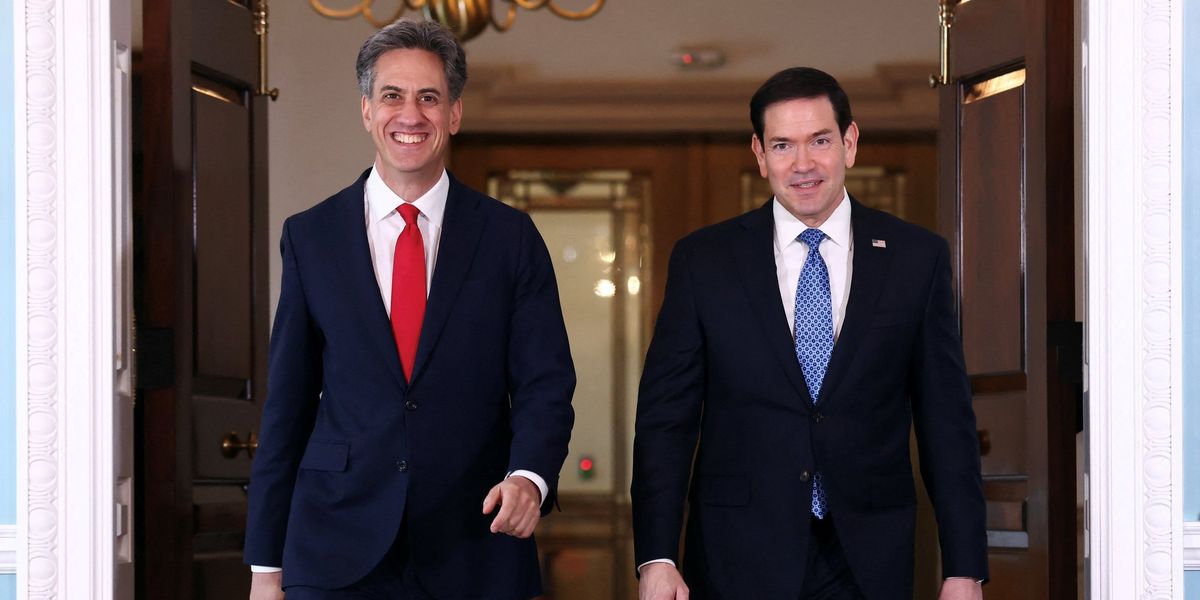
As a long time analyst of the US-UK relationship, I cringed when Ed Miliband was announced as Britain's latest liaison to face the Trump administration. His first visit to DC is underway and he appears to have escaped Donald Trump’s wrath. For now.
That reprieve says more about American priorities than about any change in how Washington views Britain’s new Foreign Secretary.
On Wednesday Miliband sat with Secretary of State Marco Rubio for ninety minutes. They discussed Iran, Ukraine, Gaza and Europe’s persistent failure to meet its own defence obligations. The old remarks in which Miliband called Trump a racist, a misogynist, an idiot and a self-confessed groper never arose.
Before the meeting the warnings had been explicit and public. Steve Bannon labelled the appointment of this “twit” injurious to the Special Relationship. Some spoke openly of a “point of friction.” Serious analysts judged him the worst possible choice to negotiate anything of substance with the current White House. MAGA circles supplied their own verdict in advance: “Ed Miliwatt,” a nickname that reduces his Net Zero record to the negligible practical power it actually delivered while he held the energy portfolio.
Yet when the moment arrived, the personal history stayed off the table. Rubio’s public account ignored the Special Relationship entirely. It focused instead on open transit through the Strait of Hormuz and the imperative of preventing an Iranian nuclear weapon. Miliband declared America “our closest ally.” The exchange remained strictly transactional.
Washington is managing live questions of deterrence, energy security and alliance burden-sharing. In that hierarchy the rhetorical self-indulgence of a British politician from a decade ago ranks low. The United States has larger interests to protect than the satisfaction of publicly correcting Miliband’s past judgement. The administration is focused on ensuring Europe carries a greater share of its own security, keeping critical waterways open, and containing Iranian ambition. Those files demand attention. Old soundbites do not.
That judgement remains the central problem. Miliband’s long record of personal denunciation and his rigid attachment to Net Zero revealed a persistent failure to grasp the strategic realities that now define American power. As Energy Secretary he pursued policies that treated domestic fossil-fuel production as an ideological liability rather than a foundation of national strength.
He resisted the offensive use of British bases against Iran at a moment when Gulf security and energy routes were under direct pressure. Those choices left a mark. They still sit uneasily with an American administration that treats energy abundance and credible deterrence as non-negotiable.
The pre-meeting atmosphere in Washington made the mismatch clear. Officials had already cautioned against elevating a figure so closely identified with an energy agenda the White House regards as self-defeating. The nickname “Ed Miliwatt” circulated precisely because it captured the gap between rhetorical ambition and measurable result. When Britain’s Foreign Secretary arrives carrying that reputation, the relationship begins under a cloud of diminished credibility and strain.
The Special Relationship has always rested on shared interests. Churchill and Roosevelt, Thatcher and Reagan understood that institutional alignment and strategic clarity outweighed momentary disagreements. When Britain aligns its posture with the harder requirements of the age—energy realism, defence spending, willingness to share risk—the relationship holds. When it does not, no amount of diplomatic politeness can conceal the drift. Miliband’s elevation tests that principle directly. His past rhetoric and policy choices raise the question of whether Britain still speaks the same strategic language as its closest ally.
The silence on Wednesday does not erase that question. It merely postpones it. Rubio’s refrain to invoke the Special Relationship in his public remarks was itself a signal. The United States is prepared to conduct necessary business. It is less prepared to indulge the fiction that all is well. Britain’s Foreign Secretary was granted a narrow exemption from presidential memory because larger files currently dominate the agenda. That exemption is provisional. It will last only as long as Britain demonstrates it understands the priorities that actually matter in Washington.
Miliband has been allowed to pass through the first encounter without public rebuke. The larger test of judgement still lies ahead. If Burnham's Britain continues to treat energy policy as a moral crusade rather than a foundation of national power, if it hesitates when collective security requires clear decisions, the temporary reprieve will end. The Special Relationship endures when both sides keep their eyes on the strategic horizon. It frays when one side prioritises yesterday’s rhetorical positions over today’s requirements of deterrence and sovereignty.
The American side has made its calculation. For the moment, the old insults rank below the urgent files. That calculation can change. Britain’s Foreign Secretary has escaped the immediate reckoning. Whether the relationship itself escapes lasting damage depends on whether Whitehall recovers a clearer sense of the interests that have always sustained the alliance.