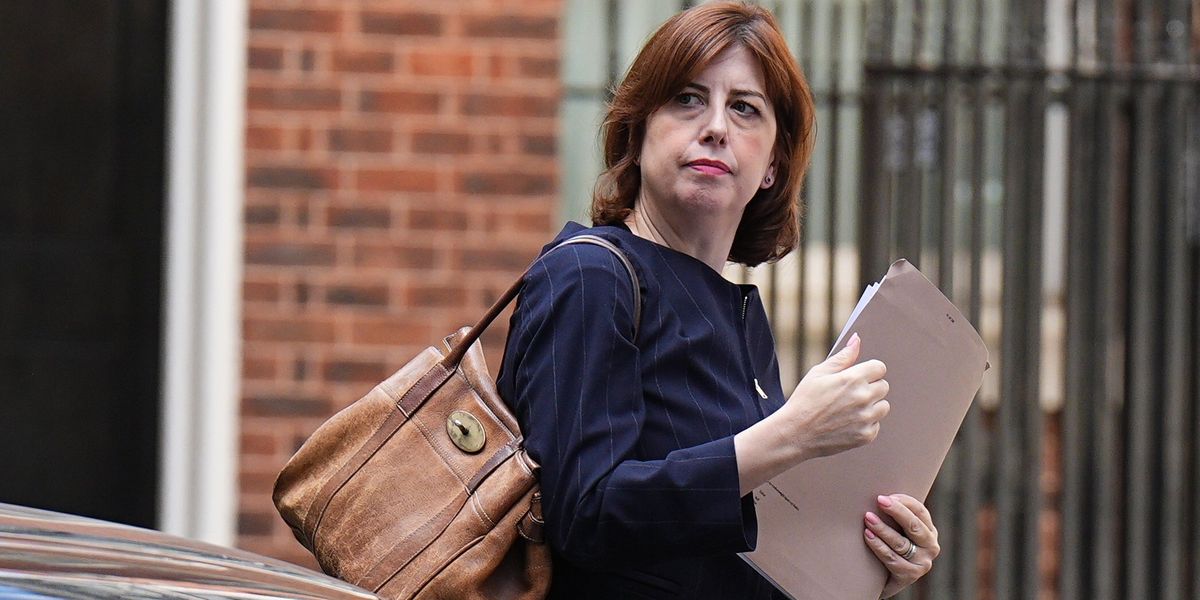
Tory MP Katie Lam writes about Lucy Powell's bizarre Oxford University claim
Just days after her appointment as Education Secretary, Lucy Powell was already being forced to explain misleading stories that she'd told about her own education.
Last year, she told the BBC that she was "the only one out of [her] very big sixth form college, 2,000 people, to get into Oxford that year".
Former pupils from Powell's school have since revealed that at least three other pupils in her year went to Oxford.
The school in question was Xaverian College, a Catholic sixth form college rated 'Outstanding' by Ofsted, which performs well above the national average on almost every metric.
But more interesting than the specific facts of Lucy Powell's case is the fact that she felt the need to play up the "difficulty" of her upbringing in the first place.
Like many of her Labour colleagues, Powell suffers from a worldview that is shaped by victimhood, and that splits the world into categories of oppressors and oppressed, regardless of individual reality.
In this way of looking at the world, certain features of a person's background or upbringing automatically indicate that they've lived a more difficult life — and, therefore, that they are better people.
Thus, the 93 per cent of pupils who attend state-funded schools are grouped together: they are good, and people whose parents paid to educate them are bad.
The results of this can be completely perverse, allowing people like Powell — whose mother, grandfather, uncle and aunts were all head teachers — to claim they were educationally disadvantaged.
The same goes for everybody who grew up in the north of England, for everybody who belongs to an ethnic minority group, and for all women.
The greater the number of apparently 'disadvantaged' groups a person belongs to, the more 'oppressed' they are.
The solution offered, inevitably, is that the state should take more money and opportunities from people in the 'privileged' categories, in order to provide more support to those who belong to the 'underprivileged' categories.
This kind of group-based grievance politics is completely poisonous, and profoundly unhelpful.
It divides people up, according to arbitrary categories, and ignores the fact that individual experiences rarely fit neatly into broad, group-based generalisations.
Despite our new Prime Minister's obsession with it, according to the 2021 Census, many of the places with the highest levels of household deprivation are actually on the south and east coasts — places like North Norfolk, Thanet in Kent, and South Holland in Lincolnshire.
On the same metric, Trafford, in Greater Manchester, ranks slightly higher than Tunbridge Wells.
When it comes to educational outcomes, in 2025, it was the Isle of Wight which had the lowest proportion of higher-grade passes at A-Level, with Bedfordshire ranked second-to-last.
Places like Suffolk and Worcestershire did a little worse than average, while Lancashire and North Yorkshire did a little better.
And within each of these places, the experience of each individual and each family will differ.
Some people grow up with incredibly supportive parents; others don't.
Some people will have parents or grandparents who attended university; others won't.
Some people attend good schools in places that are less well off, others attend poorly-performing schools in very affluent areas.
The experiences and circumstances that shape a person's life will always be complicated and specific.
Rather than treating everyone based on sweeping assumptions about certain characteristics, we should be creating a system which allows talented and hard-working individuals to succeed, regardless of their background.
Instead of teaching people that they're defined by the circumstances of their upbringing, we must instead rediscover the value of treating people as individuals.