Thank you for subscribing!
Charlie Peters reacts to new research revealing the shocking scale of the criminal networks behind Britain’s grooming gangs scandal
I have spent years reporting on Britain’s grooming gangs scandal. I have travelled around the country, speaking to survivors about the horrific abuse they endured, as well as whistleblowers, social workers, campaigners and people who have spent years trying to force the authorities to confront what happened.
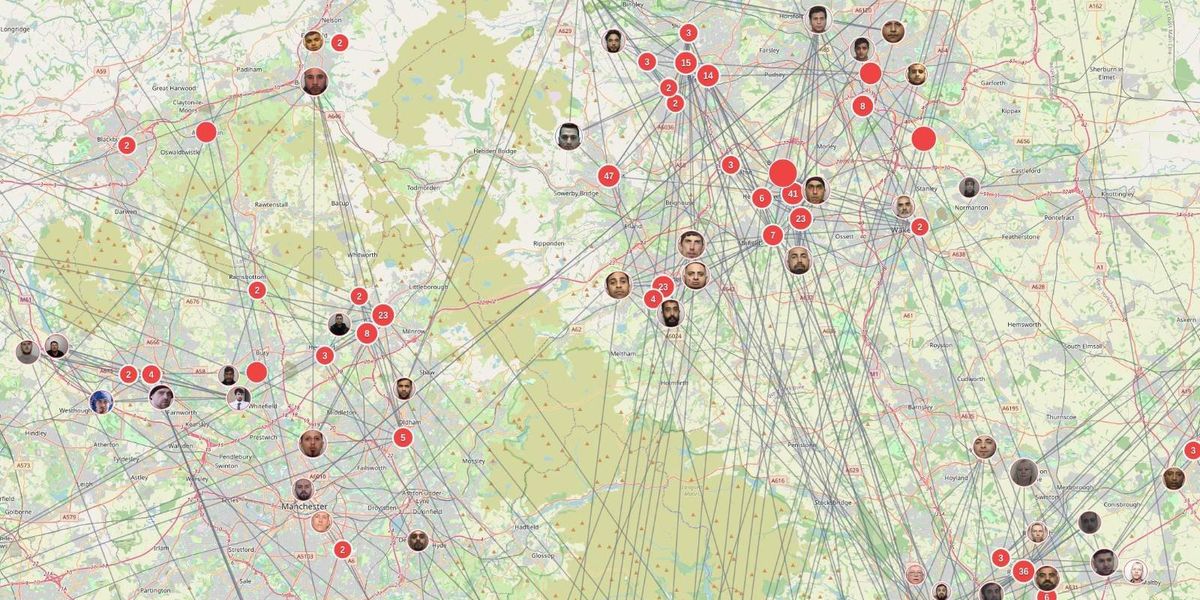
Central to our GB News reporting has been showing that this was never about isolated gangs, but an interconnected network of offending. New evidence produced by independent researchers for The Network Map has shown just how widespread it is.
The data has identified over 100 links between grooming gang perpetrators and other violent or organised criminals. Over 100. Just consider that for a moment. And the connections stretch into drug dealing, protection rackets and other forms of serious criminality.
The research has also begun to map how perpetrators and victims moved between different parts of the country, revealing a network that stretches from Plymouth to Dundee. This matters enormously.
Why? Because for years, there has been a tendency to talk about grooming gangs as though each town represents a separate scandal: Rotherham here, Rochdale there, Telford somewhere else, Bradford somewhere else again.
But the more I have investigated this story, the harder that explanation has become to sustain. What I have found repeatedly is connection.
People connected to people. Criminals connected to criminals. Victims moved from one place to another. Perpetrators with links beyond the immediate group carrying out the sexual abuse.
And now we have research which attempts to put some of those connections on a map. The scale is staggering.
More than 1,000 people, gangs, families, establishments and other notable individuals are included in the research. The systematic assembly of the connections should now force an understanding of just how extensive these gangs may be.
And we should be clear about what this does, and does not, prove. It does not mean every person connected to a grooming gang perpetrator is themselves guilty of a crime.
Nor does it mean every grooming gang formed part of one giant nationwide organisation. But it does provide further evidence that we should stop thinking about this as a collection of completely disconnected local scandals.
The evidence points towards something much more complicated: overlapping networks of perpetrators, criminals, families, gangs and associates, with some individuals involved in multiple forms of serious offending. That should profoundly concern us.
Because the central failure of this scandal has always been the failure to see the bigger picture. For years, victims were failed because authorities looked at pieces of the problem rather than the whole.
A girl was abused. A complaint was made. A social worker had concerns. A police officer encountered a suspect. Somewhere else, another girl was being exploited by someone connected to the same wider criminal world.
But the dots were too often not joined. I have heard repeatedly from people inside the system about information that was not shared, warnings that did not lead to action and institutions that were reluctant to confront what was happening.
Baroness Casey’s national audit documented serious and repeated failures in protecting children from group-based sexual exploitation. The statutory Independent Inquiry into Grooming Gangs is now underway, with national accountability hearings and local investigations planned.
That inquiry has an enormous responsibility, and GB News will continue to bring you every detail of it. It must not simply ask what happened in individual towns.
It must ask how these networks operated, how information moved, or failed to move, between agencies and across geographical boundaries, and whether authorities understood the connections between organised sexual exploitation and other forms of organised crime.
Because after everything I have seen, I am no longer surprised that the scandal was bigger than we were originally told.
These figures are a reminder that we may still be nowhere near the full reality.
We must keep fighting to expose the truth. Here is the question I’m asking today: how do these networks manage such a high degree of trust to offend and reoffend together, time and time again?
How do they rely on each other to traffic victims and drugs and share their abuse among friends, family and criminal associates? I’ll have an answer for you soon.